







Question: This problem and the next one illustrate how some integrals can be difficult to evaluate numerically. Watch for how a function that changes dramatically over
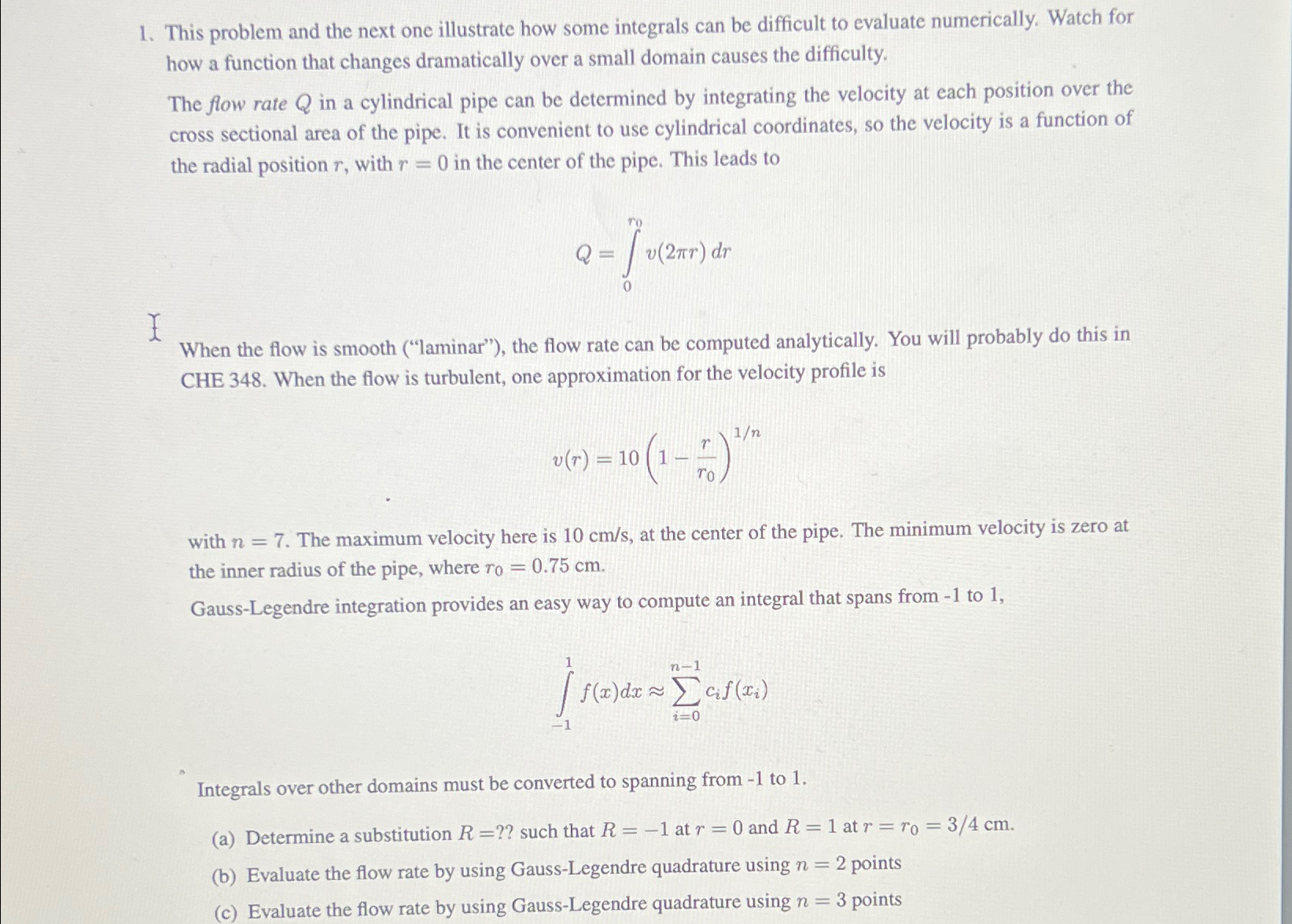
This problem and the next one illustrate how some integrals can be difficult to evaluate numerically. Watch for how a function that changes dramatically over a small domain causes the difficulty.
The flow rate in a cylindrical pipe can be determined by integrating the velocity at each position over the cross sectional area of the pipe. It is convenient to use cylindrical coordinates, so the velocity is a function of the radial position with in the center of the pipe. This leads to
When the flow is smooth laminar the flow rate can be computed analytically. You will probably do this in CHE When the flow is turbulent, one approximation for the velocity profile is
with The maximum velocity here is at the center of the pipe. The minimum velocity is zero at the inner radius of the pipe, where
GaussLegendre integration provides an easy way to compute an integral that spans from to
~~
Integrals over other domains must be converted to spanning from to
a Determine a substitution such that at and at
b Evaluate the flow rate by using GaussLegendre quadrature using points
c Evaluate the flow rate by using GaussLegendre quadrature using points
Step by Step Solution
There are 3 Steps involved in it
1 Expert Approved Answer
Step: 1 Unlock

Question Has Been Solved by an Expert!
Get step-by-step solutions from verified subject matter experts
Step: 2 Unlock
Step: 3 Unlock
 Study Help