







Question: This problem concerns the development of the analytical solution for the velocity and pressure fields in a steady Poiseuille flow of an incompressible fluid of
This problem concerns the development of the analytical solution for the velocity and
pressure fields in a steady Poiseuille flow of an incompressible fluid of density and
viscosity in the thin gap between a pair of concentric cylindrical surfaces.
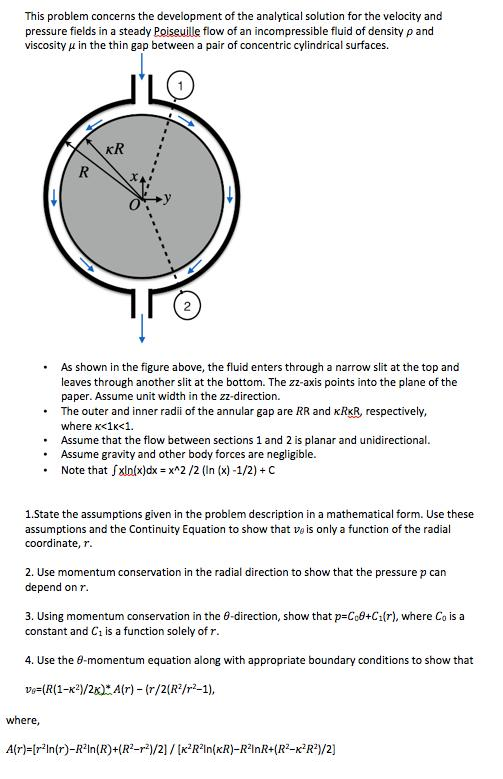
As shown in the figure above, the fluid enters through a narrow slit at the top and
leaves through another slit at the bottom. The axis points into the plane of the
paper. Assume unit width in the direction.
The outer and inner radii of the annular gap are and respectively,
where
Assume that the flow between sections and is planar and unidirectional.
Assume gravity and other body forces are negligible.
Note that
State the assumptions given in the problem description in a mathematical form. Use these
assumptions and the Continuity Equation to show that is only a function of the radial
coordinate,
Use momentum conservation in the radial direction to show that the pressure can
depend on
Using momentum conservation in the direction, show that where is a
constant and is a function solely of
Use the momentum equation along with appropriate boundary conditions to show that
vtheta leftfracRkappakapparight ArfracrleftfracRrright where
Step by Step Solution
There are 3 Steps involved in it
1 Expert Approved Answer
Step: 1 Unlock

Question Has Been Solved by an Expert!
Get step-by-step solutions from verified subject matter experts
Step: 2 Unlock
Step: 3 Unlock
 Study Help