







Question: This problem deals with Dijkstra's algorithm copied below procedure Dijkstra; begin S:= {1}; for i:-2 to n do begin P[i] := 1 end; for i
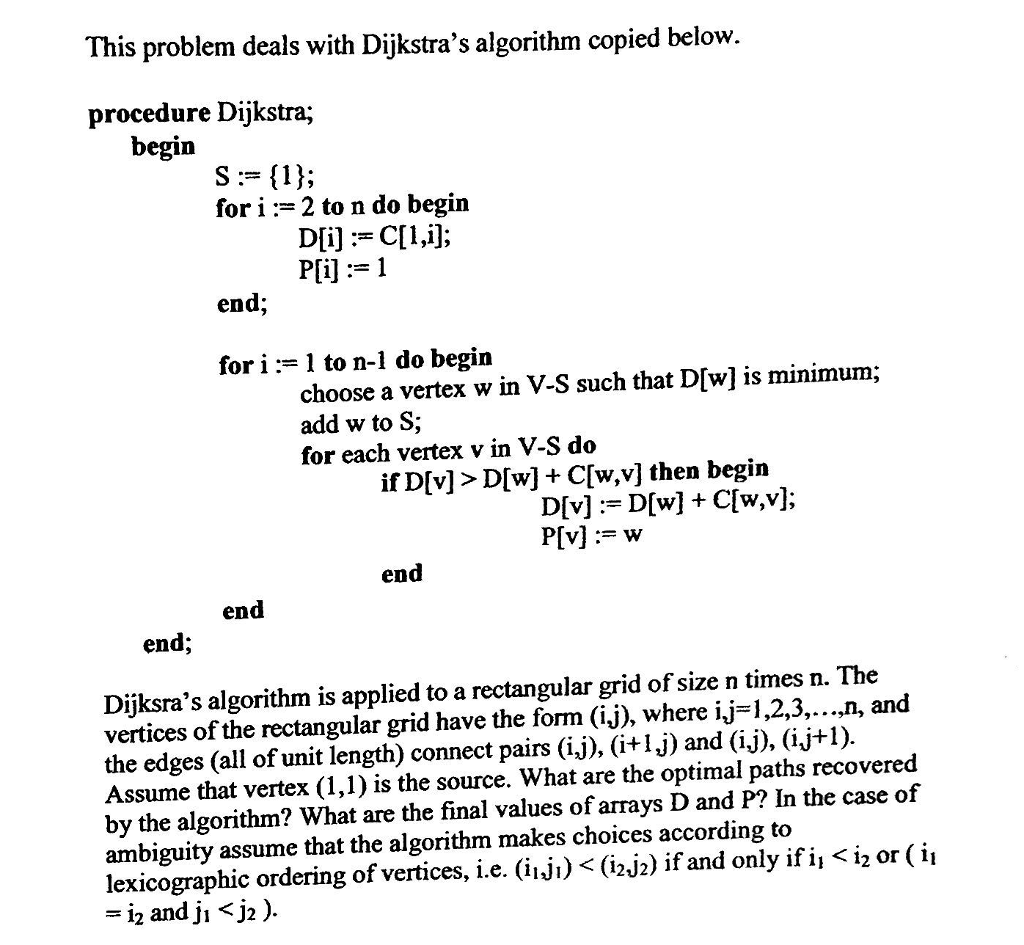
This problem deals with Dijkstra's algorithm copied below procedure Dijkstra; begin S:= {1}; for i:-2 to n do begin P[i] := 1 end; for i := 1 to n-1 do begin choose a vertex w in V-S such that D[w] is minimum; add w to S; for each vertex v in V-S do if D[v]> D[w] + C[w,v] then begin end end end; Dijksra's algorithm is applied to a rectangular grid of size n times n. The vertices of the rectangular grid have the form (ij), where ij-1,2,3,... .n, and the edges (all of unit length) connect pairs (ij), (i+Ij) and (ij), (ij+1). Assume that vertex (1,1) is the source. What are the optimal paths recovered by the algorithm? What are the final values of arrays D and P? In the case of ambiguity assume that the algorithm makes choices according to lexicographic ordering of vertices, i.e. (inji) D[w] + C[w,v] then begin end end end; Dijksra's algorithm is applied to a rectangular grid of size n times n. The vertices of the rectangular grid have the form (ij), where ij-1,2,3,... .n, and the edges (all of unit length) connect pairs (ij), (i+Ij) and (ij), (ij+1). Assume that vertex (1,1) is the source. What are the optimal paths recovered by the algorithm? What are the final values of arrays D and P? In the case of ambiguity assume that the algorithm makes choices according to lexicographic ordering of vertices, i.e. (inji)
Step by Step Solution
There are 3 Steps involved in it

Get step-by-step solutions from verified subject matter experts
 Study Help