







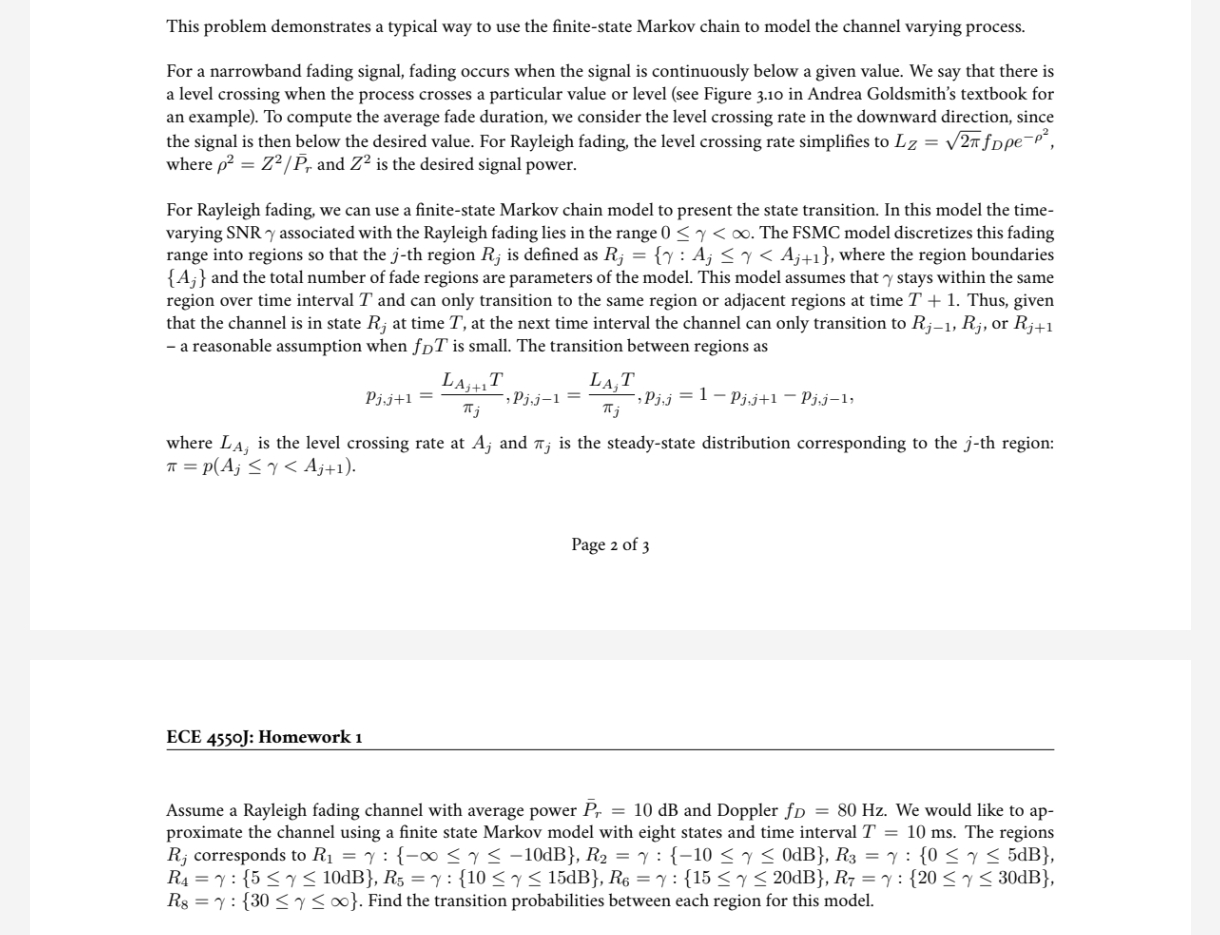
Question: This problem demonstrates a typical way to use the finite - state Markov chain to model the channel varying process. For a narrowband fading signal,
This problem demonstrates a typical way to use the finitestate Markov chain to model the channel varying process. For a narrowband fading signal, fading occurs when the signal is continuously below a given value. We say that there is a level crossing when the process crosses a particular value or level see Figure in Andrea Goldsmith's textbook for an example To compute the average fade duration, we consider the level crossing rate in the downward direction, since the signal is then below the desired value. For Rayleigh fading, the level crossing rate simplifies to where bar and is the desired signal power. For Rayleigh fading, we can use a finitestate Markov chain model to present the state transition. In this model the time varying SNR associated with the Rayleigh fading lies in the range The FSMC model discretizes this fading range into regions so that the th region is defined as ::::::::
Step by Step Solution
There are 3 Steps involved in it
1 Expert Approved Answer
Step: 1 Unlock

Question Has Been Solved by an Expert!
Get step-by-step solutions from verified subject matter experts
Step: 2 Unlock
Step: 3 Unlock
 Study Help