







Question: This problem explores pipeline design. As discussed earlier, pipelining involves balancing the pipe stages. Good pipeline implementations minimize both internal and external fragmentation to create
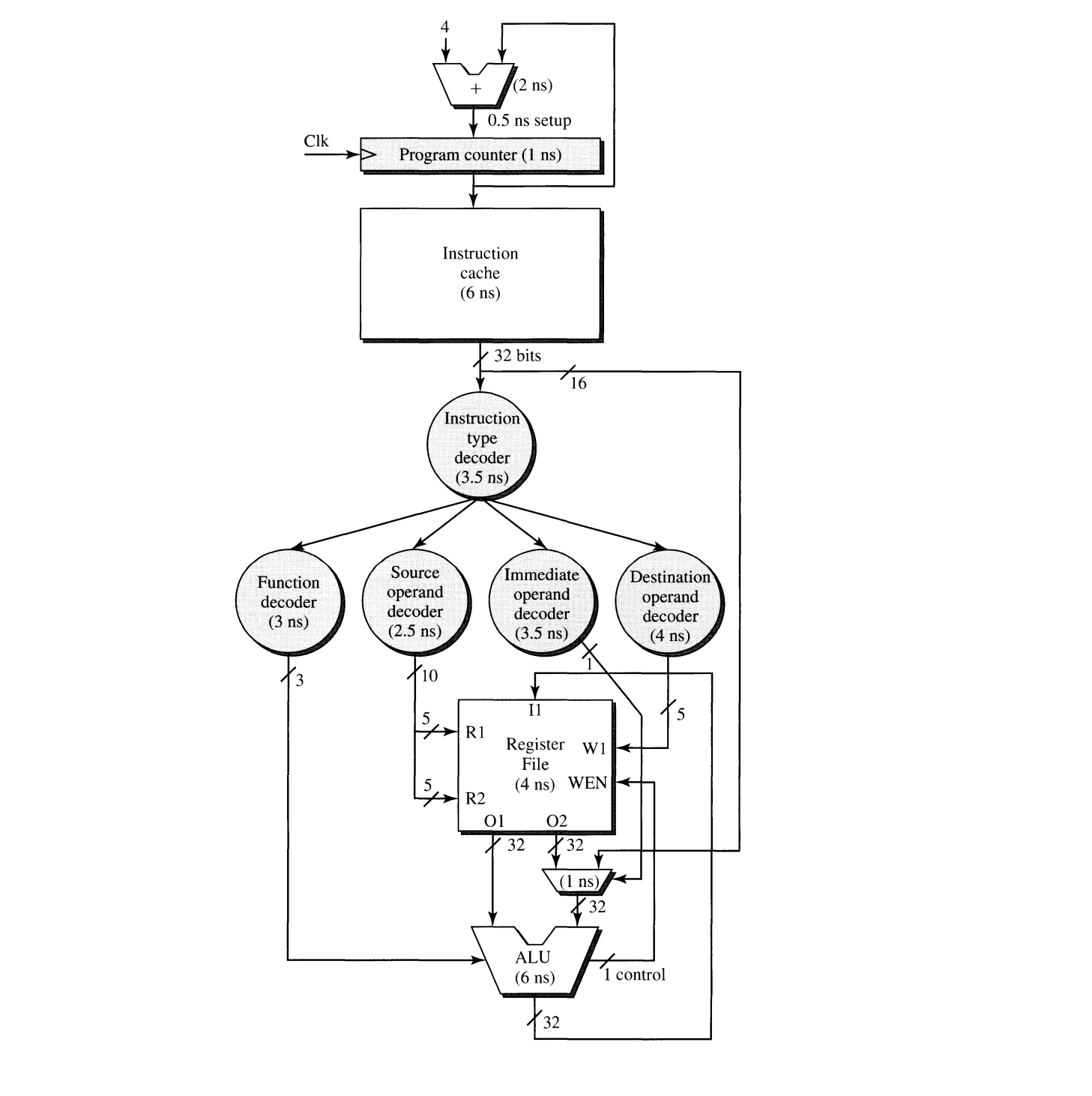
This problem explores pipeline design. As discussed earlier, pipelining involves balancing the pipe stages. Good pipeline implementations minimize both internal and external fragmentation to create simple balanced designs. Below is a nonpipelined implementation of a simple microprocessor that executes only ALU instructions, with no data hazards:
P Generate a pipelined implementation of the simple processor outlined in the figure that minimizes internal fragmentation. Each subblock in the diagram is a primitive unit that cannot be further partitioned into smaller ones. The original functionality must be maintained in the pipelined implementation. Show the diagram of your pipelined implementation. Pipeline registers have the following timing requirements:
ns setup time
ns delay time from clock to output
P Compute the latencies in nanoseconds of the instruction cycle of the nonpipelined and the pipelined implementations.
P Compute the machine cycle times in nanoseconds of the nonpipelined and the pipelined implementations.
P Compute the potential speedup of the pipelined implementation in Problems over the original nonpipelined implementation.
P What microarchitectural techniques could be used to further reduce the machine cycle time of pipelined designs? Explain how the machine cycle time is reduced.
P Draw a simplified diagram of the pipeline stages in Problem ; you should include all the necessary data forwarding paths.
Step by Step Solution
There are 3 Steps involved in it
1 Expert Approved Answer
Step: 1 Unlock

Question Has Been Solved by an Expert!
Get step-by-step solutions from verified subject matter experts
Step: 2 Unlock
Step: 3 Unlock
 Study Help