







Question: This problem explores the idea behind APT and factor models. Suppose the statistical properties of all asset returns are described by a single factor model
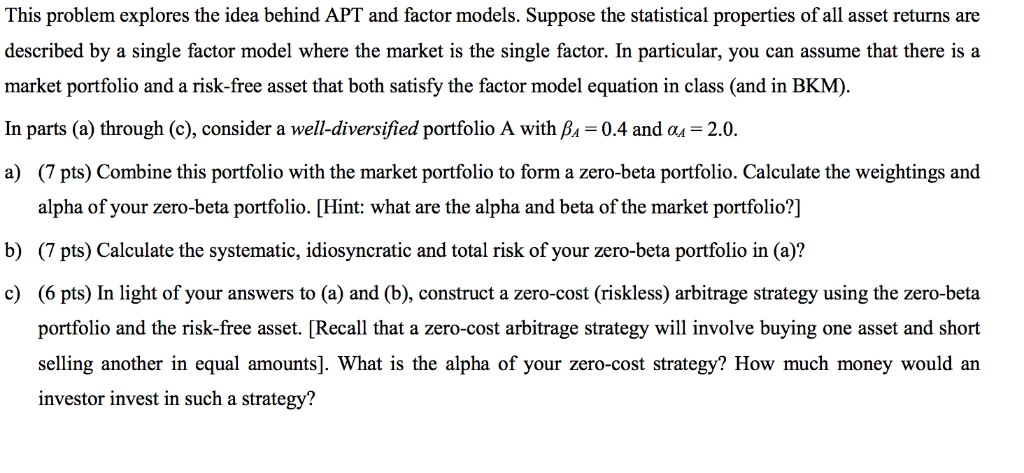
This problem explores the idea behind APT and factor models. Suppose the statistical properties of all asset returns are described by a single factor model where the market is the single factor. In particular, you can assume that there is a market portfolio and a risk-free asset that both satisfy the factor model equation in class (and in BKM) In parts (a) through (c), consider a well-diversified portfolio A with BA 0.4 and a 2.0. a) (7 pts) Combine this portfolio with the market portfolio to form a zero-beta portfolio. Calculate the weightings and b) (7 pts) Calculate the systematic, idiosyncratic and total risk of your zero-beta portfolio in (a)? (6 pts) In light of your answers to (a) and (b), construct a zero-cost (riskless) arbitrage strategy using the zero-beta portfolio and the risk-free asset. [Recall that a zero-cost arbitrage strategy will involve buying one asset and short selling another in equal amounts]. What is the alpha of your zero-cost strategy? How much money would an investor invest in such a strategy? c) This problem explores the idea behind APT and factor models. Suppose the statistical properties of all asset returns are described by a single factor model where the market is the single factor. In particular, you can assume that there is a market portfolio and a risk-free asset that both satisfy the factor model equation in class (and in BKM) In parts (a) through (c), consider a well-diversified portfolio A with BA 0.4 and a 2.0. a) (7 pts) Combine this portfolio with the market portfolio to form a zero-beta portfolio. Calculate the weightings and b) (7 pts) Calculate the systematic, idiosyncratic and total risk of your zero-beta portfolio in (a)? (6 pts) In light of your answers to (a) and (b), construct a zero-cost (riskless) arbitrage strategy using the zero-beta portfolio and the risk-free asset. [Recall that a zero-cost arbitrage strategy will involve buying one asset and short selling another in equal amounts]. What is the alpha of your zero-cost strategy? How much money would an investor invest in such a strategy? c)
Step by Step Solution
There are 3 Steps involved in it

Get step-by-step solutions from verified subject matter experts
 Study Help