







Question: This problem has been solved!See the answer Suppose P, Q, and R, are network service providers, with respective CIDR address allocations C1.0.0.0/8, C2.0.0.0/8, and C3.0.0.0/8
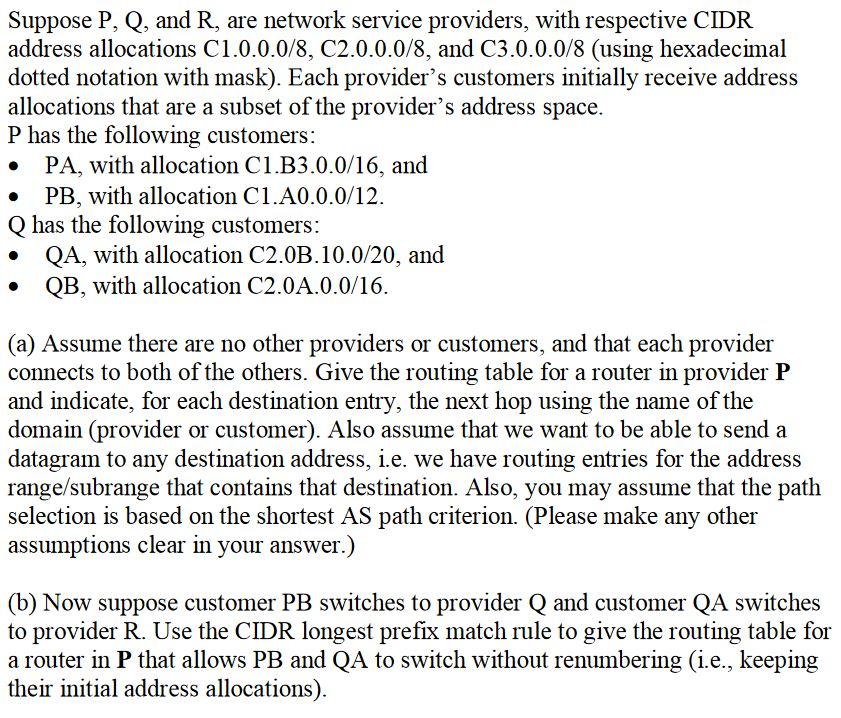
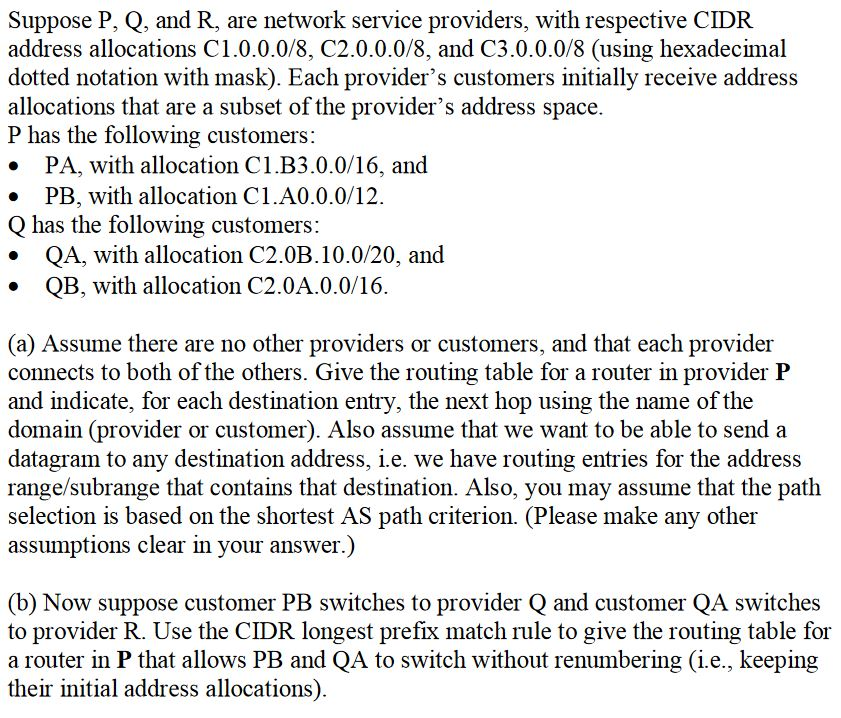
Suppose P, Q, and R, are network service providers, with respective CIDR address allocations C1.0.0.0/8, C2.0.0.0/8, and C3.0.0.0/8 (using hexadecimal dotted notation with mask). Each provider's customers initially receive address allocations that are a subset of the provider's address space. P has the following customers: PA, with allocation C1.B3.0.0/16, and PB, with allocation C1.A0.0.0/12. Q has the following customers: QA, with allocation C2.0B.10.0/20, and QB, with allocation C2.0A.0.0/16. (a) Assume there are no other providers or customers, and that each provider connects to both of the others. Give the routing table for a router in provider P and indicate, for each destination entry, the next hop using the name of the domain (provider or customer). Also assume that we want to be able to send a datagram to any destination address, i.e. we have routing entries for the address range/subrange that contains that destination. Also, you may assume that the path selection is based on the shortest AS path criterion. (Please make any other assumptions clear in your answer.) (b) Now suppose customer PB switches to provider Q and customer QA switches to provider R. Use the CIDR longest prefix match rule to give the routing table for a router in P that allows PB and QA to switch without renumbering (i.e., keeping their initial address allocations). Suppose P, Q, and R, are network service providers, with respective CIDR address allocations C1.0.0.0/8, C2.0.0.0/8, and C3.0.0.0/8 (using hexadecimal dotted notation with mask). Each provider's customers initially receive address allocations that are a subset of the provider's address space. P has the following customers: PA, with allocation C1.B3.0.0/16, and PB, with allocation C1.A0.0.0/12. Q has the following customers: QA, with allocation C2.0B.10.0/20, and QB, with allocation C2.0A.0.0/16. (a) Assume there are no other providers or customers, and that each provider connects to both of the others. Give the routing table for a router in provider P and indicate, for each destination entry, the next hop using the name of the domain (provider or customer). Also assume that we want to be able to send a datagram to any destination address, i.e. we have routing entries for the address range/subrange that contains that destination. Also, you may assume that the path selection is based on the shortest AS path criterion. (Please make any other assumptions clear in your answer.) (b) Now suppose customer PB switches to provider Q and customer QA switches to provider R. Use the CIDR longest prefix match rule to give the routing table for a router in P that allows PB and QA to switch without renumbering (i.e., keeping their initial address allocations).
Step by Step Solution
3.46 Rating (159 Votes )
There are 3 Steps involved in it
To address this problem well break it down into the two parts as requested a Routing Table for Provi... View full answer

Get step-by-step solutions from verified subject matter experts
 Study Help