







Question: This problem is on determining whether one function is Big-O of the other. Provide a proof for your answers. If you are showing that if
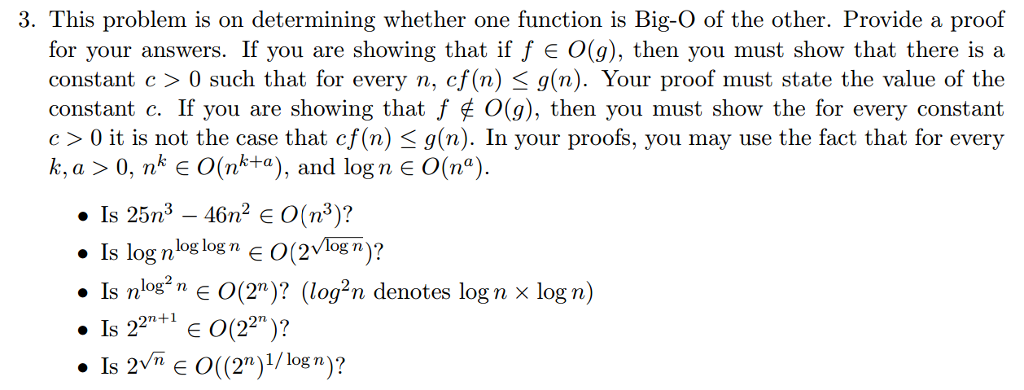
This problem is on determining whether one function is Big-O of the other. Provide a proof for your answers. If you are showing that if f element O(g), then you must show that there is a constant c > 0 such that for every n, c f(n) lessthanorequalto g(n). Your proof must state the value of the constant c. If you are showing that f notelement O(g), then you must show the for every constant c > 0 it is not the case that cf(n) lessthanorequalto g(n). In your proofs, you may use the fact that for every k, a > 0, n^k element O (n^k + a) and log n element O(n^a). Is 25n^3 - 46n^2 element O(n^3)? Is log n^log log n element O(2^squareroot log n)? Is n^log^2 n element O(2^n)? (log^2 n denotes log n times log n) Is 2^2n+1 element O(2^2n)? Is 2 squareroot n element O ((2^n)^1/log n)
Step by Step Solution
There are 3 Steps involved in it

Get step-by-step solutions from verified subject matter experts
 Study Help