







Question: This problem set is due at 1 0 am on Nov. 1 0 , 2 0 2 3 . Please be sure to show all
This problem set is due at am on Nov.
Please be sure to show all work, including units, for each step of the problem. Pay careful
attention to sig figs.
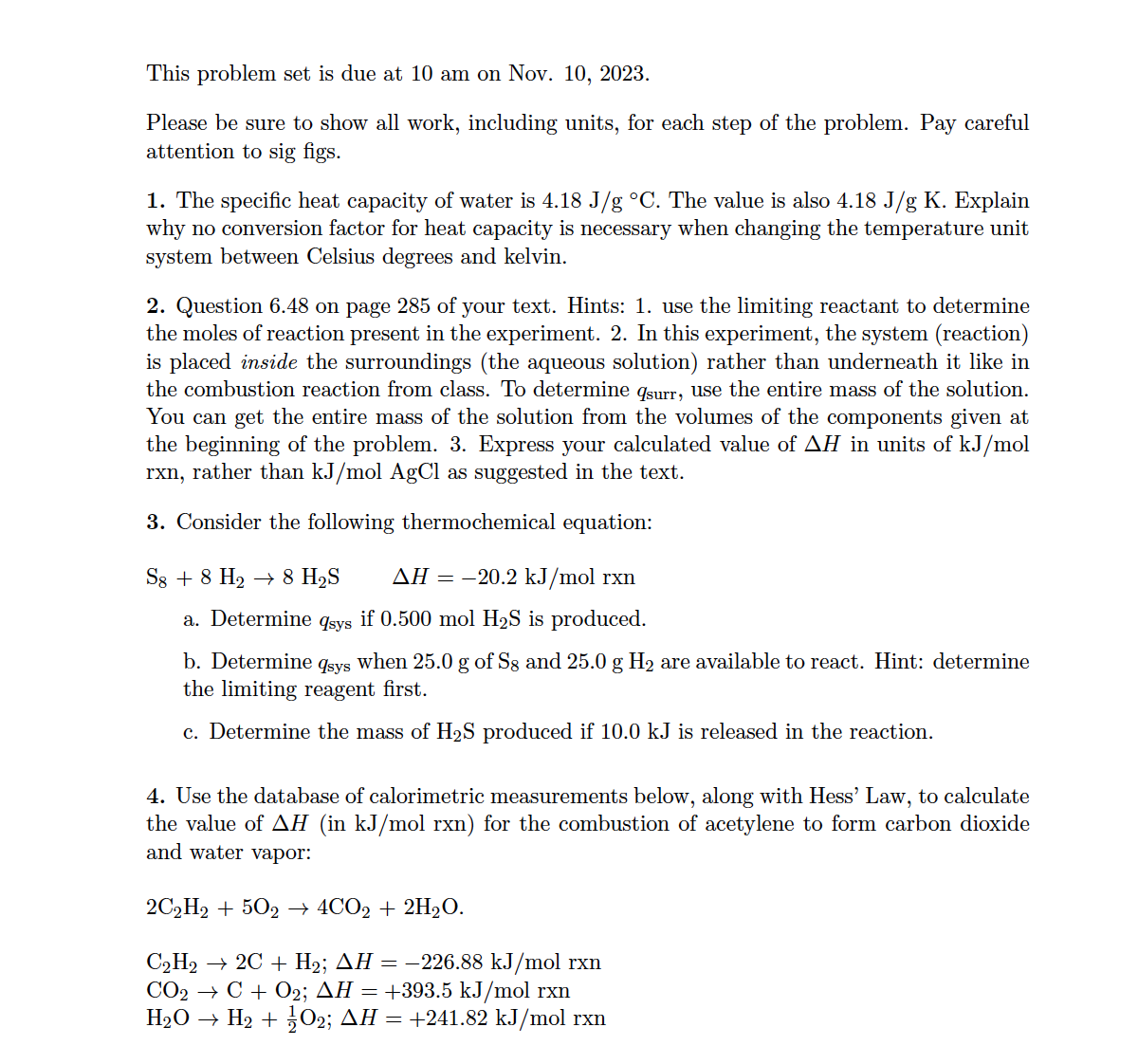
The specific heat capacity of water is The value is also Explain
why no conversion factor for heat capacity is necessary when changing the temperature unit
system between Celsius degrees and kelvin.
Question on page of your text. Hints: use the limiting reactant to determine
the moles of reaction present in the experiment. In this experiment, the system reaction
is placed inside the surroundings the aqueous solution rather than underneath it like in
the combustion reaction from class. To determine use the entire mass of the solution.
You can get the entire mass of the solution from the volumes of the components given at
the beginning of the problem. Express your calculated value of in units of
rxn rather than olAgCl as suggested in the text.
Consider the following thermochemical equation:
olrxn
a Determine if is produced.
b Determine when of and are available to react. Hint: determine
the limiting reagent first.
c Determine the mass of produced if is released in the reaction.
Use the database of calorimetric measurements below, along with Hess' Law, to calculate
the value of in olrxn
and water vapor:
;olrxn
;olrxn
;olrxn
Step by Step Solution
There are 3 Steps involved in it
1 Expert Approved Answer
Step: 1 Unlock

Question Has Been Solved by an Expert!
Get step-by-step solutions from verified subject matter experts
Step: 2 Unlock
Step: 3 Unlock
 Study Help