







Question: This problem studies the effect of changing page sizes in a demand paging system. The following sequence of requests for program words is taken from
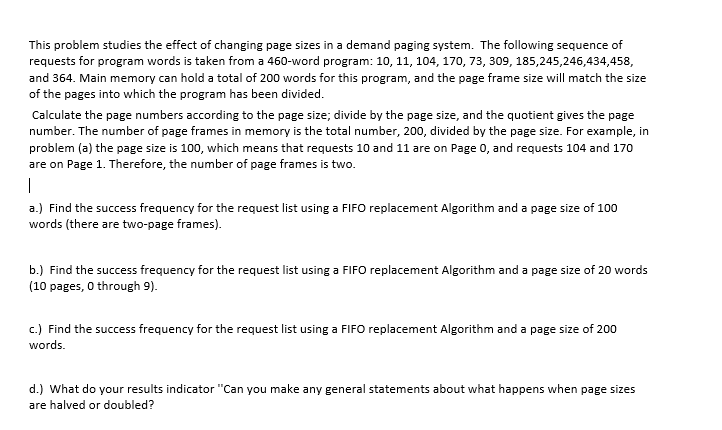
This problem studies the effect of changing page sizes in a demand paging system. The following sequence of requests for program words is taken from a 460-word program: 10, 11, 104, 170, 73, 309, 185,245,246,434,458, and 364. Main memory can hold a total of 200 words for this program, and the page frame size will match the size of the pages into which the program has been divided. Calculate the page numbers according to the page size; divide by the page size, and the quotient gives the page number. The number of page frames in memory is the total number, 200, divided by the page size. For example, in problem (a) the page size is 100, which means that requests 10 and 11 are on Page 0, and requests 104 and 170 are on Page 1. Therefore, the number of page frames is two. a.) Find the success frequency for the request list using a FIFO replacement Algorithm and a page size of 100 words (there are two-page frames). b.) Find the success frequency for the request list using a FIFO replacement Algorithm and a page size of 20 words (10 pages, O through 9). c.) Find the success frequency for the request list using a FIFO replacement Algorithm and a page size of 200 words. d.) What do your results indicator "Can you make any general statements about what happens when page sizes are halved or doubled? This problem studies the effect of changing page sizes in a demand paging system. The following sequence of requests for program words is taken from a 460-word program: 10, 11, 104, 170, 73, 309, 185,245,246,434,458, and 364. Main memory can hold a total of 200 words for this program, and the page frame size will match the size of the pages into which the program has been divided. Calculate the page numbers according to the page size; divide by the page size, and the quotient gives the page number. The number of page frames in memory is the total number, 200, divided by the page size. For example, in problem (a) the page size is 100, which means that requests 10 and 11 are on Page 0, and requests 104 and 170 are on Page 1. Therefore, the number of page frames is two. a.) Find the success frequency for the request list using a FIFO replacement Algorithm and a page size of 100 words (there are two-page frames). b.) Find the success frequency for the request list using a FIFO replacement Algorithm and a page size of 20 words (10 pages, O through 9). c.) Find the success frequency for the request list using a FIFO replacement Algorithm and a page size of 200 words. d.) What do your results indicator "Can you make any general statements about what happens when page sizes are halved or doubled
Step by Step Solution
There are 3 Steps involved in it

Get step-by-step solutions from verified subject matter experts
 Study Help