







Question: This problem uses the data set baeskel from the alr4 package. a) Fit the regression model with Tension as response and Sulfur predictor, and produce
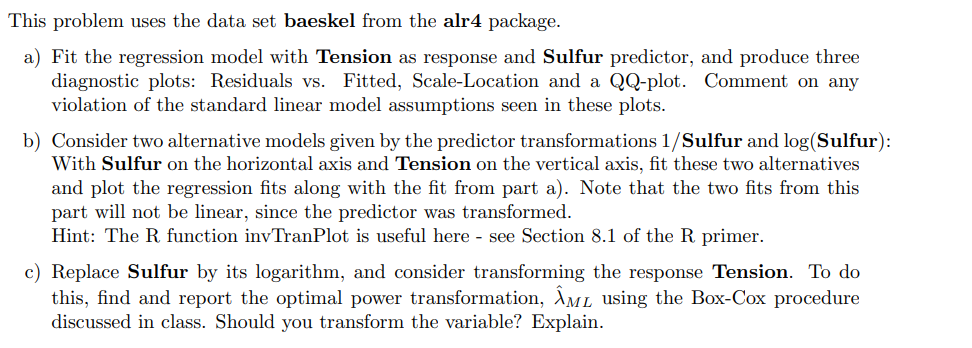
This problem uses the data set baeskel from the alr4 package. a) Fit the regression model with Tension as response and Sulfur predictor, and produce three diagnostic plots: Residuals vs. Fitted, Scale-Location and a QQ-plot. Comment on any violation of the standard linear model assumptions seen in these plots. b) Consider two alternative models given by the predictor transformations 1/Sulfur and log(Sulfur): With Sulfur on the horizontal axis and Tension on the vertical axis, fit these two alternatives and plot the regression fits along with the fit from part a). Note that the two fits from this part will not be linear, since the predictor was transformed. Hint: The R function inv TranPlot is useful here - see Section 8.1 of the R primer. c) Replace Sulfur by its logarithm, and consider transforming the response Tension. To do this, find and report the optimal power transformation, Iml using the Box-Cox procedure discussed in class. Should you transform the variable? Explain. This problem uses the data set baeskel from the alr4 package. a) Fit the regression model with Tension as response and Sulfur predictor, and produce three diagnostic plots: Residuals vs. Fitted, Scale-Location and a QQ-plot. Comment on any violation of the standard linear model assumptions seen in these plots. b) Consider two alternative models given by the predictor transformations 1/Sulfur and log(Sulfur): With Sulfur on the horizontal axis and Tension on the vertical axis, fit these two alternatives and plot the regression fits along with the fit from part a). Note that the two fits from this part will not be linear, since the predictor was transformed. Hint: The R function inv TranPlot is useful here - see Section 8.1 of the R primer. c) Replace Sulfur by its logarithm, and consider transforming the response Tension. To do this, find and report the optimal power transformation, Iml using the Box-Cox procedure discussed in class. Should you transform the variable? Explain
Step by Step Solution
There are 3 Steps involved in it

Get step-by-step solutions from verified subject matter experts
 Study Help