







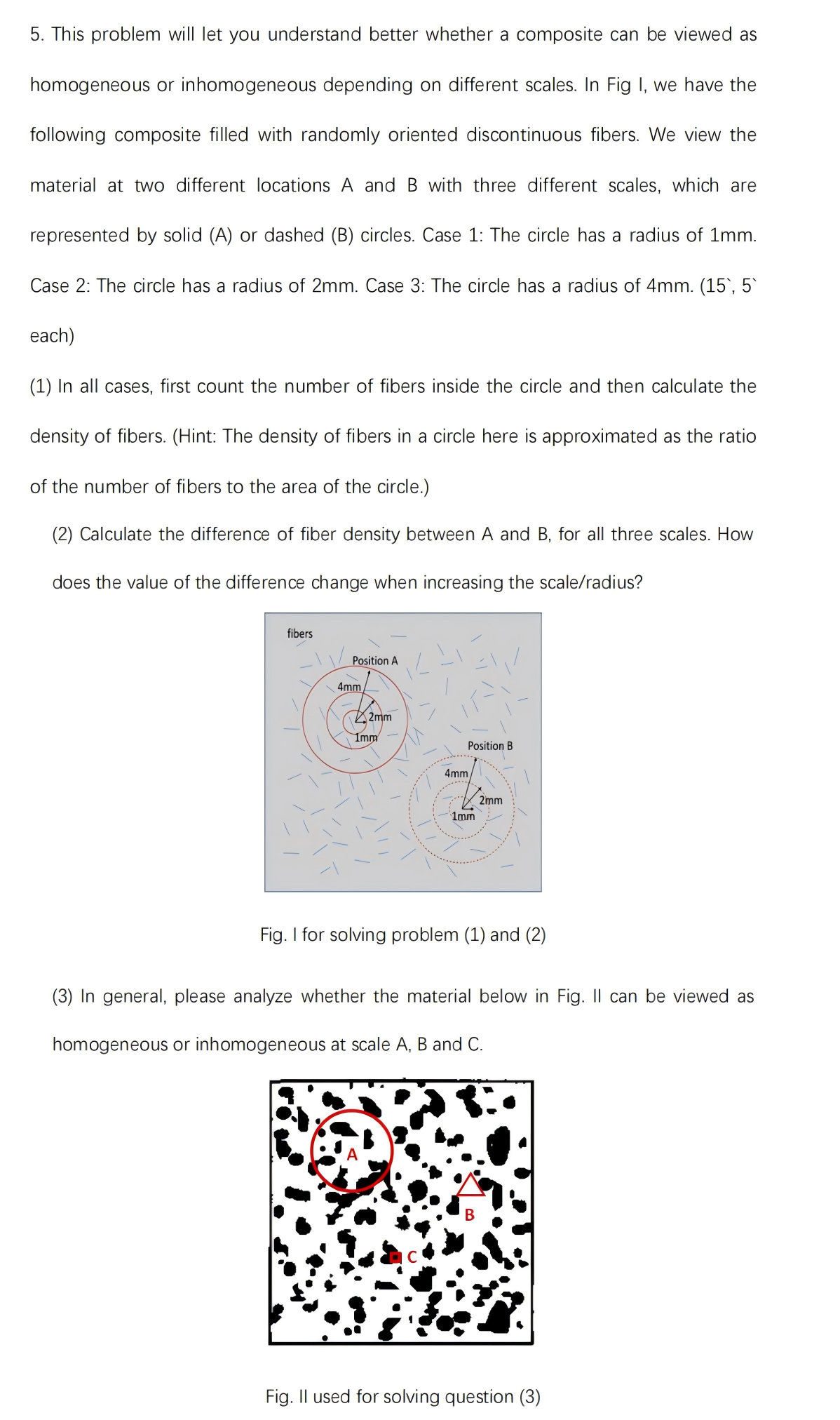
Question: This problem will let you understand better whether a composite can be viewed as homogeneous or inhomogeneous depending on different scales. In Fig I, we
This problem will let you understand better whether a composite can be viewed as
homogeneous or inhomogeneous depending on different scales. In Fig I, we have the
following composite filled with randomly oriented discontinuous fibers. We view the
material at two different locations A and with three different scales, which are
represented by solid or dashed circles. Case : The circle has a radius of mm
Case : The circle has a radius of mm Case : The circle has a radius of
each
In all cases, first count the number of fibers inside the circle and then calculate the
density of fibers. Hint: The density of fibers in a circle here is approximated as the ratio
of the number of fibers to the area of the circle.
Calculate the difference of fiber density between A and for all three scales. How
does the value of the difference change when increasing the scaleradius
Fig. I for solving problem and
In general, please analyze whether the material below in Fig. II can be viewed as
homogeneous or inhomogeneous at scale A B and C
Fig. Il used for solving question
Step by Step Solution
There are 3 Steps involved in it
1 Expert Approved Answer
Step: 1 Unlock

Question Has Been Solved by an Expert!
Get step-by-step solutions from verified subject matter experts
Step: 2 Unlock
Step: 3 Unlock
 Study Help