







Question: This process requires The process for converting present values into future values is called knowledge of the values of three of four time-value-of-money variables. Which
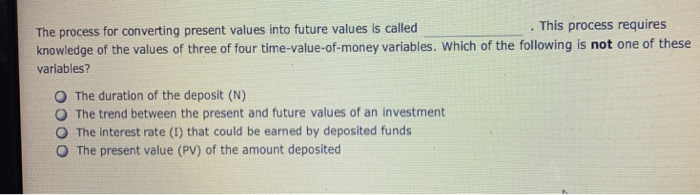
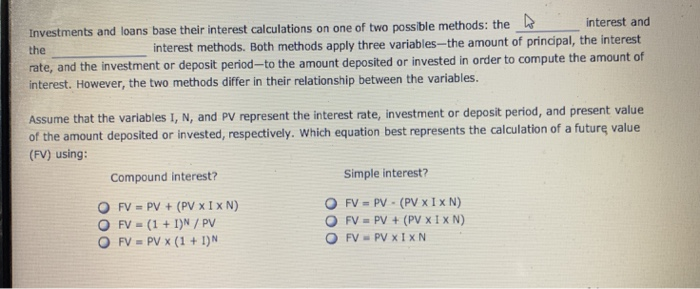
This process requires The process for converting present values into future values is called knowledge of the values of three of four time-value-of-money variables. Which of the following is not one of these variables? The duration of the deposit (N) The trend between the present and future values of an investment O The interest rate (I) that could be earned by deposited funds O The present value (PV) of the amount deposited interest and Investments and loans base their interest calculations on one of two possible methods: the interest methods. Both methods apply three variables-the amount of prindipal, the interest the rate, and the investment or deposit period-to the amount deposited or invested in order to compute the amount of interest. However, the two methods differ in their relationship between the variables. Assume that the variables 1, N, and PV represent the interest rate, investment or deposit period, and present value of the amount deposited or invested, respectively. Which equation best represents the calculation of a future value (FV) using: Simple interest? Compound interest? FV= PV- (PV x I x N) O FV PV +(PV x Ix N) O FV PV+(PV x Ix N) O FV-(1+1)N / PV O FV PV x (1 +1)N O FV PV XIXN
Step by Step Solution
There are 3 Steps involved in it

Get step-by-step solutions from verified subject matter experts
 Study Help