







Question: This program will read a file over a network from a server and display the file on the screen of the client. It will be
This program will read a file over a network from a server and display the file on the screen of the client. It will be done in a group of two students. It will use a TCP/IP stream socket connection between a server student and a client student.
Server Student (read file, write over network):
The hvcc.txt file attached will reside on the server computer. The server program will use a port number for a connection with clients. The connection will use the server's host address (local host if using the same computer). The server program will be able to send a file to the client upon request of the file's name if that file exists (if it doesn't exist, it will just send back a message saying so). As you loop through the reading the file, write it over the socket line by line. You can set it up so only one file is read by each client at a time.
Client Student (read over network, write onto screen):
The client program will prompt the user to enter the server's host address or name (address or name of server host using getByName()) and the server's determined port number for a connection with the server. The user will also be prompted to enter a file name and will be sent to the server. The file should then be read back over the network and displayed onto your computer (in readable lines). As you loop through reading over the socket, write it onto the screen line by line. You can set it up so only one file is read each time the program is run.
Both programs will use try blocks for possible exceptions. They both will use buffers and streams of data to read and write data. You may need to flush() the output buffer between writing the output streams.
1. client will have user input host, port #, and filename.
2. client filename to server.
3. server reads filename from client.
4 server reads the file from their computer line by line.
5. server writes the file to client line by line.
6. client reads the file from the server line by line.
7. client writes the file onto screen line by line.
The output to be submitted will be:
Server - server program .java code with full documentation - 4 line full paragraph about program, and at least 5 lines explaining throughout.
Client - client program .java code with full documentation - 4 line full paragraph about program, and at least 5 lines explaining throughout. The console output text copied and pasted (this will be the server's file on the client's computer screen) in a .txt file.
The server and client students will demonstrate their programs on separate computers to show they work over the network. The server will run and wait for client requests. The client will run and input the server host address and port number and will request the attached hvcc.txt file from the server. The client will demonstrate the inputs of the server host address and port number and will request the hvcc.txt file from the server. Both the server and client student names should be on everything, but clearly indicate who was the server and who was the client. Grades will be based on both the overall program and individual programs, so you are partially responsible to assist your partner.
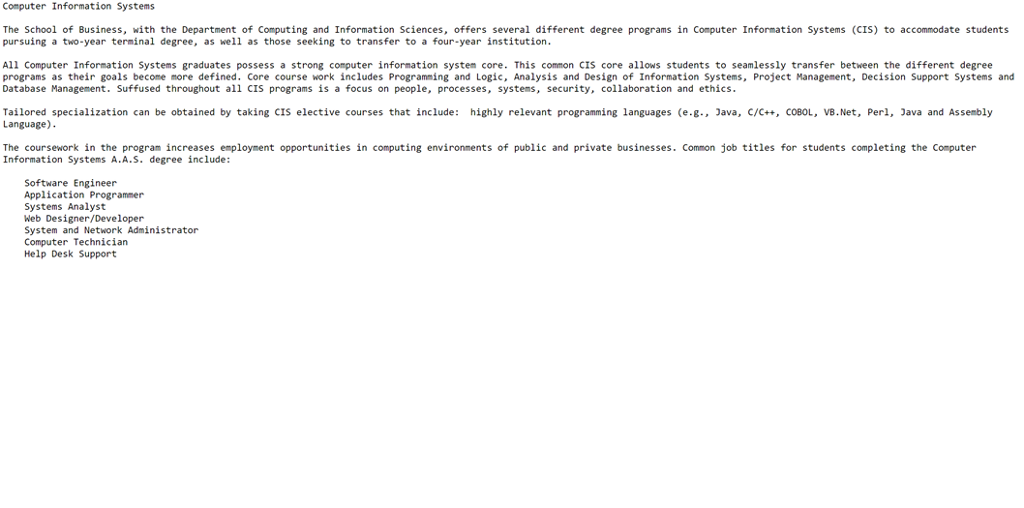
Computer Information Systems The School of Business, with the Department of Computing and Information Sciences, offers several different degree programs in Computer Information Systems (CIS) to accommodate students pursuing a two-year terminal degree, as well as those seeking to transfer to a four-year institution. All Computer Information Systems graduates possess a strong computer information system core. This common CIS core allows students to seamlessly transfer between the different degree programs as their goals become more defined. Core course work includes Programming and Logic, Analysis and Design of Information Systems, Project Management, Decision Support Systems and Database Management. Suffused throughout all CIS programs is a focus on people, processes, systems, security, collaboration and ethics Tailored specialization can be obtained by taking cis elective courses that include: highly relevant programming languages (e.g., Java, C/CCOBoL, vB.Net, Per, ava and Assembly Language) The coursework in the program increases employment opportunities in computing environments of public and private businesses. Common job titles for students completing the Computer Information Systems A.A.S. degree include: Software Engineer Application Programmer Systems Analyst Web Designer/Developer System and Network Administrator Computer Technician Help Desk Support
Step by Step Solution
There are 3 Steps involved in it

Get step-by-step solutions from verified subject matter experts
 Study Help