Question: This project involves students analyzing a real-world business problem. The business problem will be presented to the class by the instructor at the start of
This project involves students analyzing a real-world business problem. The business problem will be presented to the class by the instructor at the start of the course. The business problem could be in the form of a case study of HH Gregg: Deciding on a new information technology platform discussing IT-related problem relating to an organization. You will critically analyze the case study, summarize the key ideas, discuss the IT challenges, and present your recommendations. This report will be organized as follows:
1.Introduction - Short summary of the business problem. This section will also include a background of the organization.
2.Challenges - Provide for a brief description of the challenges that the organization is facing and how they are planning to address them. This section will provide the audience with a picture of how the organization is planning to address some of the challenges.
3.Change Management Discuss how change is being managed by the organization.
4.Recommendations Discuss what you would have done differently and why.
5.Conclusions - Discuss the lessons learned and the key messages that you would like the audience to take away.
The report should not be more than 1000 words.
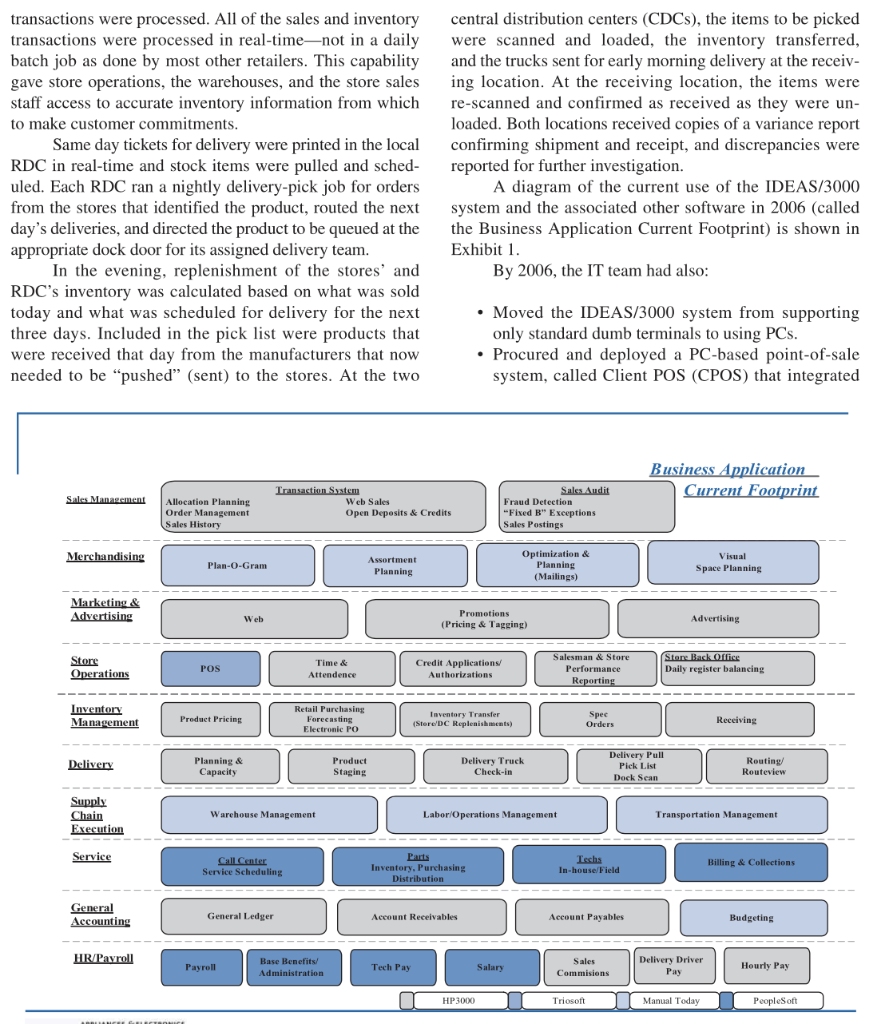
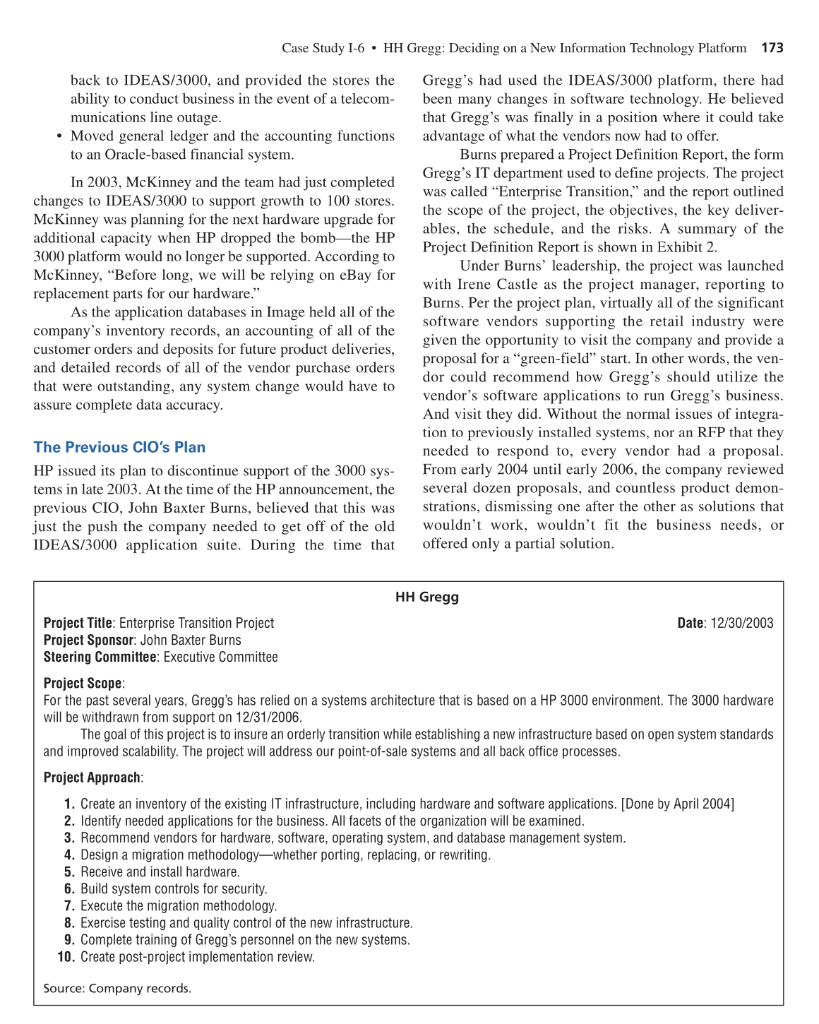
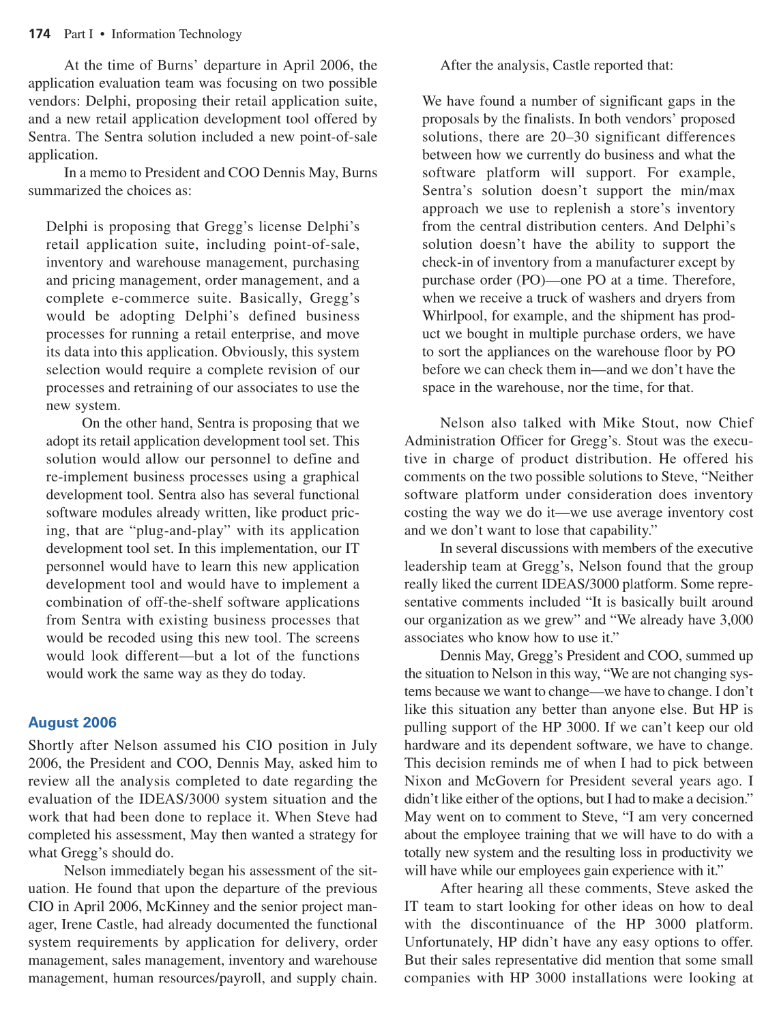
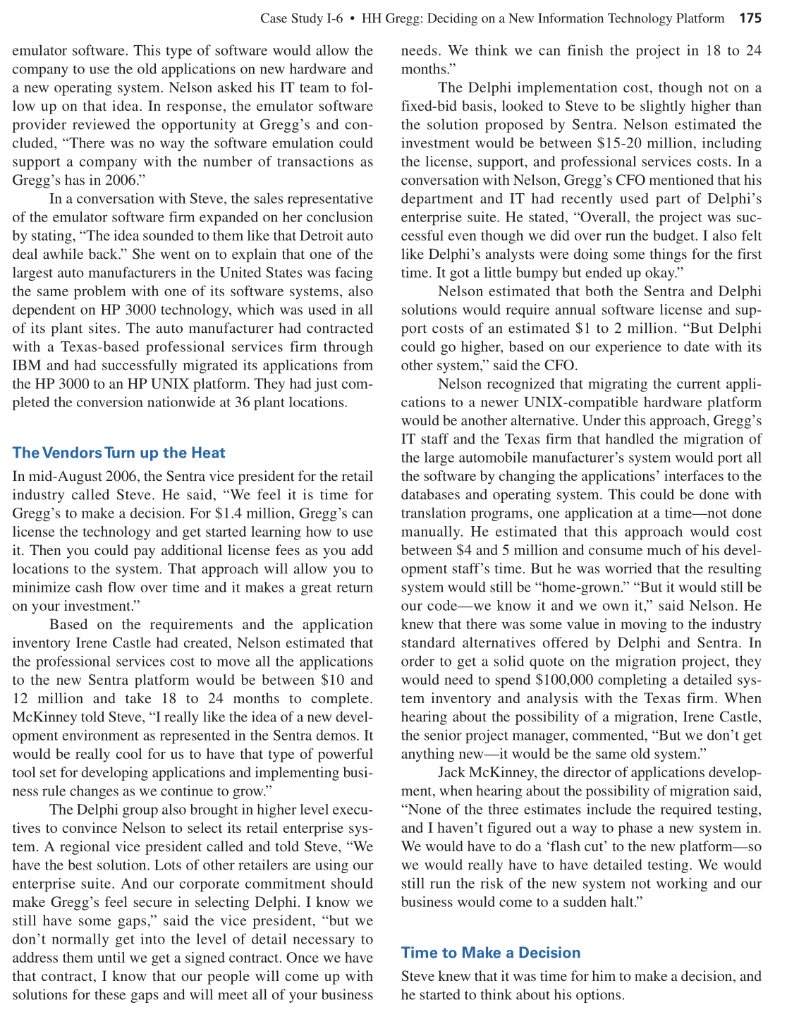
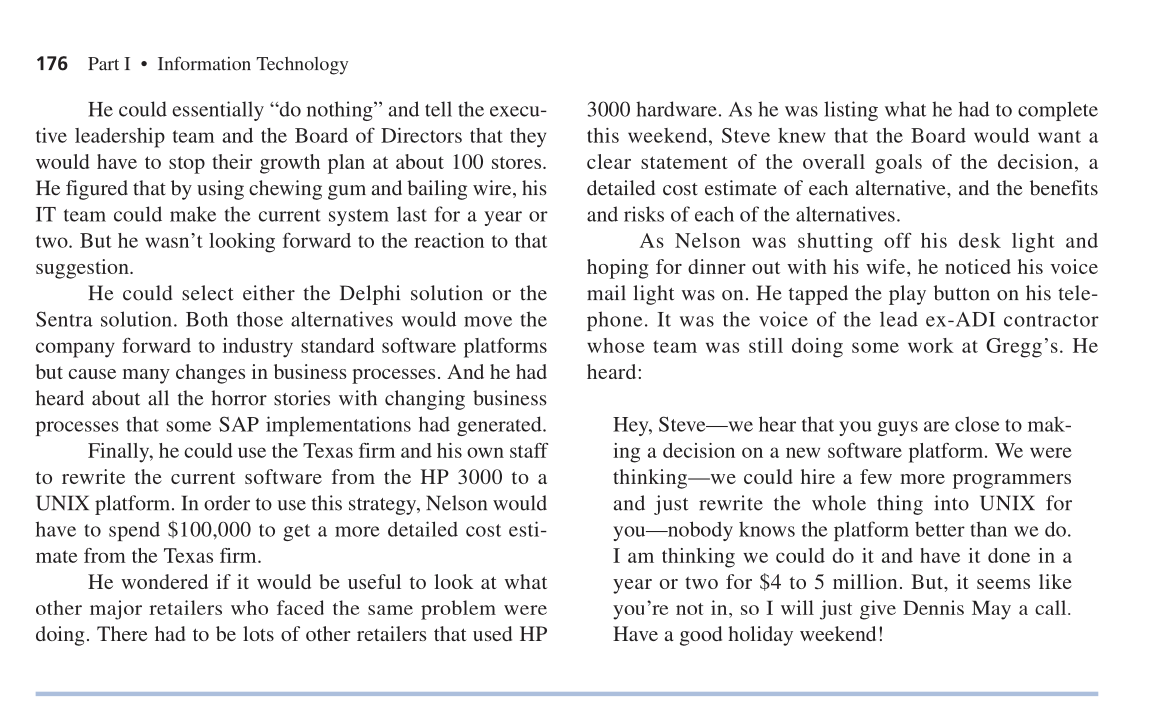
CASE STUDY 1-6 HH Gregg: Deciding on a New Information Technology Platform With a broad background in technology manage- ment, Steve "retired" back to Indianapolis, worked as a consultant, and launched a technology start-up. In mid- 2006, he interviewed for the open CIO position at Gregg's, hoping to make a contribution and get back in the IT game." It was 7 p.m. on the Friday heading into the Labor Day weekend 2006, and Steve Nelson, the newly appointed Chief Information Officer (CIO) for Gregg's Appliances, Inc. (Gregg's), was facing a deadline. Actually, he was fac- ing two deadlines. First, Hewlett-Packard (HP), Gregg's principal information technology vendor, had chosen to discontinue support for its line of HP 3000 mainframe processors, the operating system (MPE), and the propri- etary database management system (Image) that Gregg's relied upon for its transaction processing and inventory management applications. The last support date was December 31, 2006. Second, Gregg's executive leadership team and the Board of Directors wanted to know what Steve's plans were for dealing with this worrisome devel- opment. As matter of fact, Gregg's Chief Financial Officer (CFO) had just left Steve's doorway, reminding him that he would need Steve's PowerPoint slides next Tuesday for inclusion in the next "board book." Stephen R. Nelson Steve Nelson was born in Indianapolis and grew up on the city's north side. While attending Broad Ripple High School, he got his first exposure to the retail industry while working as a clerk in a local toy and hobby shop. After high school, Steve attended Purdue University where he earned a B.S. degree in Engineering and later received the M.B.A. degree from Indiana University. After college, Steve worked for sev- eral years for IBM, with increasing responsibility until reach- ing his last assignment as a branch manager in a major city. During the deregulation of the telecommunications industry in the 1980s, Steve recognized that "telephone" companies would soon be operating in a competitive industry. As a result, he was one of many computer compa- ny mid-level executives who moved into the telecommuni- cations industry, eventually rising to both corporate vice president and operating company president positions at major carriers. Gregg's Appliances, Inc. (Doing Business as HH Gregg) The HH Gregg company was founded on April 15, 1955, in Indianapolis, Indiana, by Henry Harold Gregg and his wife Fansy. The initial store was an 800 square feet appli- ance showroom and office. By 1960, H.H. and Fansy had relocated their store to a space nearly 3 times larger. And a few years later, they moved into a 5,200 square feet loca- tion on North Keystone Avenue in Indianapolis. Mr. Gregg's son, Gerald Throgmartin, joined the company in 1966, after nearly 10 years of sales at Sears, Roebuck & Company. In 1971, a store was opened on the south side of Indianapolis, and 2 years later another store opened in Anderson, Indiana. Gerald assumed his father's position as President in 1974. Jerry Throgmartin, Gerald's son, joined the family business in 1978. Between 1979 and 1984, sensing a move toward larger stores in the appliance and electronics industry, the decision was made to build a "superstore" on the north side of Indianapolis. Three additional superstore openings soon followed, including one in Lafayette, Indiana, as well as locations on the south and east side of Indianapolis for a total of 6 stores. Gregg's purchased Famous State Sales in Nashville, Tennessee, in 1984, marking the company's first move of Indiana Two years later, 1986, was a watershed year for Gregg's. The company purchased a small appliances and electronics company in Terre Haute, Indiana. A new 180,000 square feet corporate headquarters and warehouse distribution center opened in Indianapolis that summer. And the company began to use computers, for operational purposes, for the first time. By the end of 1987, Gregg's had purchased Old Hickory TV in Nashville, Tennessee, and opened 3 more stores. In 1989, Gerald Throgmartin became Chairman and Chief Executive Officer, promoting Copyright 2010 by Stephen R. Nelson and Daniel W. DeHayes. This case was developed with the cooperation of officials of Gregg's Appliances, Inc. Some names and data have been disguised. The case is intended for use in the classroom and is not designed to illustrate either effective or ineffective administrative practices. 170 his son Jerry Throgmartin to President and Chief Operating Officer (COO). Nearly 10 years later, Gregg's acquired eight Sun TV stores in the Cincinnati market. Shortly thereafter, Dennis May joined the company as Executive Vice President. A short time later, Gregg's expanded further in Ohio, this time in Cleveland. Over the next five years, the company began building stores with a new hi-tech design and opened its first HH Gregg's Fine Lines (for upscale brands) in Indianapolis. Dennis May was promoted to President and COO in 2000. By the summer of 2006, Gregg's was operating more than 60 stores and the company's strategy of offering out- standing, personal customer service and competitive pric- ing through a team of well trained associates was working well for the company. The executive team employed a business model that they believed worked well, and with the support of their suppliers, was planning for significant expansion to eventually become a nationwide retailer with several hundred stores. references ADI provided. The team was satisfied that this platform would be a good fit for the company. The IDEAS/3000 application system operated on HP 3000 series hardware and was initially sized to run on a computer expandable to 3 megabytes (MB) of memory and required a single 404-MB disk drive. While the available disk space was potentially expandable, the proposal from ADI made it clear Gregg's would never need more than that amount of online storage. The hardware from HP was initially quoted to Gregg's at $140,000 and the software at $30,000, but Mike Stout was able to negotiate a package deal for $161,000, plus $17,000 in implementation costs. The system was to be operational before the 1986 holiday season. At production start-up, the system could support up to 60 terminal connections. As part of the license agreement, Gregg's negotiated to receive a copy of the system's source code, written principally in COBOL and Basic, as assurance that they would be able to maintain and upgrade the system themselves in the event ADI ceased to do business (as ADI did just a few years later). Gregg's IT team, led by Senior Director and ex-trainee FAA air traffic controller) Jack McKinney, with assistance from a pair of ex-ADI programmers under contract, was able to expand, enhance, and grow the IDEAS/3000 system, includ- ing several hardware changes, to continue to meet the needs of the business for the next 20 years. Information Technology at Gregg's In 1985, Jerry Throgmartin knew that the company would have to move to a computer-based order processing, inven- tory, and warehouse management system. Using 3-inch by 5-inch cards to track inventory and paper-based ledgers would not be scalable as the business continued to grow beyond the 6 stores they had at the time. After several vis- its to review his plan, and its costs, with his father Gerald, Jerry finally received the okay to pursue computerization. Jerry and the company's CFO, Mike Stout, with assistance from Gregg's CPA firm, wrote a Request for Proposal (RFP) for a computer-based information system to help them manage and grow the company's retail activi- ties. They required the system to provide application func- tionality to include: Inventory management Purchase order management General ledger Accounts payable and accounts receivable Sales order processing/commission management Merchandise warranty tracking/customer service Advertising accruals/volume rebates Delivery After a thorough review process that included several vendors, frequent sales presentations, and many product demonstrations, Throgmartin and Stout selected a software product called IDEAS/3000 from American Data Industries (ADI) of Irvine, CA. ADI had been in business for over ten years and had upwards of 70 client installations at the time of the decision. Executives from Gregg's visited several existing customers of ADI and talked to many other The IDEAS/3000 System in 2006 The IDEAS/3000 system was critical to operating Gregg's business and was fully integrated into daily operations at the company. The team had enhanced the IDEAS/3000 system significantly over the years to deal with changes in business processes and enterprise growth. By 2006, the system had grown to over 60 databases and 3600 programs. In addition to COBOL and Basic, the developers also employed six other programming systems, including threeSpeedware, Data Now, and Business Report Writer (BRW)which had been developed specifically for the HP MPE operating system. The IDEAS/3000 system received and processed all of the point-of-sale transactions in the stores, updated store inventory, and scheduled deliveries for the same day, the next day, or some future date. As a significant percentage of the orders was delivered from warehouses, and the rev- enue was not recognized until received by the customer, the system also kept track of all open orders, customer deposits, and payments. Modifications, such as changing the delivery date or time, were made in the system and processed in real-time. As deliveries were completed, the transactions were processed as complete in the system by regional delivery center (RDC) associates, and the appro- priate inventory adjustments and revenue recognition transactions were processed. All of the sales and inventory transactions were processed in real-timenot in a daily batch job as done by most other retailers. This capability gave store operations, the warehouses, and the store sales staff access to accurate inventory information from which to make customer commitments. Same day tickets for delivery were printed in the local RDC in real-time and stock items were pulled and sched- uled. Each RDC ran a nightly delivery-pick job for orders from the stores that identified the product, routed the next day's deliveries, and directed the product to be queued at the appropriate dock door for its assigned delivery team. In the evening, replenishment of the stores and RDC's inventory was calculated based on what was sold today and what was scheduled for delivery for the next three days. Included in the pick list were products that were received that day from the manufacturers that now needed to be "pushed (sent) to the stores. At the two central distribution centers (CDCs), the items to be picked were scanned and loaded, the inventory transferred, and the trucks sent for early morning delivery at the receiv- ing location. At the receiving location, the items were re-scanned and confirmed as received as they were un- loaded. Both locations received copies of a variance report confirming shipment and receipt, and discrepancies were reported for further investigation. A diagram of the current use of the IDEAS/3000 system and the associated other software in 2006 (called the Business Application Current Footprint) is shown in Exhibit 1. By 2006, the IT team had also: Moved the IDEAS/3000 system from supporting only standard dumb terminals to using PCs. Procured and deployed a PC-based point-of-sale system, called Client POS (CPOS) that integrated Business Application Current Footprint Sales Management Allocation Planning Order Management Sales History Transaction System Web Sales Open Deposits & Credits Sales Audit Fraud Detection -Fixed B" Exceptions Sales Postings Merchandising Assortment Plan-O-Gram Optimization & Planning (Mailings) Visual Space Planning Planning --- Marketing & Advertising Web Promotions (Pricing & Tagging) Advertising Store Operations Store Back Office Daily register balancing Time & Attendence POS Salesman & Store Credit Applications/ Performance Authorizations Reporting ----------------- Inventory Management ---------------- Retail Purchasing Produet Pricing Forecasting Electronic PO Inventory Transfer (Stere DC Replenishments) Spec Orders Receiving Delivery Planning & Capacity Product Staging Delivery Truck Check-in Delivery Pull Pick List Dock Scan Routing Routeview Supply Chain Execution Warehouse Management Labor/Operations Management Transportation Management Service Call Center Service Scheduling Parts Inventory, Purchasing Distribution Techa In-house/Field Billing & Collections & General Accounting General Ledger Account Receivables Account Payables Budgeting HR/Payroll Payroll Base Benefits Administration Tech Pay Salary Sales Commisions Delivery Driver Pay Hourly Pay HP3000 Triosoft Manual Today PeopleSoft Case Study 1-6 HH Gregg: Deciding on a New Information Technology Platform 173 back to IDEAS/3000, and provided the stores the ability to conduct business in the event of a telecom- munications line outage. Moved general ledger and the accounting functions to an Oracle-based financial system. In 2003, McKinney and the team had just completed changes to IDEAS/3000 to support growth to 100 stores. McKinney was planning for the next hardware upgrade for additional capacity when HP dropped the bomb the HP 3000 platform would no longer be supported. According to McKinney, Before long, we will be relying on eBay for replacement parts for our hardware." As the application databases in Image held all of the company's inventory records, an accounting of all of the customer orders and deposits for future product deliveries, and detailed records of all of the vendor purchase orders that were outstanding, any system change would have to assure complete data accuracy. Gregg's had used the IDEAS/3000 platform, there had been many changes in software technology. He believed that Gregg's was finally in a position where it could take advantage of what the vendors now had to offer. Burns prepared a Project Definition Report, the form Gregg's IT department used to define projects. The project was called "Enterprise Transition," and the report outlined the scope of the project, the objectives, the key deliver- ables, the schedule, and the risks. A summary of the Project Definition Report is shown in Exhibit 2. Under Burns' leadership, the project was launched with Irene Castle as the project manager, reporting to Burns. Per the project plan, virtually all of the significant software vendors supporting the retail industry were given the opportunity to visit the company and provide a proposal for a "green-field" start. In other words, the ven- dor could recommend how Gregg's should utilize the vendor's software applications to run Gregg's business. And visit they did. Without the normal issues of integra- tion to previously installed systems, nor an RFP that they needed to respond to, every vendor had a proposal. From early 2004 until early 2006, the company reviewed several dozen proposals, and countless product demon- strations, dismissing one after the other as solutions that wouldn't work, wouldn't fit the business needs, or offered only a partial solution. The Previous CIO's Plan HP issued its plan to discontinue support of the 3000 sys- tems in late 2003. At the time of the HP announcement, the previous CIO, John Baxter Burns, believed that this was just the push the company needed to get off of the old IDEAS/3000 application suite. During the time that HH Gregg Project Title: Enterprise Transition Project Date: 12/30/2003 Project Sponsor: John Baxter Burns Steering Committee: Executive Committee Project Scope: For the past several years, Gregg's has relied on a systems architecture that is based on a HP 3000 environment. The 3000 hardware will be withdrawn from support on 12/31/2006. The goal of this project is to insure an orderly transition while establishing a new infrastructure based on open system standards and improved scalability. The project will address our point-of-sale systems and all back office processes. Project Approach: 1. Create an inventory of the existing IT infrastructure, including hardware and software applications. [Done by April 2004) 2. Identify needed applications for the business. All facets of the organization will be examined. 3. Recommend vendors for hardware, software, operating system, and database management system. 4. Design a migration methodology-whether porting, replacing, or rewriting. 5. Receive and install hardware. 6. Build system controls for security. 7. Execute the migration methodology 8. Exercise testing and quality control of the new infrastructure. 9. Complete training of Gregg's personnel on the new systems. 10. Create post-project implementation review. Source: Company records. 174 Part I . Information Technology After the analysis, Castle reported that: At the time of Burns' departure in April 2006, the application evaluation team was focusing on two possible vendors: Delphi, proposing their retail application suite, and a new retail application development tool offered by Sentra. The Sentra solution included a new point-of-sale application. In a memo to President and COO Dennis May, Burns summarized the choices as: We have found a number of significant gaps in the proposals by the finalists. In both vendors proposed solutions, there are 2030 significant differences between how we currently do business and what the software platform will support. For example, Sentra's solution doesn't support the min/max approach we use to replenish a store's inventory from the central distribution centers. And Delphi's solution doesn't have the ability to support the check-in of inventory from a manufacturer except by purchase order (PO)one PO at a time. Therefore, when we receive a truck of washers and dryers from Whirlpool, for example, and the shipment has prod- uct we bought in multiple purchase orders, we have to sort the appliances on the warehouse floor by PO before we can check them inand we don't have the space in the warehouse, nor the time, for that. Delphi is proposing that Gregg's license Delphi's retail application suite, including point-of-sale, inventory and warehouse management, purchasing and pricing management, order management, and a complete e-commerce suite. Basically, Gregg's would be adopting Delphi's defined business processes for running a retail enterprise, and move its data into this application. Obviously, this system selection would require a complete revision of our processes and retraining of our associates to use the new system On the other hand, Sentra is proposing that we adopt its retail application development tool set. This solution would allow our personnel to define and re-implement business processes using a graphical development tool. Sentra also has several functional software modules already written, like product pric- ing, that are "plug-and-play" with its application development tool set. In this implementation, our IT personnel would have to learn this new application development tool and would have to implement a combination of off-the-shelf software applications from Sentra with existing business processes that would be recoded using this new tool. The screens would look differentbut a lot of the functions would work the same way as they do today. Nelson also talked with Mike Stout, now Chief Administration Officer for Gregg's. Stout was the execu- tive in charge of product distribution. He offered his comments on the two possible solutions to Steve, Neither software platform under consideration does inventory costing the way we do itwe use average inventory cost and we don't want to lose that capability." In several discussions with members of the executive leadership team at Gregg's, Nelson found that the group really liked the current IDEAS/3000 platform. Some repre- sentative comments included It is basically built around our organization as we grew" and "We already have 3,000 associates who know how to use it." Dennis May, Gregg's President and COO, summed up the situation to Nelson in this way, "We are not changing sys- tems because we want to changewe have to change. I don't like this situation any better than anyone else. But HP is pulling support of the HP 3000. If we can't keep our old hardware and its dependent software, we have to change. This decision reminds me of when I had to pick between Nixon and McGovern for President several years ago. I didn't like either of the options, but I had to make a decision." May went on to comment to Steve, I am very concerned about the employee training that we will have to do with a totally new system and the resulting loss in productivity we will have while our employees gain experience with it." After hearing all these comments, Steve asked the IT team to start looking for other ideas on how to deal with the discontinuance of the HP 3000 platform. Unfortunately, HP didn't have any easy options to offer. But their sales representative did mention that some small companies with HP 3000 installations were looking at August 2006 Shortly after Nelson assumed his CIO position in July 2006, the President and COO, Dennis May, asked him to review all the analysis completed to date regarding the evaluation of the IDEAS/3000 system situation and the work that had been done to replace it. When Steve had completed his assessment, May then wanted a strategy for what Gregg's should do. Nelson immediately began his assessment of the sit- uation. He found that upon the departure of the previous CIO in April 2006, McKinney and the senior project man- ager, Irene Castle, had already documented the functional system requirements by application for delivery, order management, sales management, inventory and warehouse management, human resources/payroll, and supply chain. Case Study 1-6. HH Gregg: Deciding on a New Information Technology Platform 175 emulator software. This type of software would allow the company to use the old applications on new hardware and a new operating system. Nelson asked his IT team to fol- low up on that idea. In response, the emulator software provider reviewed the opportunity at Gregg's and con- cluded, There was no way the software emulation could support a company with the number of transactions as Gregg's has in 2006." In a conversation with Steve, the sales representative of the emulator software firm expanded on her conclusion by stating, The idea sounded to them like that Detroit auto deal awhile back." She went on to explain that one of the largest auto manufacturers in the United States was facing the same problem with one of its software systems, also dependent on HP 3000 technology, which was used in all of its plant sites. The auto manufacturer had contracted with a Texas-based professional services firm through IBM and had successfully migrated its applications from the HP 3000 to an HP UNIX platform. They had just com- pleted the conversion nationwide at 36 plant locations. The Vendors Turn up the Heat In mid-August 2006, the Sentra vice president for the retail industry called Steve. He said, "We feel it is time for Gregg's to make a decision. For $1.4 million, Gregg's can license the technology and get started learning how to use it. Then you could pay additional license fees as you add locations to the system. That approach will allow you to minimize cash flow over time and it makes a great return on your investment." Based on the requirements and the application inventory Irene Castle had created, Nelson estimated that the professional services cost to move all the applications to the new Sentra platform would be between $10 and 12 million and take 18 to 24 months to complete. McKinney told Steve, I really like the idea of a new devel- opment environment as represented in the Sentra demos. It would be really cool for us to have that type of powerful tool set for developing applications and implementing busi- ness rule changes as we continue to grow." The Delphi group also brought in higher level execu- tives to convince Nelson to select its retail enterprise sys- tem. A regional vice president called and told Steve, "We have the best solution. Lots of other retailers are using our enterprise suite. And our corporate commitment should make Gregg's feel secure in selecting Delphi. I know we still have some gaps," said the vice president, but we don't normally get into the level of detail necessary to address them until we get a signed contract. Once we have that contract, I know that our people will come up with solutions for these gaps and will meet all of your business needs. We think we can finish the project in 18 to 24 months." The Delphi implementation cost, though not on a fixed-bid basis, looked to Steve to be slightly higher than the solution proposed by Sentra. Nelson estimated the investment would be between $15-20 million, including the license, support, and professional services costs. In a conversation with Nelson, Gregg's CFO mentioned that his department and IT had recently used part of Delphi's enterprise suite. He stated, Overall, the project was suc- cessful even though we did over run the budget. I also felt like Delphi's analysts were doing some things for the first time. It got a little bumpy but ended up okay." Nelson estimated that both the Sentra and Delphi solutions would require annual software license and sup- port costs of an estimated $1 to 2 million. But Delphi could go higher, based on our experience to date with its other system," said the CFO. Nelson recognized that migrating the current appli- cations to a newer UNIX-compatible hardware platform would be another alternative. Under this approach, Gregg's IT staff and the Texas firm that handled the migration of the large automobile manufacturer's system would port all the software by changing the applications' interfaces to the databases and operating system. This could be done with translation programs, one application at a timenot done manually. He estimated that this approach would cost between $4 and 5 million and consume much of his devel- opment staff's time. But he was worried that the resulting system would still be "home-grown." "But it would still be our code-we know it and we own it," said Nelson. He knew that there was some value in moving to the industry standard alternatives offered by Delphi and Sentra. In order to get a solid quote on the migration project, they would need to spend $100,000 completing a detailed sys- tem inventory and analysis with the Texas firm. When hearing about the possibility of a migration, Irene Castle, the senior project manager, commented, But we don't get anything newit would be the same old system." Jack McKinney, the director of applications develop- ment, when hearing about the possibility of migration said, "None of the three estimates include the required testing, and I haven't figured out a way to phase a new system in We would have to do a 'flash cut to the new platform-so we would really have to have detailed testing. We would still run the risk of the new system not working and our business would come to a sudden halt." Time to Make a Decision Steve knew that it was time for him to make a decision, and he started to think about his options. 176 Part I. Information Technology He could essentially do nothing and tell the execu- tive leadership team and the Board of Directors that they would have to stop their growth plan at about 100 stores. He figured that by using chewing gum and bailing wire, his IT team could make the current system last for a year or two. But he wasn't looking forward to the reaction to that suggestion. He could select either the Delphi solution or the Sentra solution. Both those alternatives would move the company forward to industry standard software platforms but cause many changes in business processes. And he had heard about all the horror stories with changing business processes that some SAP implementations had generated. Finally, he could use the Texas firm and his own staff to rewrite the current software from the HP 3000 to a UNIX platform. In order to use this strategy, Nelson would have to spend $100,000 to get a more detailed cost esti- mate from the Texas firm. He wondered if it would be useful to look at what other major retailers who faced the same problem were doing. There had to be lots of other retailers that used HP 3000 hardware. As he was listing what he had to complete this weekend, Steve knew that the Board would want a clear statement of the overall goals of the decision, a detailed cost estimate of each alternative, and the benefits and risks of each of the alternatives. As Nelson was shutting off his desk light and hoping for dinner out with his wife, he noticed his voice mail light was on. He tapped the play button on his tele- phone. It was the voice of the lead ex-ADI contractor whose team was still doing some work at Gregg's. He heard: Hey, Stevewe hear that you guys are close to mak- ing a decision on a new software platform. We were thinking-we could hire a few more programmers and just rewrite the whole thing into UNIX for younobody knows the platform better than we do. I am thinking we could do it and have it done in a year or two for $4 to 5 million. But, it seems like you're not in, so I will just give Dennis May a call. Have a good holiday weekend









 Study Help