







Question: This project will answer the problems from the problem set below. Each question should have its own background section and solution section. The background section
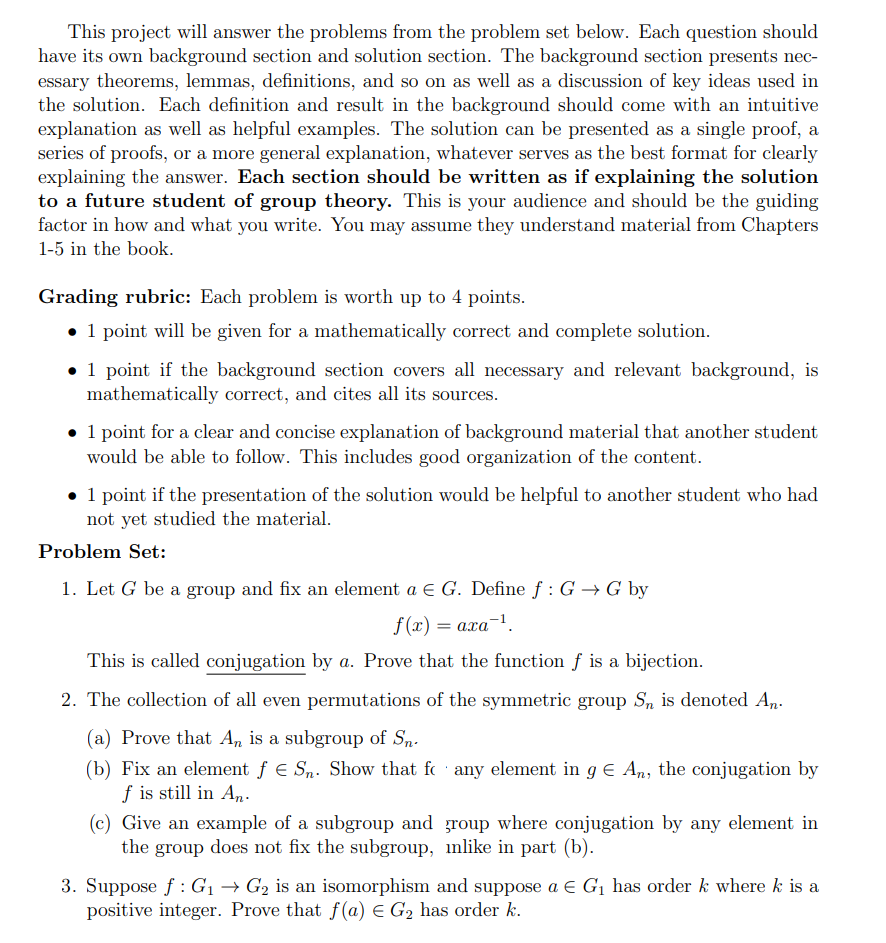
This project will answer the problems from the problem set below. Each question should have its own background section and solution section. The background section presents nec- essary theorems, lemmas, definitions, and so on as well as a discussion of key ideas used in the solution. Each definition and result in the background should come with an intuitive explanation as well as helpful examples. The solution can be presented as a single proof, a series of proofs, or a more general explanation, whatever serves as the best format for clearly explaining the answer. Each section should be written as if explaining the solution to a future student of group theory. This is your audience and should be the guiding factor in how and what you write. You may assume they understand material from Chapters 1-5 in the book. Grading rubric: Each problem is worth up to 4 points. e 1 point will be given for a mathematically correct and complete solution. e 1 point if the background section covers all necessary and relevant background, is mathematically correct, and cites all its sources. e 1 point for a clear and concise explanation of background material that another student would be able to follow. This includes good organization of the content. e 1 point if the presentation of the solution would be helpful to another student who had not yet studied the material. Problem Set: 1. Let G be a group and fix an element a GG. Define f : G G by f(z) = azaL. This is called conjugation by a. Prove that the function f is a bijection. 2. The collection of all even permutations of the symmetric group S,, is denoted A,,. (a) Prove that A, is a subgroup of S,,. (b) Fix an element f S,,. Show that fc - any element in g A,,, the conjugation by f is still in A,,. (c) Give an example of a subgroup and sroup where conjugation by any element in the group does not fix the subgroup, inlike in part (b). 3. Suppose f: G; (5 is an isomorphism and suppose a G| has order k where k is a positive integer. Prove that f(a) G5 has order k
Step by Step Solution
There are 3 Steps involved in it

Get step-by-step solutions from verified subject matter experts
 Study Help