







Question: This question combines capital accumulation from Solow with the idea production function of Romer. Our capital accumulation equation can be written in terms of capital
This question combines capital accumulation from Solow with the idea production function of Romer. Our capital accumulation equation can be written in terms of capital growth:? KY K KK ?? ? ?? = = ? ?? ??
An idea production function could be written in terms of growth for technology:? ALA AA A ?? ?? = =where:AA LL ? =The previous two equations can be derived using differenced data (?K and ?A) or time derivatives (dK dt and dA dt ).One way to write the production function is:1 () Y Y K L A ?? ?=where:YA L L L = ? These curves may apply at all times in a model, but for this question we are only interested in steady-state growth rates of L, K, Y, ?, and A, written asgL , gK , gY , g? , and gA , respectively. Assuming all parameters in this model are constant, positive, and less than 1, these 3 equation can be used to show that in the steady state:
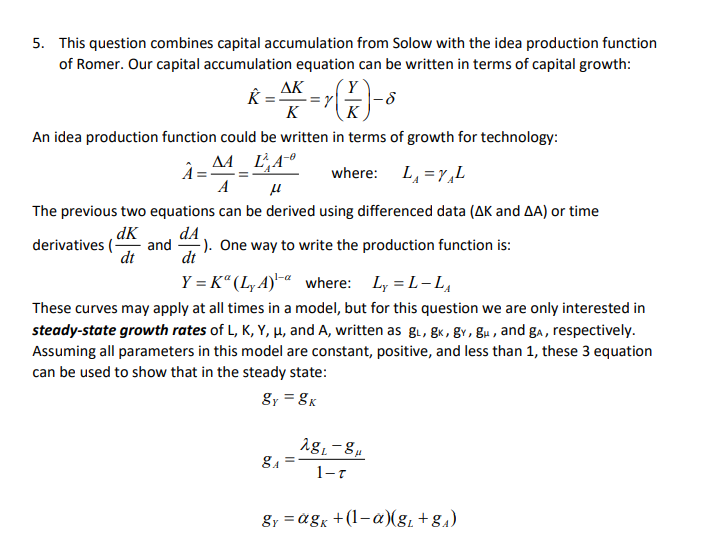
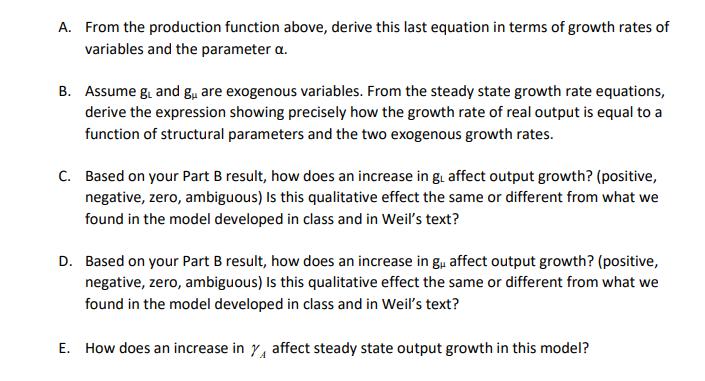
5. This question combines capital accumulation from Solow with the idea production function of Homer. Dur capital accumulation equation can be written in terms of capital growth: ,. Mi 1' K == rlJa K K An idea production function could be written in terms of growth for technology: a M Li A"? A== " where: L4=r4L A Jits ' ' The previous two equations can be derived using dierenced data {MC and M} or time . . (K M . . . . derivatives {E and Ft }. One way to write the production fu nctlon Is: Y = K\"{,,A}]'\" where: L1r = LLA These curves may apply at all times in a model, but for this question we are only interested in steady-state growth rates of L, K. T, u. and A, written as EL, EN, Ev . 3p, and 3s, respectively. Assuming all parameters in this model are constant, positive. and less than 1. these 3 equation can he used to show that in the steady state: gr =gr: lg]: g gs 1!" gr =agx +055ng +3.4) A. From the production function above, derive this last equation in terms of growth rates of variables and the parameter a. B. Assume g and go are exogenous variables. From the steady state growth rate equations, derive the expression showing precisely how the growth rate of real output is equal to a function of structural parameters and the two exogenous growth rates. C. Based on your Part B result, how does an increase in gi affect output growth? (positive, negative, zero, ambiguous) Is this qualitative effect the same or different from what we found in the model developed in class and in Weil's text? D. Based on your Part B result, how does an increase in go affect output growth? (positive, negative, zero, ambiguous) Is this qualitative effect the same or different from what we found in the model developed in class and in Weil's text? E. How does an increase in y affect steady state output growth in this model
Step by Step Solution
There are 3 Steps involved in it

Get step-by-step solutions from verified subject matter experts
 Study Help