







Question: This question examines how much two actors can cooperate. [may and Peak are two high-te rms that are thinking about forming a strategic alliance between
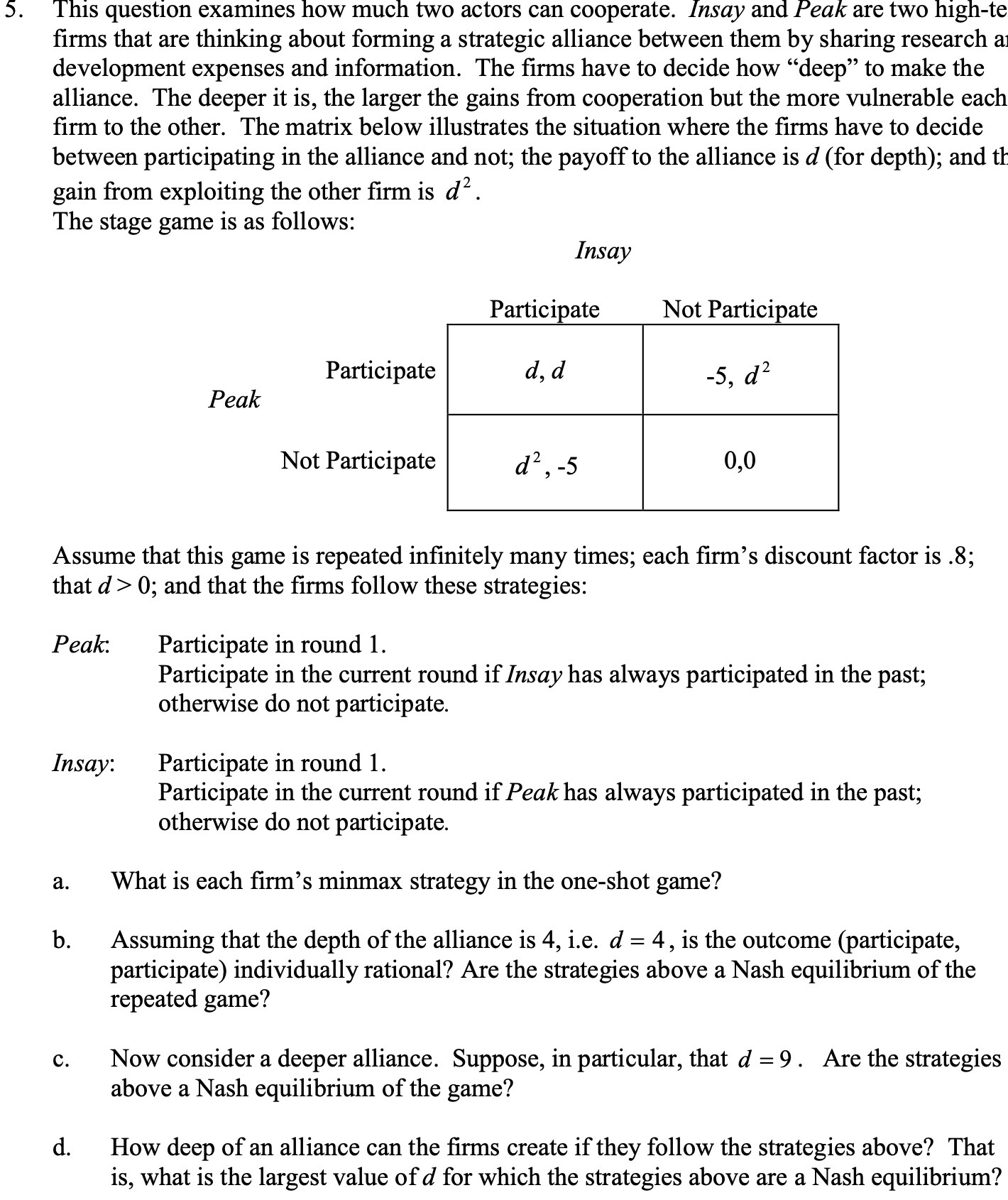
This question examines how much two actors can cooperate. [may and Peak are two high-te rms that are thinking about forming a strategic alliance between them by sharing research a: development expenses and information. The rms have to decide how \"deep\" to make the alliance. The deeper it is, the larger the gains from cooperation but the more vulnerable each rm to the other. The matrix below illustrates the situation where the rms have to decide between participating in the alliance and not; the payoff to the alliance is d (for depth); and ti gain om exploiting the other rm is d 2. The stage game is as follows: Insay Participate Not Participate Participate Peak Not Participate Assume that this game is repeated innitely many times; each rm's discount factor is .8; that d > 0; and that the rms follow these strategies: Pealc Participate in round 1. Participate in the current round if Insay has always participated in the past; otherwise do not participate. Insay: Participate in round 1. Participate in the current round if Peak has always participated in the past; otherwise do not participate. a. What is each fnm's minmax strategy in the one-shot game? b. Assuming that the depth of the alliance is 4, i.e. d = 4 , is the outcome (participate, participate) individually rational? Are the strategies above a Nash equilibrium of the repeated game? c. Now consider a deeper alliance. Suppose, in particular, that d = 9 . Are the strategies above a Nash equilibrium of the game? d. How deep of an alliance can the rms create if they follow the strategies above? That is, what is the largest value of d for which the strategies above are a Nash equilibrium
Step by Step Solution
There are 3 Steps involved in it

Get step-by-step solutions from verified subject matter experts
 Study Help