







Question: This question has several parts that must be completed sequentially. If you skip a part of the question, you will not receive any points for
This question has several parts that must be completed sequentially. If you skip a part of the question, you will not receive any points for the skipped part, and you will not be able to come back to the skipped part.
Analysis Model Tutorial
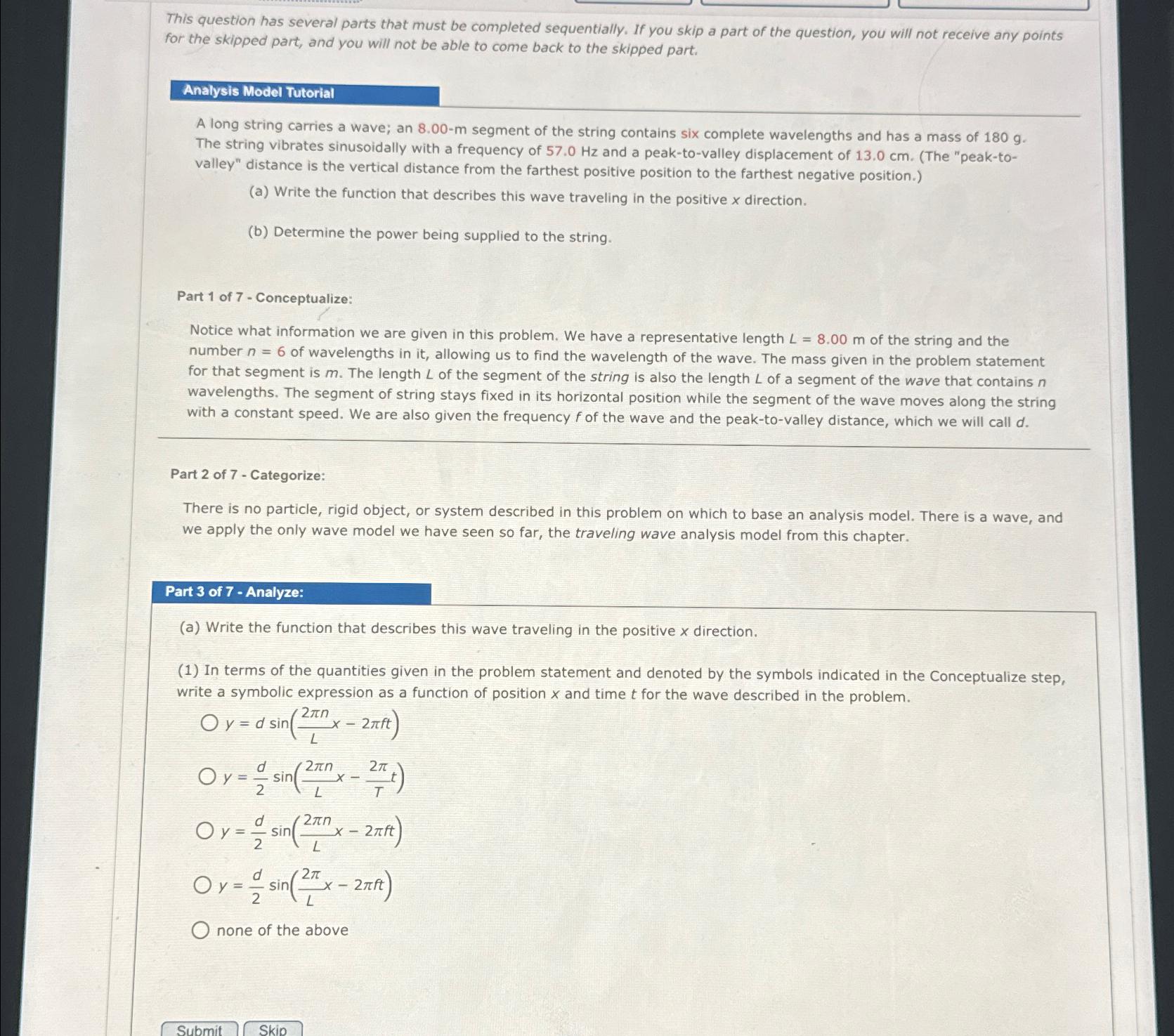
A long string carries a wave; an segment of the string contains six complete wavelengths and has a mass of The string vibrates sinusoidally with a frequency of and a peaktovalley displacement of The "peaktovalle distance is the vertical distance from the farthest positive position to the farthest negative position.
a Write the function that describes this wave traveling in the positive direction.
b Determine the power being supplied to the string.
Part of Conceptualize:
Notice what information we are given in this problem. We have a representative length of the string and the number of wavelengths in it allowing us to find the wavelength of the wave. The mass given in the problem statement for that segment is The length of the segment of the string is also the length of a segment of the wave that contains wavelengths. The segment of string stays fixed in its horizontal position while the segment of the wave moves along the string with a constant speed. We are also given the frequency of the wave and the peaktovalley distance, which we will call
Part of Categorize:
There is no particle, rigid object, or system described in this problem on which to base an analysis model. There is a wave, and we apply the only wave model we have seen so far, the traveling wave analysis model from this chapter.
Part of Analyze:
a Write the function that describes this wave traveling in the positive direction.
In terms of the quantities given in the problem statement and denoted by the symbols indicated in the Conceptualize step, write a symbolic expression as a function of position and time for the wave described in the problem.
dsin
none of the above
Step by Step Solution
There are 3 Steps involved in it
1 Expert Approved Answer
Step: 1 Unlock

Question Has Been Solved by an Expert!
Get step-by-step solutions from verified subject matter experts
Step: 2 Unlock
Step: 3 Unlock
 Study Help