







Question: This question involves hypothesis testing. The following numbers will help you answer these questions. The random variable Z ~N(0, 1) is standard normal. P(Z
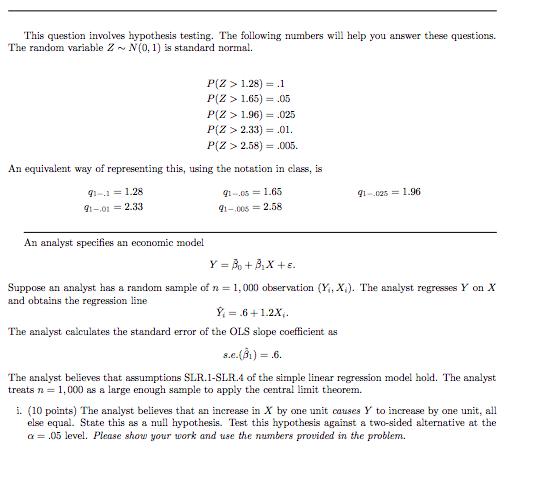
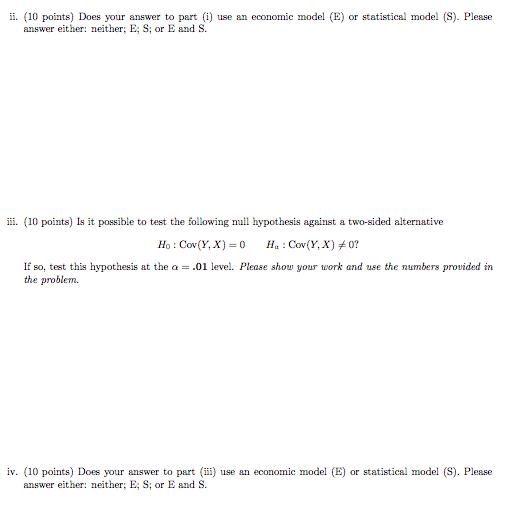
This question involves hypothesis testing. The following numbers will help you answer these questions. The random variable Z ~N(0, 1) is standard normal. P(Z >1.28).1 P(Z1.65) .05 P(Z1.96) .025 P(Z >2.33) .01. P(Z >2.58) .005. An equivalent way of representing this, using the notation in class, is 91-1-1.28 91-01 2.33 91-05 1.65 91-005 2.58 91-025 1.96 An analyst specifies an economic model Y = B + BX+. Suppose an analyst has a random sample of n = 1,000 observation (Y, X). The analyst regresses Y on X and obtains the regression line =6+1.2X. The analyst calculates the standard error of the OLS slope coefficient as 8.c.(81) = .6. The analyst believes that assumptions SLR.I-SLR.4 of the simple linear regression model hold. The analyst treats n = 1,000 as a large enough sample to apply the central limit theorem. i. (10 points) The analyst believes that an increase in X by one unit causes Y to increase by one unit, all else equal. State this as a null hypothesis. Test this hypothesis against a two-sided alternative at the a=.05 level. Please show your work and use the numbers provided in the problem. ii. (10 points) Does your answer to part (i) use an economic model (E) or statistical model (S). Please answer either: neither; E; S; or E and S. iii. (10 points) Is it possible to test the following null hypothesis against a two-sided alternative Ho: Cov(Y, X)=0 H: Cov(Y, X) 0? If so, test this hypothesis at the a=.01 level. Please show your work and use the numbers provided in the problem. iv. (10 points) Does your answer to part (iii) use an economic model (E) or statistical model (S). Please answer either: neither; E; S; or E and S.
Step by Step Solution
There are 3 Steps involved in it

Get step-by-step solutions from verified subject matter experts
 Study Help