







Question: This question is about bogus proof. Please include detailed explanations in your answer. Thumbs up if your answer helps. Thanks so much!!! MCS 5.26: A
This question is about bogus proof. Please include detailed explanations in your answer. Thumbs up if your answer helps. Thanks so much!!!
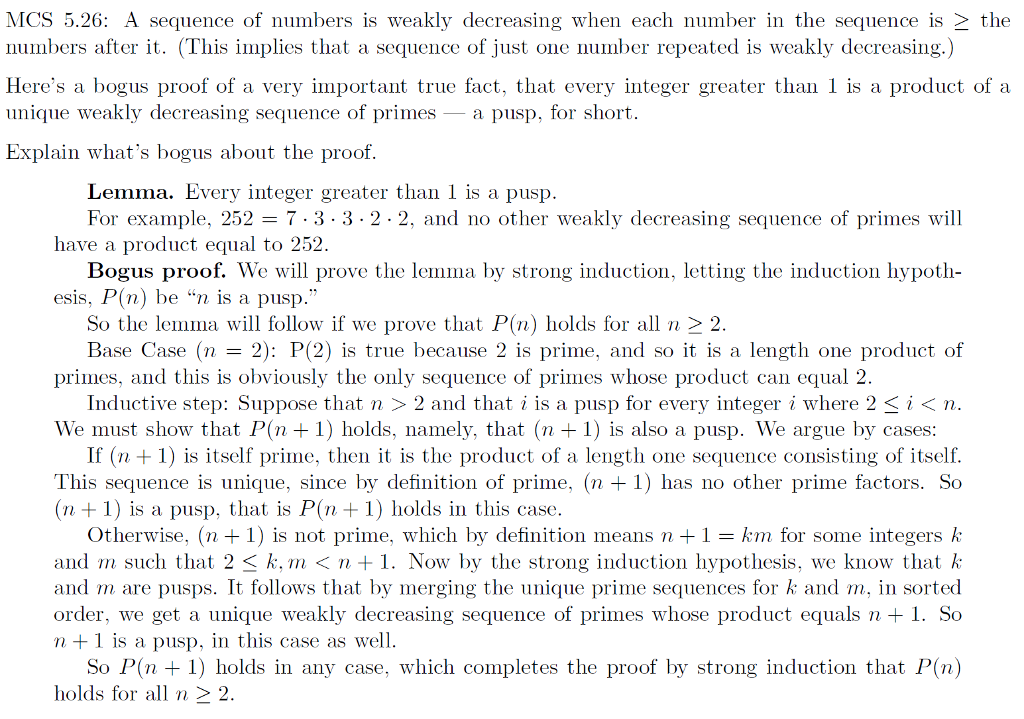
MCS 5.26: A sequence of numbers is weakly decreasing when each number in the sequence is the numbers after it. (This implies that a sequence of just one number repeated is wea decreasing. Here's a bogus proof of a very important true fact, that every integer greater than 1 is a product of a unique weakly decreasing sequence of primes a pusp, for short Explain what's bogus about the proof Lemma. Every integer greater than 1 is a pusp For example, 252 7. 3. 3. 2. 2, and no other weakly decreasing sequence of primes will have a product equal to 252 Bogus proof. We will prove the lemma by strong induction, letting the induction hypoth- esis, P(n) be "n is a pusp So the lemma will follow if we prove that Pn) holds for all n 2 Base Case (n 2): P(2) is true because 2 is prime, and so it is a length one product of primes, and this is obviously the only sequence of primes whose product can equal 2 Inductive step: Suppose that n 2 and that i is a pusp for every integer i where 2 S i r We must show that P n 1) holds, namely, that (n 1) is also a pusp. We argue by cases: If (n 1) is itself prime, then it is the product of a length one sequence consisting of itself This sequence is unique, since by definition of prime (n 1) has no other prime factors. So (n 1) is a pusp, that is P n 1) holds in this case Otherwise (n 1) is not prime, which by definition means n 1 km for some integers k and m such that 2 S k, m n 1. Now by the strong induction hypothesis, we know that k and m are pusps. It follows that by merging the unique prime sequences for k and m, in sorted order, we get a unique weakly decreasing sequence of primes whose product equals n 1. So n 1 is a pusp, in this case as well So P n 1) holds in any case, which completes the proof by strong induction that P(n) holds for all n
Step by Step Solution
There are 3 Steps involved in it

Get step-by-step solutions from verified subject matter experts
 Study Help