







Question: This question is about search . There are three rooms and two robots, A and B . Each room allows at most one robot at
This question is about search There are three rooms and two robots, A and B
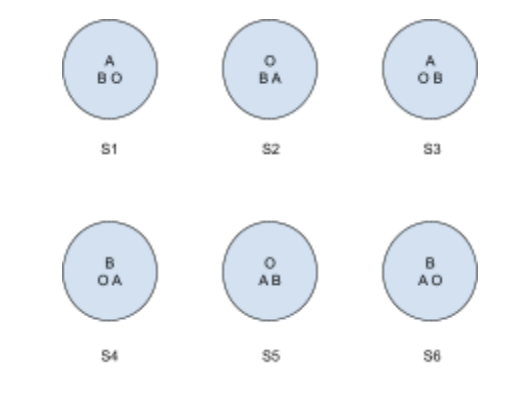
Each room allows at most one robot at a time. We use O to represent an empty room.
As a result, there are the following six states. Its a centralized system, and the operator
can move one robot A or B to the empty room at a time, resulting in two actions of
MovA and MovB respectively. The operator also has a switch action to exchange the
positions of the two robots.
The costs of the MovA, MovB, and Switch actions are and respectively. In case of
a tie, actions are selected alphabetically MovA is evaluated first, and Switch is the last
evaluated As an example, the operator can use the action sequence SwitchMovB to
go from S to S
a The start state is S and the goal state is S Using depthfirst search DFS
write down the computed action sequence for the operator. Hint: You might find a
tree helpful in answering this question and following two
b The start state is S and the goal state is S Using breadthfirst search BFS
write down the computed action sequence for the operator.
c
S
S
S The start state is S and the goal state is S Using uniformcost search UCS
write down the computed action sequence for the operator.
Step by Step Solution
There are 3 Steps involved in it
1 Expert Approved Answer
Step: 1 Unlock

Question Has Been Solved by an Expert!
Get step-by-step solutions from verified subject matter experts
Step: 2 Unlock
Step: 3 Unlock
 Study Help