







Question: This question is based on the Specific factors model example we went through in class. Suppose two countries, Home and Foreign, produce two goods, timber
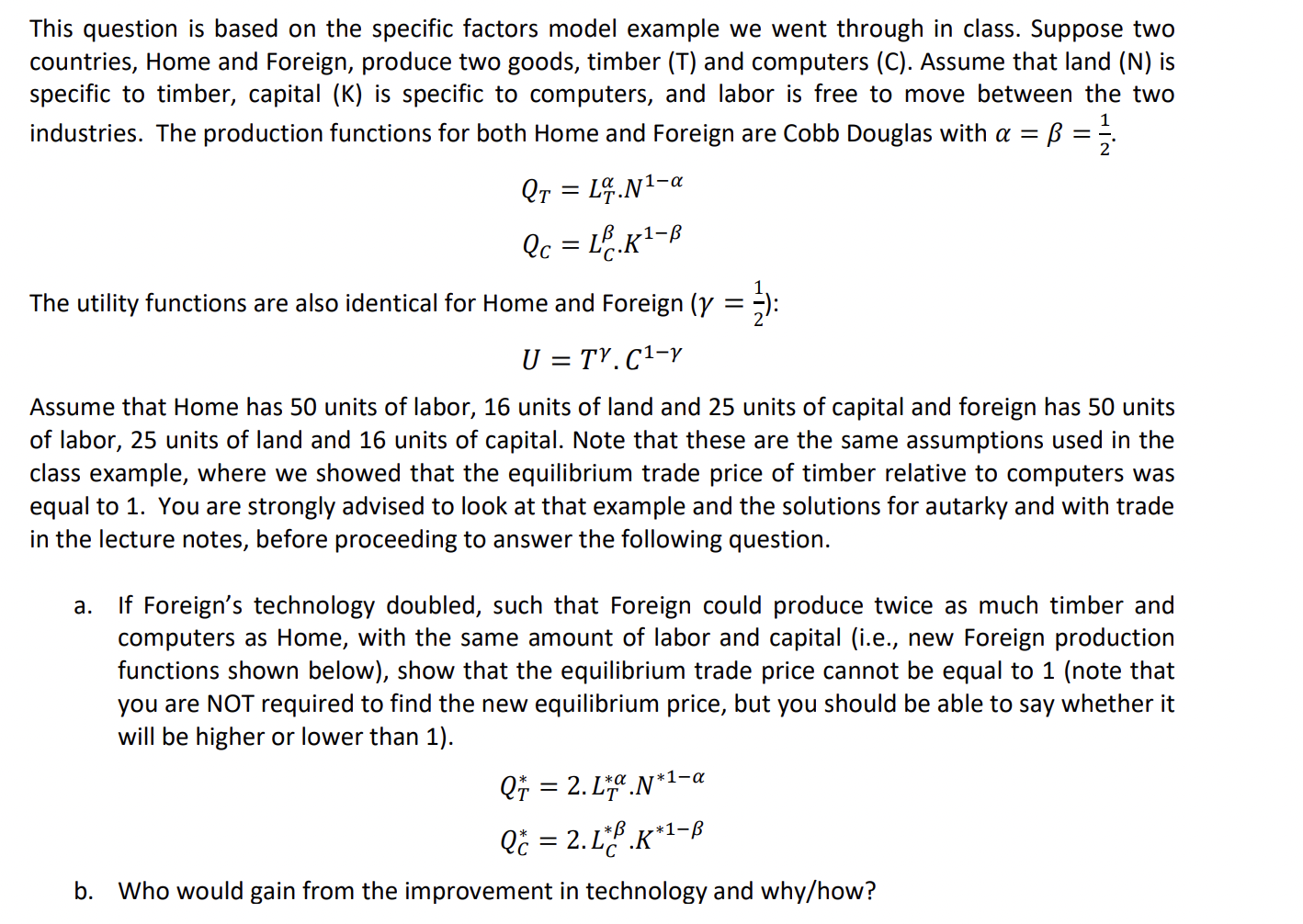
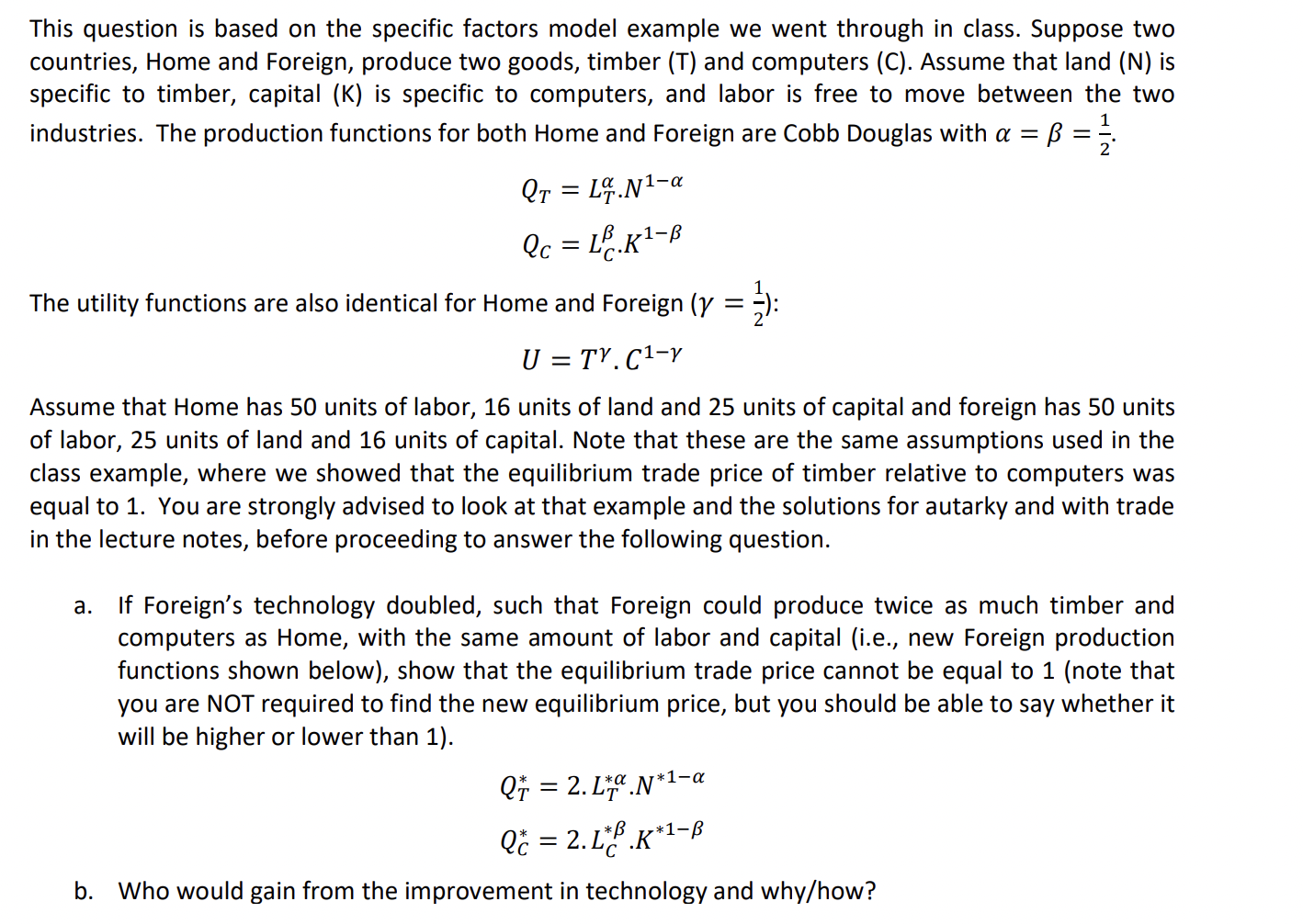
This question is based on the Specific factors model example we went through in class. Suppose two countries, Home and Foreign, produce two goods, timber (T) and computers (C). Assume that land (N) is specific to timber, capital (K) is specific to computers, and labor is free to move between the two industries. The production functions for both Home and Foreign are Cobb Douglas with at = B = g. T = LEE-N1\" QC = L51?\" 1 The utility functions are also identical for Home and Foreign {y = E): U = T7.C1'l' Assume that Home has 50 units of labor, 16 units of land and 25 units of capital and foreign has 50 units of labor, 25 units of land and 16 units of capital. Note that these are the same assumptions used in the class example, where we showed that the equilibrium trade price of timber relative to computers was equal to 1. You are strongly advised to look at that example and the solutions for autarky and with trade in the lecture notes, before proceeding to answer the following question. a. If Foreign's technology doubled, such that Foreign could produce twice as much timber and computers as Home, with the same amount of labor and capital (i.e., new Foreign production functions shown below), show that the equilibrium trade price cannot be equal to 1 (note that you are NOT required to find the new equilibrium price, but you should be able to say whether it will be higher or lower than 1). Q; = 2. L'59".N*1'\" Q; = 2.1.}? 1613 b. Who would gain from the improvement in technology and why/how
Step by Step Solution
There are 3 Steps involved in it

Get step-by-step solutions from verified subject matter experts
 Study Help