







Question: this question is for management principle's required only 700 words Case study 1: McDonald's Ray Kroc, founder of McDonald's, once said, 'I don't know what
this question is for management principle's 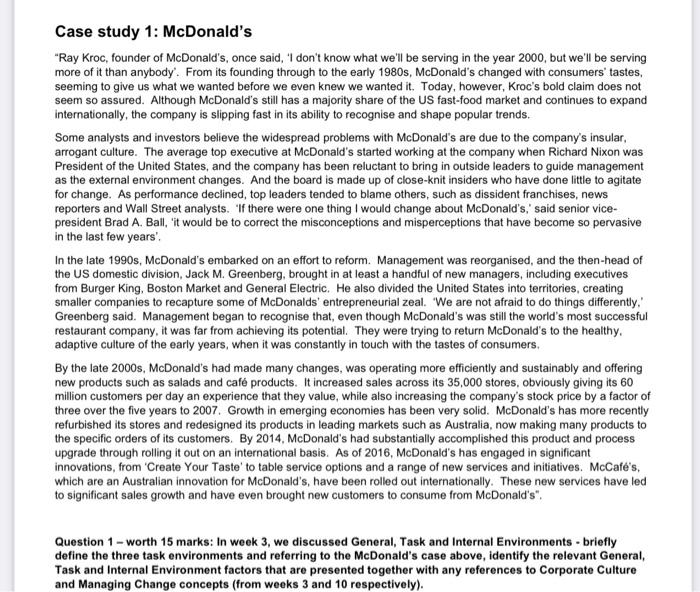
Case study 1: McDonald's "Ray Kroc, founder of McDonald's, once said, 'I don't know what we'll be serving in the year 2000, but we'll be serving more of it than anybody'. From its founding through to the early 1980s, McDonald's changed with consumers' tastes, seeming to give us what we wanted before we even knew we wanted it. Today, however, Kroc's bold claim does not seem so assured. Although McDonald's still has a majority share of the US fast-food market and continues to expand internationally, the company is slipping fast in its ability to recognise and shape popular trends. Some analysts and investors believe the widespread problems with McDonald's are due to the company's insular, arrogant culture. The average top executive at McDonald's started working at the company when Richard Nixon was President of the United States, and the company has been reluctant to bring in outside leaders to guide management as the external environment changes. And the board is made up of close-knit insiders who have done little to agitate for change. As performance declined, top leaders tended to blame others, such as dissident franchises, news reporters and Wall Street analysts. If there were one thing I would change about McDonald's,' said senior vice- president Brad A. Ball, it would be to correct the misconceptions and misperceptions that have become so pervasive in the last few years'. In the late 1990s, McDonald's embarked on an effort to reform. Management was reorganised, and the then-head of the US domestic division, Jack M. Greenberg, brought in at least a handful of new managers, including executives from Burger King, Boston Market and General Electric. He also divided the United States into territories, creating smaller companies to recapture some of McDonalds' entrepreneurial zeal. We are not afraid to do things differently. Greenberg said. Management began to recognise that, even though McDonald's was still the world's most successful restaurant company, it was far from achieving its potential. They were trying to return McDonald's to the healthy. adaptive culture of the early years, when it was constantly in touch with the tastes of consumers. By the late 2000s, McDonald's had made many changes, was operating more efficiently and sustainably and offering new products such as salads and caf products. It increased sales across its 35,000 stores, obviously giving its 60 million customers per day an experience that they value, while also increasing the company's stock price by a factor of three over the five years to 2007. Growth in emerging economies has been very solid. McDonald's has more recently refurbished its stores and redesigned its products in leading markets such as Australia, now making many products to the specific orders of its customers. By 2014, McDonald's had substantially accomplished this product and process upgrade through rolling it out on an international basis. As of 2016, McDonald's has engaged in significant innovations, from 'Create Your Taste' to table service options and a range of new services and initiatives. McCaf's, which are an Australian innovation for McDonald's, have been rolled out internationally. These new services have led to significant sales growth and have even brought new customers to consume from McDonald's". Question 1- worth 15 marks: In week 3, we discussed General, Task and Internal Environments - briefly define the three task environments and referring to the McDonald's case above, identify the relevant General, Task and Internal Environment factors that are presented together with any references to Corporate Culture and Managing Change concepts (from weeks 3 and 10 respectively) required only 700 words
Step by Step Solution
There are 3 Steps involved in it
1 Expert Approved Answer
Step: 1 Unlock

Question Has Been Solved by an Expert!
Get step-by-step solutions from verified subject matter experts
Step: 2 Unlock
Step: 3 Unlock
 Study Help