







Question: This question is from consultancy management course-Book name -Management consultancy by joe o mahoney Please review the case study and summarize the learning. Case-Study Exercise:
This question is from consultancy management course-Book name -Management consultancy by joe o mahoney
Please review the case study and summarize the learning.
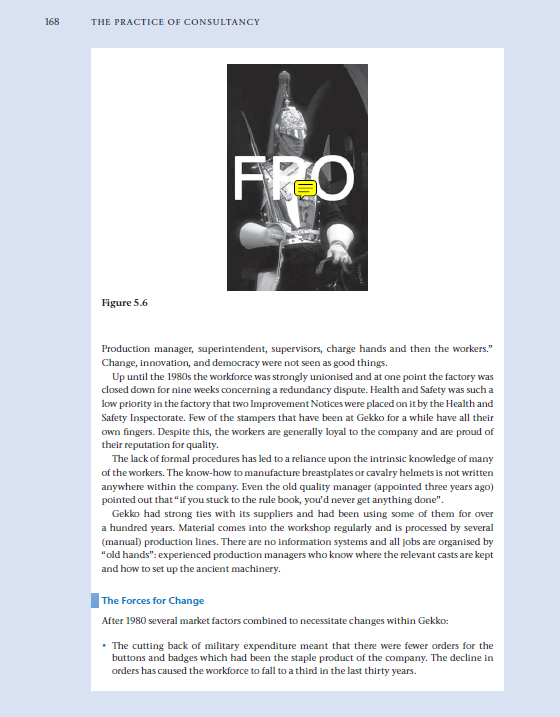
Case-Study Exercise: Gekko Case Study History In 1677, one year after the Great Fire of London, the first mention of Gekko can be evidenced. Thomas Gekko established the company in order to supply the army of Charles II with brass buttons for their uniforms. On the back of British Imperial expansion as well as the First and Second World Wars, Gekko grew. However, after 1950, the inaction and reduction in the British military meant that Gekko's problems began to emerge. Gekko's products are very high quality. The breastplates, for example, which are made for the Queen's Cavalry, can only be made by four people in the United Kingdom, and three of them work at Gekko. On some of the lines it can take up to ten years to learn sufficient skills; on others, a production line produces hand-painted work to customer requirements. The issue of quality is what most of the Gekko employees believe makes them special. The managers maintain that many bulk orders for plastic or printed objects can be done more cheaply elsewhere. Work Practices The importance of tradition in the company has meant that most of the work in the shop has not been modernised for tens, if not hundreds, of years. The factory still operates abu- reaucratic piece-rate, time-motion attitude towards work. We have a strict hierarchy here, one production manager pointed out; "the offices and factory are separate and we have the 168 THE PRACTICE OF CONSULTANCY FRO Figure 5.6 Production manager, superintendent, supervisors, charge hands and then the workers." Change, innovation, and democracy were not seen as good things. Up until the 1980s the workforce was strongly unionised and at one point the factory was closed down for nine weeks concerning a redundancy dispute. Health and Safety was such a low priority in the factory that two Improvement Notices were placed on it by the Health and Safety Inspectorate. Few of the stampers that have been at Gekko for a while have all their own fingers. Despite this, the workers are generally loyal to the company and are proud of their reputation for quality. The lack of formal procedures has led to a reliance upon the intrinsic knowledge of many of the workers. The know-how to manufacture breastplates or cavalry helmets is not written anywhere within the company. Even the old quality manager (appointed three years ago) pointed out that "if you stuck to the rule book, you'd never get anything done". Gekko had strong ties with its suppliers and had been using some of them for over a hundred years. Material comes into the workshop regularly and is processed by several (manual) production lines. There are no information systems and all jobs are organised by "old hands": experienced production managers who know where the relevant casts are kept and how to set up the ancient machinery. The Forces for Change After 1980 several market factors combined to necessitate changes within Gekko: The cutting back of military expenditure meant that there were fewer orders for the buttons and badges which had been the staple product of the company. The decline in orders has caused the workforce to fall to a third in the last thirty years. THE CONSULTING LIFE-CYCLE 169 The movement towards competitive tendering in the MoD meant that Gekko now had to compete with other companies in India and China who were catching up with Gekko quality but at a much lower price. Internally, a number of issues began to develop: Gekko's processes had not modernised. Orders often arrived late and it was virtually impossible to let customers know when their deliveries would arrive. Although training was allocated an increased budget, there was no system to identify training needs, nor the effectiveness of training. Whilst the quality inspector received no training, people were allowed to train on computers who did not use them in the workplace. Administration (there was no marketing department) would create deadlines for production which production could rarely meet. The adherence to quality, of which production was so proud, meant that set-up and turnaround times were very slow and quality control very stringent. . Due to the increase in labour, insurance and material costs overheads were increasing and consequently profits were diminishing, whilst during the 1980s and 1990s the turnover at Gekko remained a constant at around 2 million. The machinery and procedures at Gekko were ancient and the lack of investment in the company worsened the situation-quality was only being produced at a high premium. The decision taken in 1993 by the MoD to deal only with firms who possessed ISO 9000 meant that the company needed to modernise quickly. The ancient production systems within Gekko meant that work was often retracing the same steps and that as a consequence delivery times were rarely met. This state of affairs was known by management as "the Gekko shuffle" and was a constant source of conflict between management and workers. The culture of the company was very traditional and neither workers nor managers liked the idea of change. Workers saw themselves as highly skilled artisans who should not be directed. Distinctions between levels and roles were closely guarded with a long apprentice- ship needed for any newcomers. Asadministration generally dealt with customer complaints, they increasingly became dissatisfied with the performance of production. The bad feeling was made worse by the differentiation between administration and production on working times and pay. Pro- duction would start half an hour earlier than administration on Weekdays, but would leave at 1.30 p.m. on Fridays, which appeared unfair to many of those working in admin- istration, especially when customer complaints came in on a Friday and could not be responded to by production. Conversely, production disliked working on a piece-rate system when most of the administration department were being paid a salary. This was, they maintained, symbolic of the differential esteem bestowed upon offices, as opposed to the shopfloor. What are the main problems at Gekko? What frameworks might you use to analyse their problems? What solutions might you recommend? 170 THE PRACTICE OF CONSULTANCY Tim In 1993, Gekko was bought by a Taiwanese billionaire, who gave the company to his son. Tim, a marketing executive, was determined to modernise Gekko but his impulsive decision-making made him few friends. Tim's aim when he joined the company was to change the culture from what he called a "backwards, traditional and confrontational attitude" to a modern, cohesive, Japanese style of working. Even Tim's critics admired his ability to increase sales. Architecture Tim brought in a more open-plan workplace which enabled customers to come and tour the factory, although many workers objected to this. He also brought in lockers so that workers didn't keep their jackets and food where they were working. However, his style of implementation was not always welcomewhen he saw a jacket in the wrong place, he would lay it out on the floor. He also brought cameras into the workplace which he hoped would encourage workers to work harder, but these were resented by many and often vandalised. New Products Tim began a policy of buying in pens, sweaters, baseball caps, and other goods which could be labelled, and then simply added the Gekko name to them. Thus, a cheap base- ball cap could be imported and a company logo added to it, but because it was "manufac- tured" in Gekko it could be sold on for a much higher price. The immediate effect of this was to cause the traditional workforce to become worried about the security of their own jobs. As they were paid on a piece-rate system, any lessening of their output would mean a lower wage. In 2000, Gekko took over a company called Stratton which produced up-market acces- sories such as cuff-links, handbags, and compacts. The intention was to use this company to cross-sell into other markets. Gekko also outsourced much of its mass production to China. New Technology A consultancy, Systems 21, was brought in to improve efficiency through the introduction of modern manufacturing systems. They introduced was a measurement system by which each shopfloor worker was to measure their work schedule and the time it took. Each job that was completed was to be written down, so that the"progress chaser" knew where it was, and the time it took was to be recorded so that productivity improvements could be quanti- fied. The reactions to the system have not been welcoming: "I can't see how we have changed in the last few months ... it has increased rather than decreased the amount of paperwork," "I can't see the point in me doing graphs" or "it cost 80,000 to teach us how to do our jobs." The introduction of computers was hoped to make the planning, ordering, and accounting easier, but workers were highly resistant to any changes in their work because they distrusted managerial motives. As a result there was little evidence that the system produced improve- ments in communication. THE CONSULTING LIFE-CYCLE 171 By Appointment to Her Majesty The Queen Coat & Uniform Makers Kashket & Partners London Figure 5.7. Policies In an attempt to have a more cohesive attitude between the workforce and managers, he got rid of the managers' canteen in the hope of encouraging the two groups to mix. Whilst this had some effect, it also meant that the managers resented his style and could often be seen joining in the criticisms of his style. However, he did not attempt to change the working hours or the pay structure of the shopfloor. Attitudes Tim attempted to bring in teamworking but the type of work (piece-rate) didn't lend itself to this. Moreover, the suggestion box only ever had one suggestion in it, which was for Tim to leave the company. Contrary to what he was trying to do, the relations between Tim and the rest of the company worsened, with several walk-outs taking place. Redundancies When Tim took over the factory, he assured workers three times that they would not lose their jobs. Two days later, following advice from Systems 21, Tim made fifteen workers redundant. One team leader captured the resulting emotion best: It was very bad actually. Morale was very, very low and it was a complete shock to everybody,there's a lot of bad feeling... The lack of communication not only served to make the shock bigger, but also made the transition period more difficult: none of the supervisors knew anything about it, how it was going to affect their department. It just happened... supervisors seem like they've had their heads cut off. They'd get rid of someone and not discuss people who were doing that per- son's job. People were saying "it's not my job". So there's buttons being made wrong and being scrapped. 172 THE PRACTICE OF CONSULTANCY The bitter reaction from the workforce was much worse because there was a genuine belief that the wrong people had been made redundant. This belief proved well founded when Tim was forced to get some key workers back as consultants. It was in the words of one manager, "a balls up". Regardless, the factory continued to make redundancies over the next few years and by 2005, the number of employees had fallen from 135 to 65. Postscript Despite a 20 per cent reduction in costs, 20 per cent improvement in sales, a new five-year contract with the MoD, and increasing exports, Gekko was hit by the rising cost of exports, the lm cost of modernisation, and, most importantly, a 2 million pension deficit. The law meant that any deficit needed filling before the company could be sold which Gekko did not have the resources to do. Gekko was put into administration and the administrator wound the final pension scheme up and sacked eleven more employees. Once the pension obligations had been offloaded, Gekko was bought by a quality clothing manufacturer, Bingo, who safeguarded the remain- ing sixty-one jobs What would you have done differently from Tim? What difficulties might Systems 21 have faced in working with Tim? How would you have dealt with these difficulties
Step by Step Solution
There are 3 Steps involved in it
1 Expert Approved Answer
Step: 1 Unlock

Question Has Been Solved by an Expert!
Get step-by-step solutions from verified subject matter experts
Step: 2 Unlock
Step: 3 Unlock
 Study Help