







Question: This question is to be solved in the coding language scheme. 2. Familiarize yourself with the following Scheme procedures 1. (string-length abc) produces 3 2.
This question is to be solved in the coding language scheme.
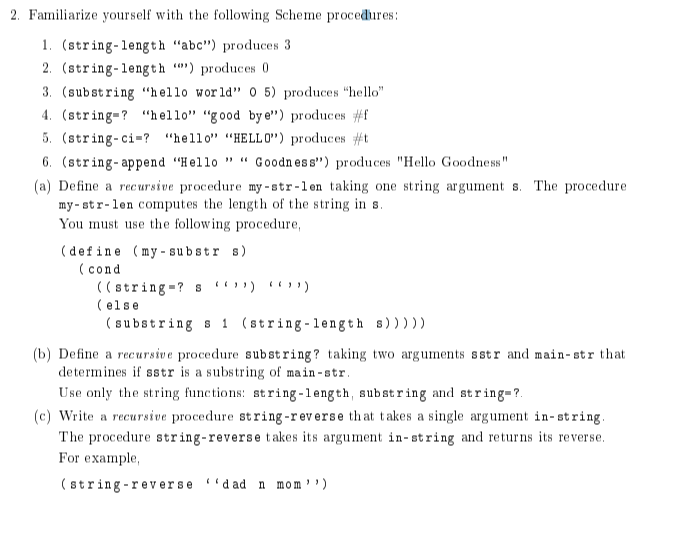
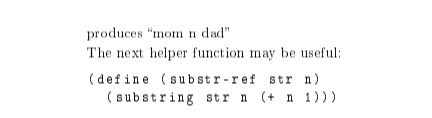
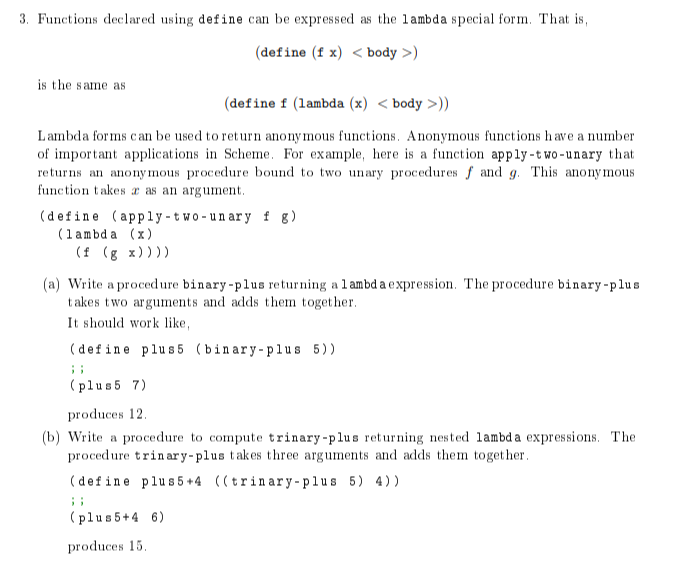
2. Familiarize yourself with the following Scheme procedures 1. (string-length "abc") produces 3 2. (string-length "") produces 0 3. (substring "hello world" 0 5) produces "hello" 4. (string=? "hello" "good bye") produces # 5. (string-ci-? "hello" "HELLO") produces #t 6. (string-append "Hello" " Goodness") produces "Hello Goodness" (a) Define a recursive procedure my-str-len taking one string arguments. The procedure my-str-len computes the length of the string in s. You must use the following procedure, (define (my - substrs) (cond ((string-? 1111 111) (else (substring s 1 (string-length s))))) (b) Define a recursive procedure substring? taking two arguments sstr and main-str that determines if sstr is a substring of main-str. Use only the string functions: string-length substring and string=?. (c) Write a recursive procedure string-reverse that takes a single argument in-string The procedure string-reverse takes its argument in-string and returns its reverse, For example, (string-reverse "dad n mom')) produces "mom n dad" The next helper function may be useful: (define (substr-ref str n) (substring strn (+ n 1))) 3. Functions declared using define can be expressed as the lambda special form. That is, (define (fx) is the same as (define f (lambda (x) )) Lambda forms can be used to return anonymous functions. Anonymous functions have a number of important applications in Scheme. For example, here is a function apply-two-unary that returns an anonymous procedure bound to two unary procedures and g. This anonymous function takes e as an argument. (define (apply-two- un ar y f g) (1 ambda (x) (f (g x)))) (a) Write a procedure binary-plus returning a lambd a expression. The procedure binary-plus takes two arguments and adds them together. It should work like, (define plus5 (binary-plus 5)) (plus57) produces 12. (b) Write a procedure to compute trinary-plus returning nested lambd a expressions. The procedure trinary-plus takes three arguments and adds them together, (define plus 5+4 ((trinary-plus 5) 4)) (plus 5+4 6) produces 15. 2. Familiarize yourself with the following Scheme procedures 1. (string-length "abc") produces 3 2. (string-length "") produces 0 3. (substring "hello world" 0 5) produces "hello" 4. (string=? "hello" "good bye") produces # 5. (string-ci-? "hello" "HELLO") produces #t 6. (string-append "Hello" " Goodness") produces "Hello Goodness" (a) Define a recursive procedure my-str-len taking one string arguments. The procedure my-str-len computes the length of the string in s. You must use the following procedure, (define (my - substrs) (cond ((string-? 1111 111) (else (substring s 1 (string-length s))))) (b) Define a recursive procedure substring? taking two arguments sstr and main-str that determines if sstr is a substring of main-str. Use only the string functions: string-length substring and string=?. (c) Write a recursive procedure string-reverse that takes a single argument in-string The procedure string-reverse takes its argument in-string and returns its reverse, For example, (string-reverse "dad n mom')) produces "mom n dad" The next helper function may be useful: (define (substr-ref str n) (substring strn (+ n 1))) 3. Functions declared using define can be expressed as the lambda special form. That is, (define (fx) is the same as (define f (lambda (x) )) Lambda forms can be used to return anonymous functions. Anonymous functions have a number of important applications in Scheme. For example, here is a function apply-two-unary that returns an anonymous procedure bound to two unary procedures and g. This anonymous function takes e as an argument. (define (apply-two- un ar y f g) (1 ambda (x) (f (g x)))) (a) Write a procedure binary-plus returning a lambd a expression. The procedure binary-plus takes two arguments and adds them together. It should work like, (define plus5 (binary-plus 5)) (plus57) produces 12. (b) Write a procedure to compute trinary-plus returning nested lambd a expressions. The procedure trinary-plus takes three arguments and adds them together, (define plus 5+4 ((trinary-plus 5) 4)) (plus 5+4 6) produces 15
Step by Step Solution
There are 3 Steps involved in it

Get step-by-step solutions from verified subject matter experts
 Study Help