



Question: This question underscores the practical importance of having a Check Standard in a pharmaceutical analysis: You prepared and injected one Aspirin Reference Standard (RS) solution
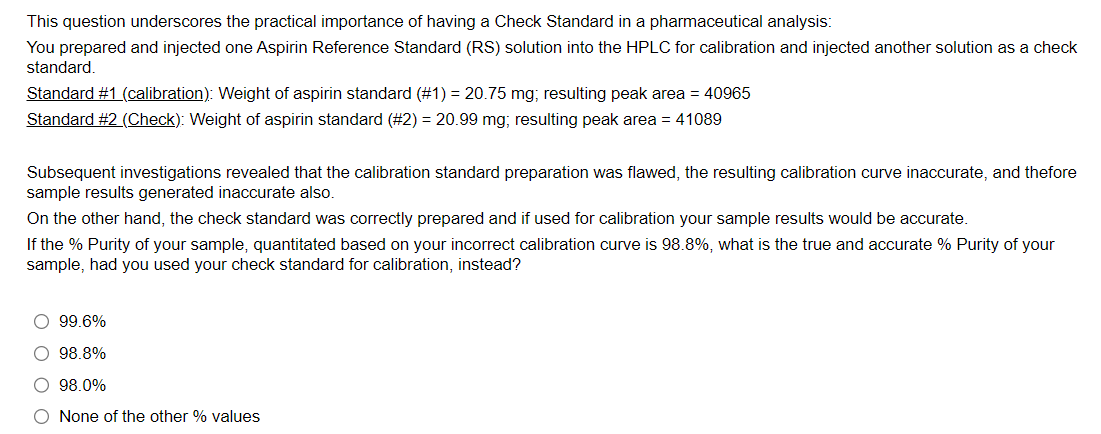
This question underscores the practical importance of having a Check Standard in a pharmaceutical analysis: You prepared and injected one Aspirin Reference Standard (RS) solution into the HPLC for calibration and injected another solution as a check standard. Standard \#1 (calibration): Weight of aspirin standard (#1)=20.75mg; resulting peak area =40965 Standard \#2 ( Check ) : Weight of aspirin standard (#2)=20.99mg; resulting peak area =41089 Subsequent investigations revealed that the calibration standard preparation was flawed, the resulting calibration curve inaccurate, and thefore sample results generated inaccurate also. On the other hand, the check standard was correctly prepared and if used for calibration your sample results would be accurate. If the \% Purity of your sample, quantitated based on your incorrect calibration curve is 98.8%, what is the true and accurate \% Purity of your sample, had you used your check standard for calibration, instead? 99.6%98.8%98.0% None of the other % values
Step by Step Solution
There are 3 Steps involved in it

Get step-by-step solutions from verified subject matter experts