







Question: This question uses a toy problem to test your knowledge of HMM - based ASR. In this question we will consider a small vocabulary ASR
This question uses a toy problem to test your knowledge of HMMbased ASR.
In this question we will consider a small vocabulary ASR task. Here are the
words and their pronunciations.
uh ah
yeah y eh
no ow
Each phone is modelled with a singlestate contextindependent HMM.
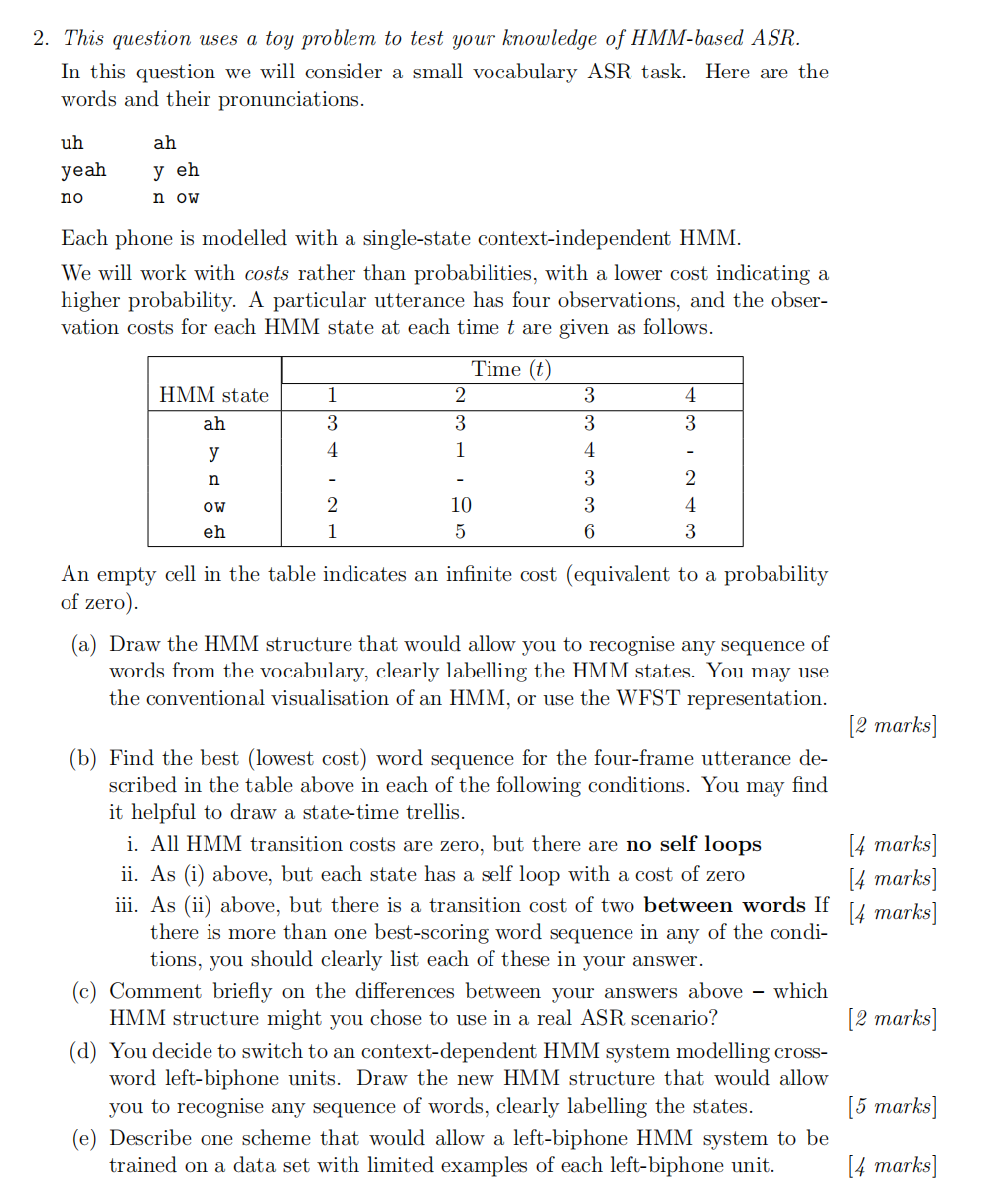
We will work with costs rather than probabilities, with a lower cost indicating a
higher probability. A particular utterance has four observations, and the obser
vation costs for each HMM state at each time are given as follows.
An empty cell in the table indicates an infinite cost equivalent to a probability
of zero
a Draw the HMM structure that would allow you to recognise any sequence of
words from the vocabulary, clearly labelling the HMM states. You may use
the conventional visualisation of an HMM, or use the WFST representation.
b Find the best lowest cost word sequence for the fourframe utterance de
scribed in the table above in each of the following conditions. You may find
it helpful to draw a statetime trellis.
i All HMM transition costs are zero, but there are no self loops
ii As i above, but each state has a self loop with a cost of zero
iii. As ii above, but there is a transition cost of two between words If
there is more than one bestscoring word sequence in any of the condi
tions, you should clearly list each of these in your answer.
c Comment briefly on the differences between your answers above which
HMM structure might you chose to use in a real ASR scenario?
d You decide to switch to an contextdependent HMM system modelling cross
word leftbiphone units. Draw the new HMM structure that would allow
you to recognise any sequence of words, clearly labelling the states.
marks
marks
marks
marks
marks
marks
e Describe one scheme that would allow a leftbiphone HMM system to be
trained on a data set with limited examples of each leftbiphone unit.
marks
Step by Step Solution
There are 3 Steps involved in it
1 Expert Approved Answer
Step: 1 Unlock

Question Has Been Solved by an Expert!
Get step-by-step solutions from verified subject matter experts
Step: 2 Unlock
Step: 3 Unlock
 Study Help