







Question: This question was set for a previous exam. Answer all four of the parts below for this question. 1. [n a diagramI draw a total
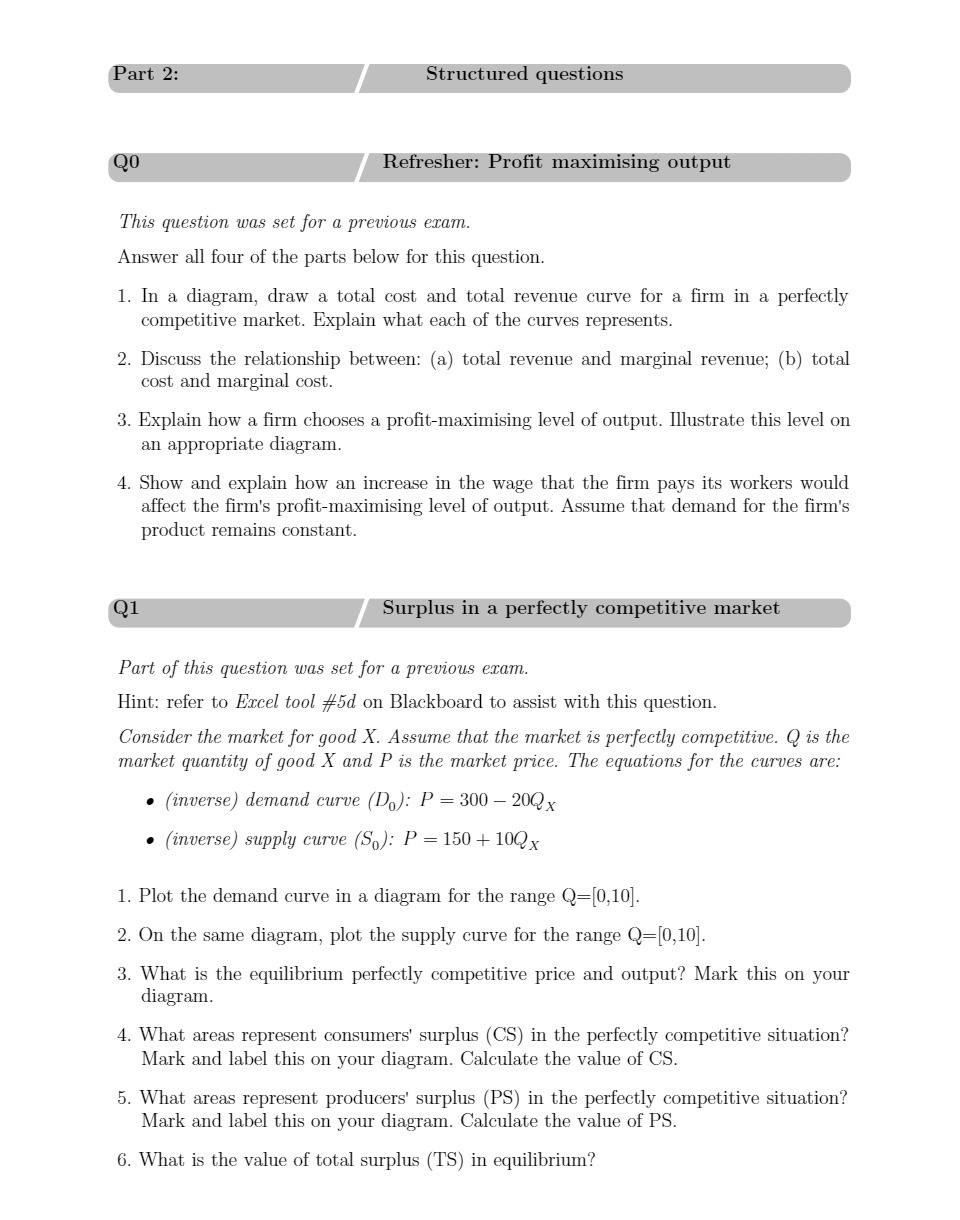
This question was set for a previous exam. Answer all four of the parts below for this question. 1. [n a diagramI draw a total cost and total revenue curve for a rm in a perfectly competitive market. Explain what each of the curves represents. 2. Discuss the relationship between: (a} total revenue and marginal revenue; (b) total cost and marginal cost. 3. Explain how a rm chooses a protmaximising level of output. Dlustrate this level on an appropriate diagram. 4. Show and explain how an increase in the 1:Ivage that the rm pays its workers would affect the rm's protmaximising level of output. Assume that demand for the rm's product remains constant. Part of this question was set for a previous exam. Hint: refer to Ereel tool #Sd on Blackboard to assist with this question. Consider the market for good X. Assume that the market is perfectly competitive. Q is the market quantity of good X and P is the market price. The equations for the curves are: an (inverse) demand curve {DD}: P = 300 QOQX a (inverse) supply curve (So). P = 150 + 1OQX 1. Plot the demand curve in a diagram for the range Q=[O,10]. 2. On the same diagram, plot the supply curve for the range Q=[U,10]. 3. What is the equilibrium perfectly competitive price and output? Mark this on your diagram. 4. What areas represent consumers\" surplus {CS} in the perfectly competitive situation? Mark and label this on your diagram. Calculate the value of CS- 5. What areas represent producers' surplus (PS) in the perfectly competitive situation? Mark and label this on your diagram. Calculate the value of PS. 5. What is the value of total surplus (TS) in equilibrium
Step by Step Solution
There are 3 Steps involved in it

Get step-by-step solutions from verified subject matter experts
 Study Help