Question: this report is written about why Target Canada failed and what is the caused of failure Can you please read the report from the pictures
this report is written about why Target Canada failed and what is the caused of failure
Can you please read the report from the pictures and tell me what is the poor elements of this report?
if we want to rely on these report as a manager we caused the failure of business , My goal in bringing out managerial Poor Elements
This report is written about the TARGET CANADA, but it has poor elements on that and if we rely on it, we will fail again. Please help me identify these points.
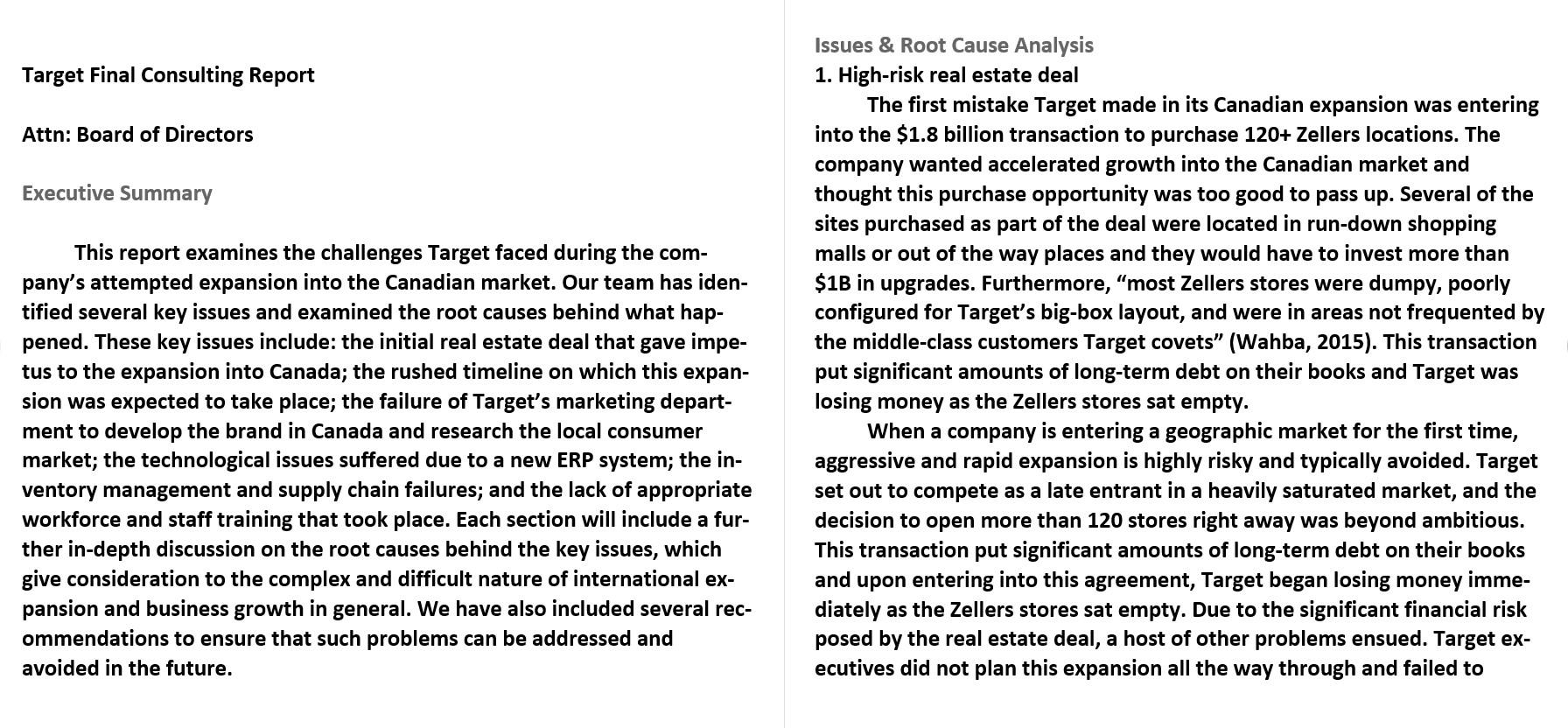

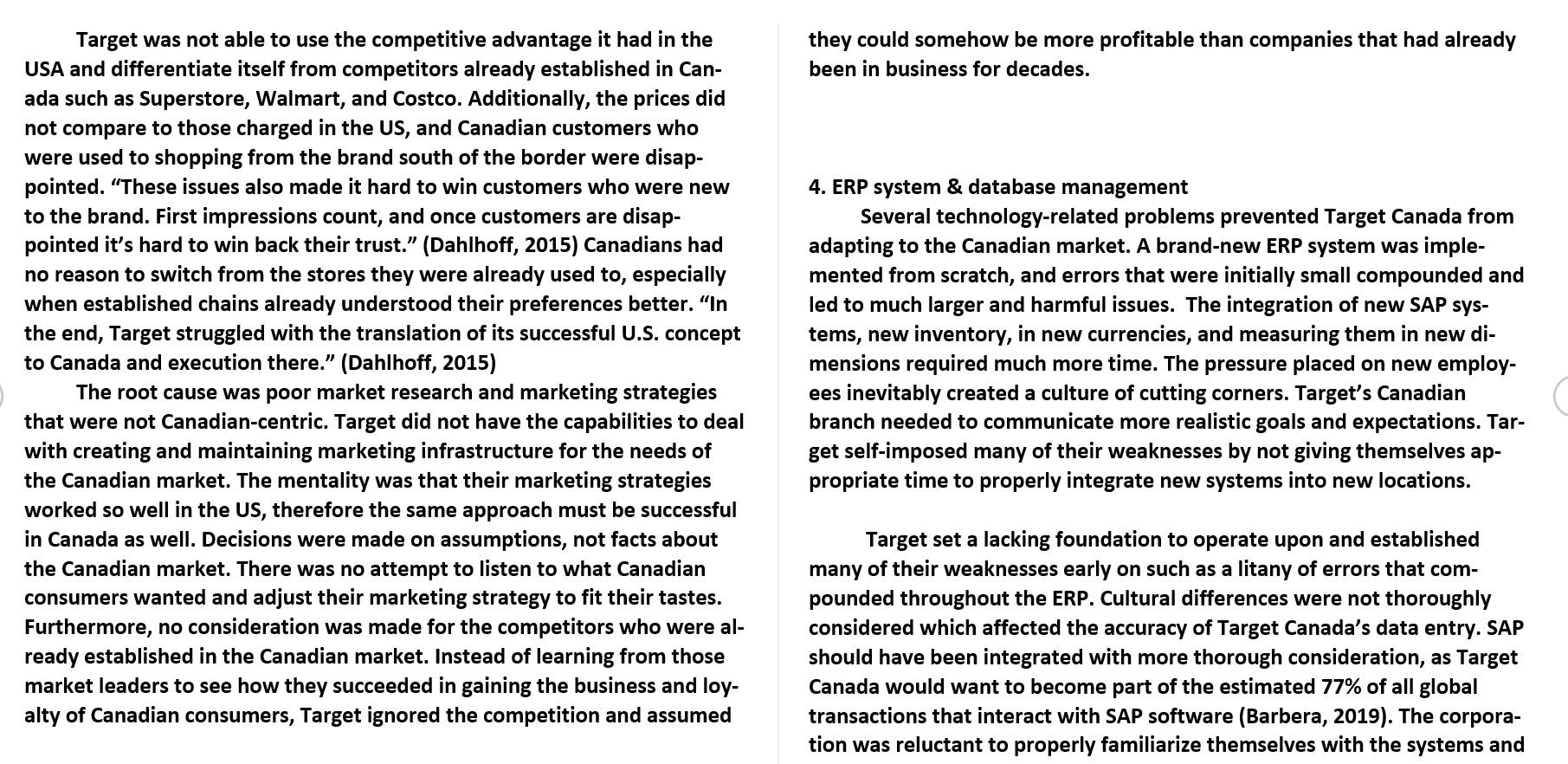
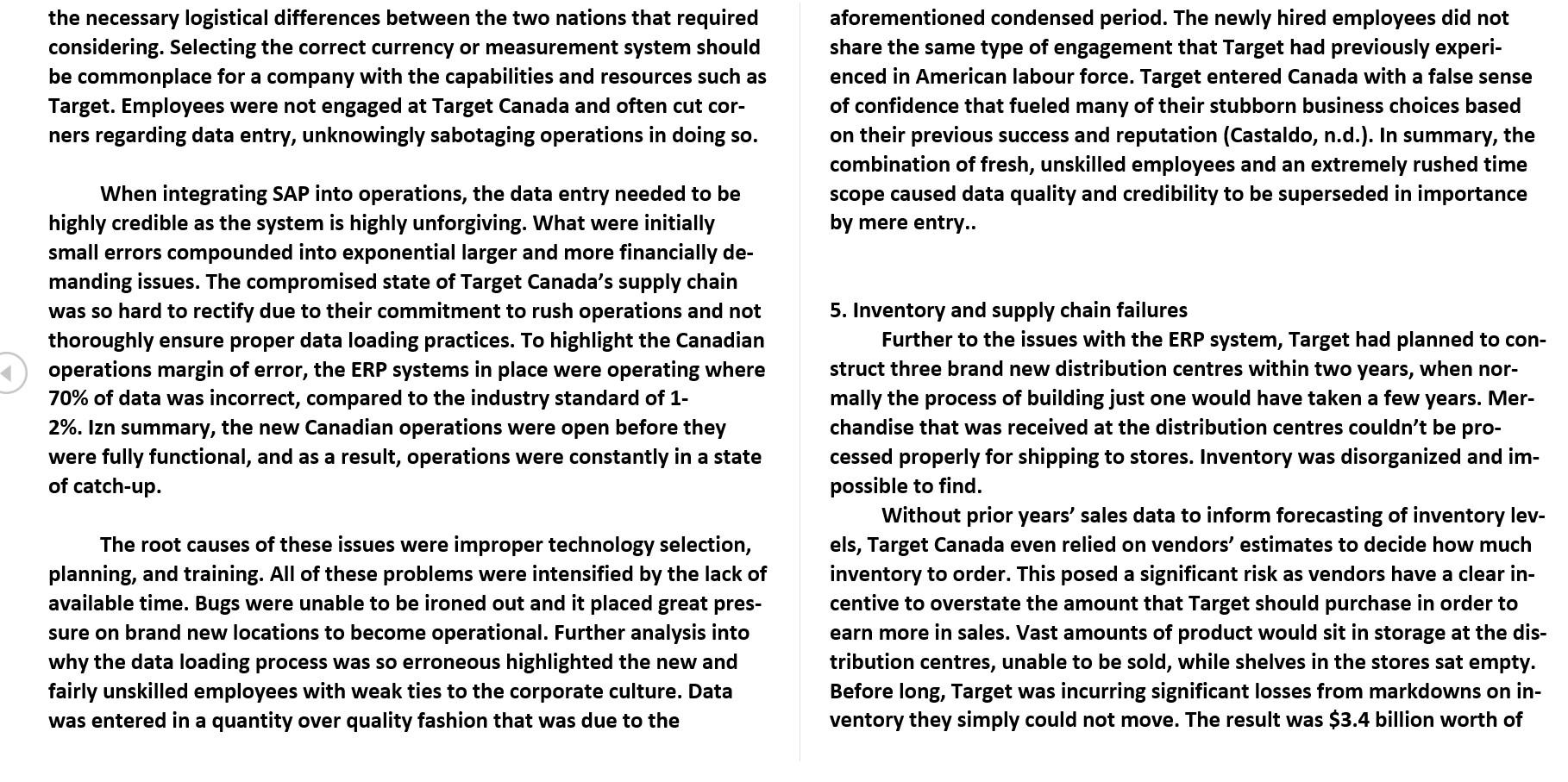
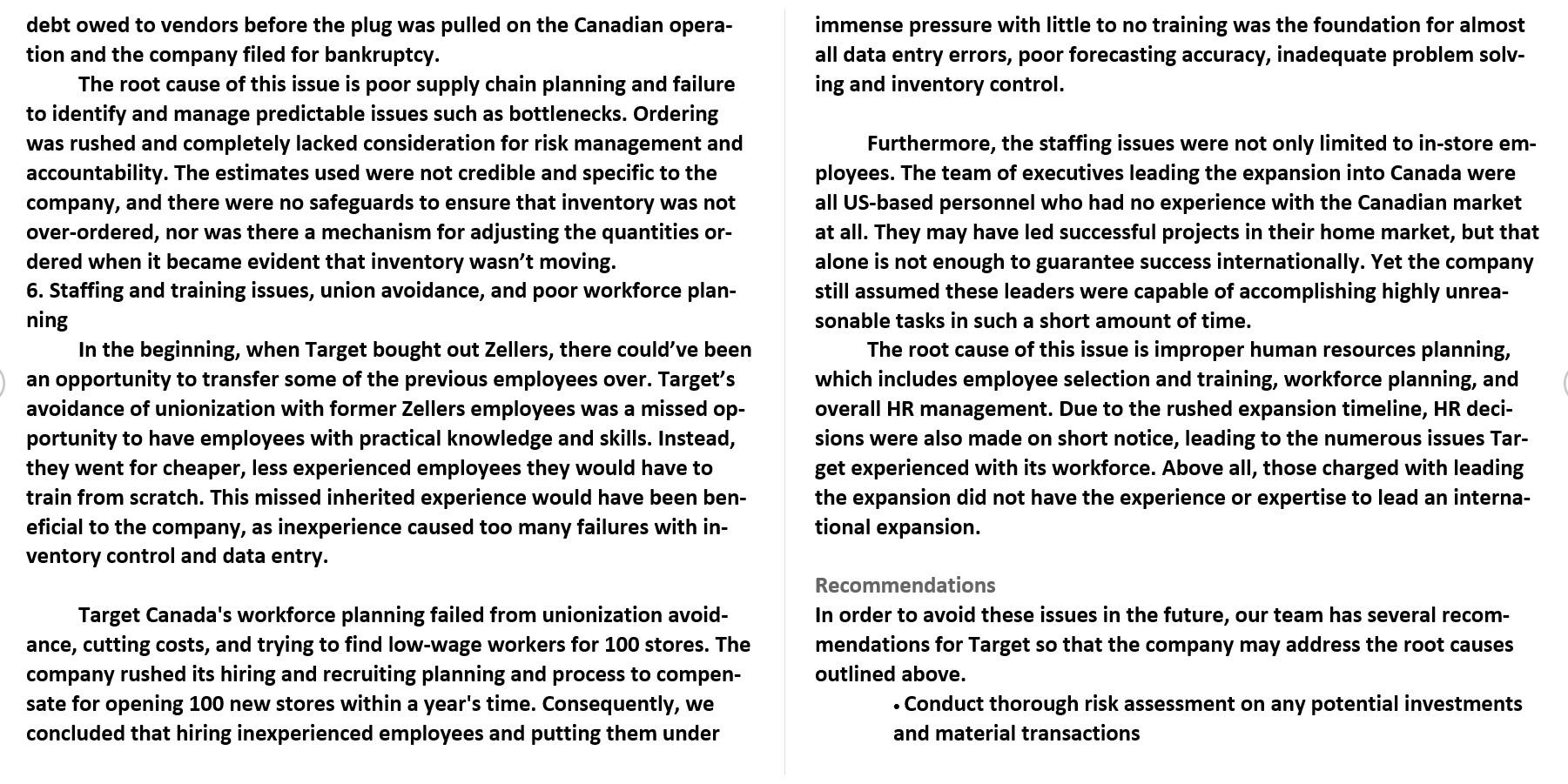
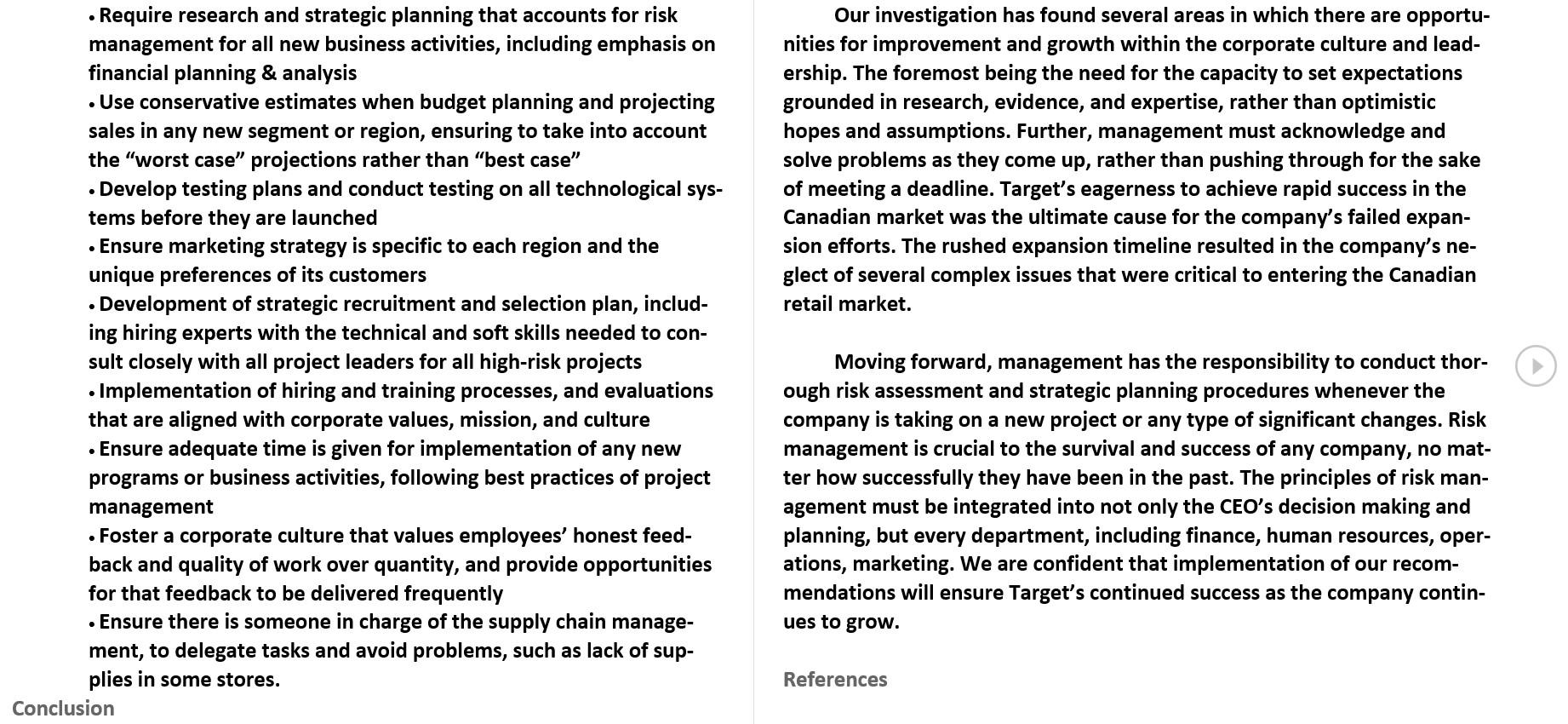
Target Final Consulting Report Attn: Board of Directors Executive Summary This report examines the challenges Target faced during the com- pany's attempted expansion into the Canadian market. Our team has iden- tified several key issues and examined the root causes behind what hap- pened. These key issues include: the initial real estate deal that gave impe- tus to the expansion into Canada; the rushed timeline on which this expan- sion was expected to take place; the failure of Target's marketing depart- ment to develop the brand in Canada and research the local consumer market; the technological issues suffered due to a new ERP system; the in- ventory management and supply chain failures; and the lack of appropriate workforce and staff training that took place. Each section will include a fur- ther in-depth discussion on the root causes behind the key issues, which give consideration to the complex and difficult nature of international ex- pansion and business growth in general. We have also included several rec- ommendations to ensure that such problems can be addressed and avoided in the future. Issues & Root Cause Analysis 1. High-risk real estate deal The first mistake Target made in its Canadian expansion was entering into the $1.8 billion transaction to purchase 120+ Zellers locations. The company wanted accelerated growth into the Canadian market and thought this purchase opportunity was too good to pass up. Several of the sites purchased as part of the deal were located in run-down shopping malls or out of the way places and they would have to invest more than $1B in upgrades. Furthermore, "most Zellers stores were dumpy, poorly configured for Target's big-box layout, and were in areas not frequented by the middle-class customers Target covets (Wahba, 2015). This transaction put significant amounts of long-term debt on their books and Target was losing money as the Zellers stores sat empty. When a company is entering a geographic market for the first time, aggressive and rapid expansion is highly risky and typically avoided. Target set out to compete as a late entrant in a heavily saturated market, and the decision to open more than 120 stores right away was beyond ambitious. This transaction put significant amounts of long-term debt on their books and upon entering into this agreement, Target began losing money imme- diately as the Zellers stores sat empty. Due to the significant financial risk posed by the real estate deal, a host of other problems ensued. Target ex- ecutives did not plan this expansion all the way through and failed to Despite continuous challenges faced in all areas of the business, the executives leading the Canadian expansion still maintained that it was pos- sible to generate revenues quickly by opening over 100 locations in the first year. Furthermore, due to a corporate culture that was steeped in un- realistic optimism, employees didn't feel comfortable speaking up, even though they knew the rushed expansion would result in a failed launch of the first Canadian stores. 3. Brand perception & replication of US marketing strategies perform a feasibility plan, in which they would see that buying Zellers' lo- cations could harm the company strategy. The root causes of these issues were inadequate risk assessment, poor strategic planning, and lack of risk management measures. The com- pany wanted to grow in the Canadian market as quickly as possible and consequently, rapid expansion was prioritized above everything else. As we know, Walmart was also considering the same deal at one point, yet the company backed out of the deal. Although this should have been a red flag for Target's CEO as well, it was unfortunately overlooked. This lack of scrutiny led management to continually downplay the risks that came with such a deal and furthermore, the leaders neglected to take appropriate steps to mitigate such risks, such as taking the time to develop thorough and feasible plans. 2. Rushed expansion timeline This high-risk transaction also set in motion a timeline for expansion into Canada that was entirely unfeasible. Target's strategy to expand its business internationally was overly aggressive for such a short period of time. Global expansion is not simple, and Target underestimated the diffi- culty of this plan, especially in such a short term, the rushed expansion was one of the main issues that caused the company to fail. Where normally a company would take the time to conduct thorough testing of its systems and develop plans for adapting to change in this new market, Target Can- ada's employees had to cut corners anywhere they possibly could so that they could keep up with this unrealistic timeline. Target did not account for how the Canadian market has clear differ- ences from the US market. The proper due diligence looking into the needs and wants of the Canadian individual was not done and led to a poor un- derstanding of the market. Clear markers such as value for money expecta- tions should have been completed to tailor the experience to consumer needs and the traits of the Canadian market. A perfect illustration is quoted as "Target's brand (for Canadians) at its height was based on the whole cache of the women's getaway of piling into the car with friends and seeing what you can get for your $20" (Kolm, Chapman, 2015). This type of brand perception should've been altered before entering the Canadian market. Target Canada should have focused more on building a strong brand perception. This is important as launching a new retailer in an al- ready competitive and saturated market needs to be done slowly and me- thodically. they could somehow be more profitable than companies that had already been in business for decades. Target was not able to use the competitive advantage it had in the USA and differentiate itself from competitors already established in Can- ada such as Superstore, Walmart, and Costco. Additionally, the prices did not compare to those charged in the US, and Canadian customers who were used to shopping from the brand south of the border were disap- pointed. These issues also made it hard to win customers who were new to the brand. First impressions count, and once customers are disap- pointed it's hard to win back their trust." (Dahlhoff, 2015) Canadians had no reason to switch from the stores they were already used to, especially when established chains already understood their preferences better. "In the end, Target struggled with the translation of its successful U.S. concept to Canada and execution there." (Dahlhoff, 2015) The root cause was poor market research and marketing strategies that were not Canadian-centric. Target did not have the capabilities to deal with creating and maintaining marketing infrastructure for the needs of the Canadian market. The mentality was that their marketing strategies worked so well in the US, therefore the same approach must be successful in Canada as well. Decisions were made on assumptions, not facts about the Canadian market. There was no attempt to listen to what Canadian consumers wanted and adjust their marketing strategy to fit their tastes. Furthermore, no consideration was made for the competitors who were al- ready established in the Canadian market. Instead of learning from those market leaders to see how they succeeded in gaining the business and loy- alty of Canadian consumers, Target ignored the competition and assumed 4. ERP system & database management Several technology-related problems prevented Target Canada from adapting to the Canadian market. A brand-new ERP system was imple- mented from scratch, and errors that were initially small compounded and led to much larger and harmful issues. The integration of new SAP sys- tems, new inventory, in new currencies, and measuring them in new di- mensions required much more time. The pressure placed on new employ- ees inevitably created a culture of cutting corners. Target's Canadian branch needed to communicate more realistic goals and expectations. Tar- get self-imposed many of their weaknesses by not giving themselves ap- propriate time to properly integrate new systems into new locations. Target set a lacking foundation to operate upon and established many of their weaknesses early on such as a litany of errors that com- pounded throughout the ERP. Cultural differences were not thoroughly considered which affected the accuracy of Target Canada's data entry. SAP should have been integrated with more thorough consideration, as Target Canada would want to become part of the estimated 77% of all global transactions that interact with SAP software (Barbera, 2019). The corpora- tion was reluctant to properly familiarize themselves with the systems and the necessary logistical differences between the two nations that required considering. Selecting the correct currency or measurement system should be commonplace for a company with the capabilities and resources such as Target. Employees were not engaged at Target Canada and often cut cor- ners regarding data entry, unknowingly sabotaging operations in doing so. aforementioned condensed period. The newly hired employees did not share the same type of engagement that Target had previously experi- enced in American labour force. Target entered Canada with a false sense of confidence that fueled many of their stubborn business choices based on their previous success and reputation (Castaldo, n.d.). In summary, the combination of fresh, unskilled employees and an extremely rushed time scope caused data quality and credibility to be superseded in importance by mere entry.. When integrating SAP into operations, the data entry needed to be highly credible as the system is highly unforgiving. What were initially small errors compounded into exponential larger and more financially de- manding issues. The compromised state of Target Canada's supply chain was so hard to rectify due to their commitment to rush operations and not thoroughly ensure proper data loading practices. To highlight the Canadian operations margin of error, the ERP systems in place were operating where 70% of data was incorrect, compared to the industry standard of 1- 2%. Izn summary, the new Canadian operations were open before they were fully functional, and as a result, operations were constantly in a state of catch-up. 5. Inventory and supply chain failures Further to the issues with the ERP system, Target had planned to con- struct three brand new distribution centres within two years, when nor- mally the process of building just one would have taken a few years. Mer- chandise that was received at the distribution centres couldn't be pro- cessed properly for shipping to stores. Inventory was disorganized and im- possible to find. Without prior years' sales data to inform forecasting of inventory lev- els, Target Canada even relied on vendors' estimates to decide how much inventory to order. This posed a significant risk as vendors have a clear in- centive to overstate the amount that Target should purchase in order to earn more in sales. Vast amounts of product would sit in storage at the dis- tribution centres, unable to be sold, while shelves in the stores sat empty. Before long, Target was incurring significant losses from markdowns on in- ventory they simply could not move. The result was $3.4 billion worth of The root causes of these issues were improper technology selection, planning, and training. All of these problems were intensified by the lack of available time. Bugs were unable to be ironed out and it placed great pres- sure on brand new locations to become operational. Further analysis into why the data loading process was so erroneous highlighted the new and fairly unskilled employees with weak ties to the corporate culture. Data was entered in a quantity over quality fashion that was due to the immense pressure with little to no training was the foundation for almost all data entry errors, poor forecasting accuracy, inadequate problem solv- ing and inventory control. debt owed to vendors before the plug was pulled on the Canadian opera- tion and the company filed for bankruptcy. The root cause of this issue is poor supply chain planning and failure to identify and manage predictable issues such as bottlenecks. Ordering was rushed and completely lacked consideration for risk management and accountability. The estimates used were not credible and specific to the company, and there were no safeguards to ensure that inventory was not over-ordered, nor was there a mechanism for adjusting the quantities or- dered when it became evident that inventory wasn't moving. 6. Staffing and training issues, union avoidance, and poor workforce plan- ning In the beginning, when Target bought out Zellers, there could've been an opportunity to transfer some of the previous employees over. Target's avoidance of unionization with former Zellers employees was a missed op- portunity to have employees with practical knowledge and skills. Instead, they went for cheaper, less experienced employees they would have to train from scratch. This missed inherited experience would have been ben- eficial to the company, as inexperience caused too many failures with in- ventory control and data entry. Furthermore, the staffing issues were not only limited to in-store em- ployees. The team of executives leading the expansion into Canada were all US-based personnel who had no experience with the Canadian market at all. They may have led successful projects in their home market, but that alone is not enough to guarantee success internationally. Yet the company still assumed these leaders were capable of accomplishing highly unrea- sonable tasks in such a short amount of time. The root cause of this issue is improper human resources planning, which includes employee selection and training, workforce planning, and overall HR management. Due to the rushed expansion timeline, HR deci- sions were also made on short notice, leading to the numerous issues Tar- get experienced with its workforce. Above all, those charged with leading the expansion did not have the experience or expertise to lead an interna- tional expansion. Target Canada's workforce planning failed from unionization avoid- ance, cutting costs, and trying to find low-wage workers for 100 stores. The company rushed its hiring and recruiting planning and process to compen- sate for opening 100 new stores within a year's time. Consequently, we concluded that hiring inexperienced employees and putting them under Recommendations In order to avoid these issues in the future, our team has several recom- mendations for Target so that the company may address the root causes outlined above. . Conduct thorough risk assessment on any potential investments and material transactions Our investigation has found several areas in which there are opportu- nities for improvement and growth within the corporate culture and lead- ership. The foremost being the need for the capacity to set expectations grounded in research, evidence, and expertise, rather than optimistic hopes and assumptions. Further, management must acknowledge and solve problems as they come up, rather than pushing through for the sake of meeting a deadline. Target's eagerness to achieve rapid success in the Canadian market was the ultimate cause for the company's failed expan- sion efforts. The rushed expansion timeline resulted in the company's ne- glect of several complex issues that were critical to entering the Canadian retail market. Require research and strategic planning that accounts for risk management for all new business activities, including emphasis on financial planning & analysis . Use conservative estimates when budget planning and projecting sales in any new segment or region, ensuring to take into account the "worst case" projections rather than "best case" Develop testing plans and conduct testing on all technological sys- tems before they are launched Ensure marketing strategy is specific to each region and the unique preferences of its customers Development of strategic recruitment and selection plan, includ- ing hiring experts with the technical and soft skills needed to con- sult closely with all project leaders for all high-risk projects Implementation of hiring and training processes, and evaluations that are aligned with corporate values, mission, and culture Ensure adequate time is given for implementation of any new programs or business activities, following best practices of project management . Foster a corporate culture that values employees' honest feed- back and quality of work over quantity, and provide opportunities for that feedback to be delivered frequently . Ensure there is someone in charge of the supply chain manage- ment, to delegate tasks and avoid problems, such as lack of sup- plies in some stores. Conclusion Moving forward, management has the responsibility to conduct thor- ough risk assessment and strategic planning procedures whenever the company is taking on a new project or any type of significant changes. Risk management is crucial to the survival and success of any company, no mat- ter how successfully they have been in the past. The principles of risk man- agement must be integrated into not only the CEO's decision making and planning, but every department, including finance, human resources, oper- ations, marketing. We are confident that implementation of our recom- mendations will ensure Target's continued success as the company contin- ues to grow. References









 Study Help