







Question: This section is similar to your practice exam ( as any good test should be ) . In the early 2 0 th century, the
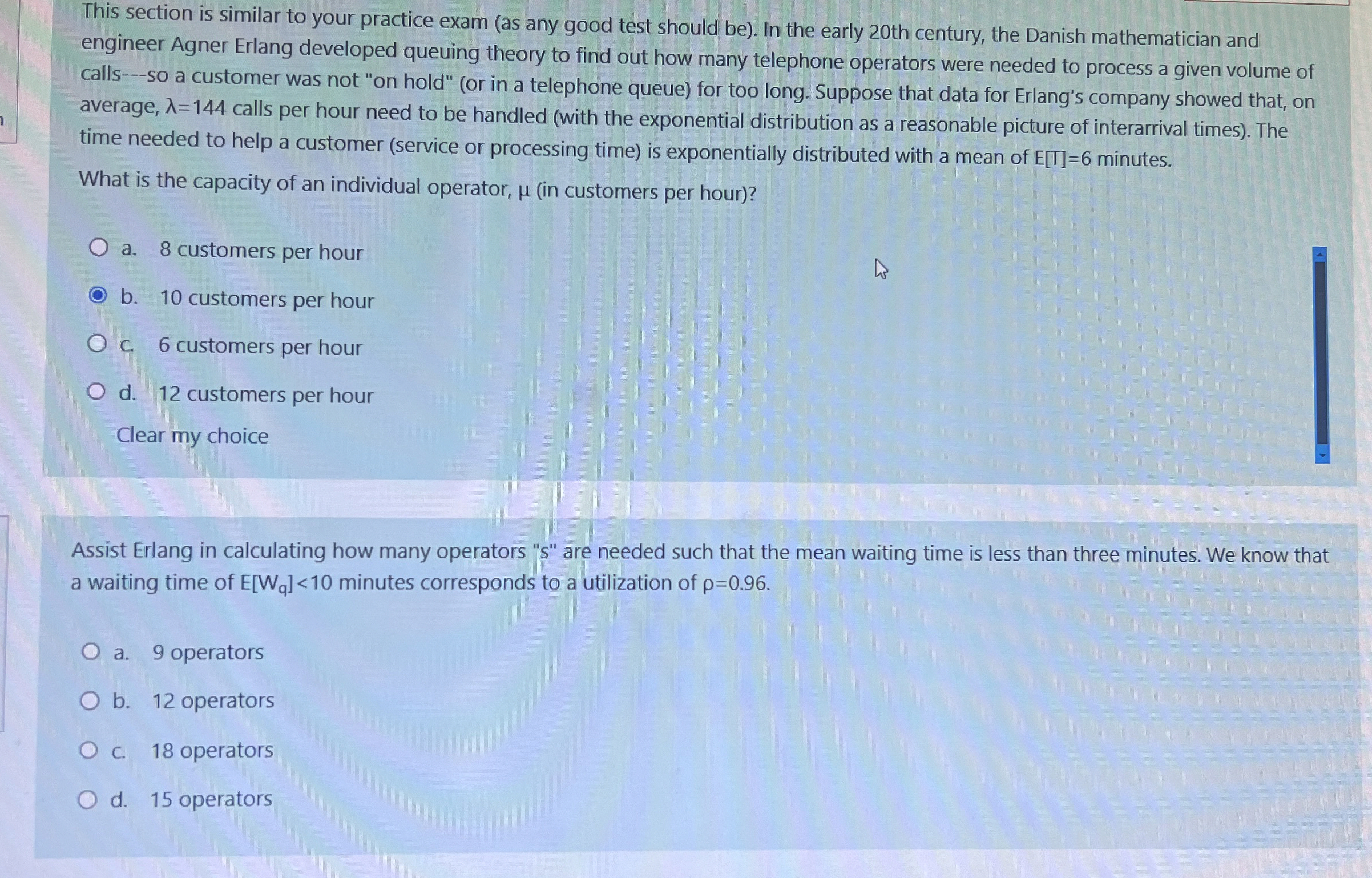
This section is similar to your practice exam as any good test should be In the early th century, the Danish mathematician and engineer Agner Erlang developed queuing theory to find out how many telephone operators were needed to process a given volume of callsso a customer was not on hold" or in a telephone queue for too long. Suppose that data for Erlang's company showed that, on average, calls per hour need to be handled with the exponential distribution as a reasonable picture of interarrival times The time needed to help a customer service or processing time is exponentially distributed with a mean of ET minutes.
What is the capacity of an individual operator, in customers per hour
a customers per hour
b customers per hour
c customers per hour
d customers per hour
Clear my choice
Assist Erlang in calculating how many operators s are needed such that the mean waiting time is less than three minutes. We know that a waiting time of minutes corresponds to a utilization of
a operators
b operators
C operators
d operators
Step by Step Solution
There are 3 Steps involved in it
1 Expert Approved Answer
Step: 1 Unlock

Question Has Been Solved by an Expert!
Get step-by-step solutions from verified subject matter experts
Step: 2 Unlock
Step: 3 Unlock
 Study Help