







Question: This shows how different gasses react to different forms of light. The flashlight on the left can be set to emit either visible light photons
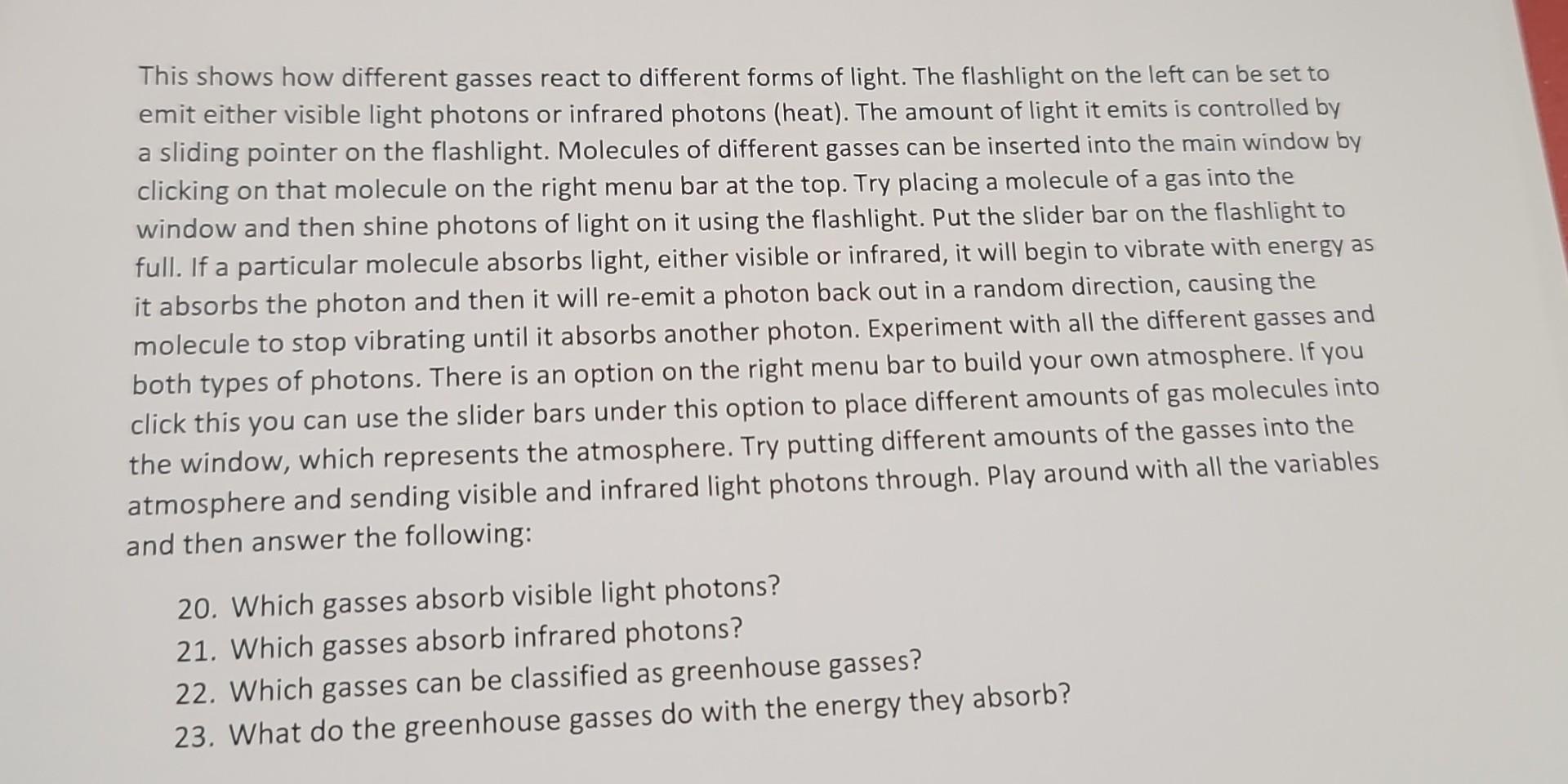
This shows how different gasses react to different forms of light. The flashlight on the left can be set to emit either visible light photons or infrared photons (heat). The amount of light it emits is controlled by a sliding pointer on the flashlight. Molecules of different gasses can be inserted into the main window by clicking on that molecule on the right menu bar at the top. Try placing a molecule of a gas into the window and then shine photons of light on it using the flashlight. Put the slider bar on the flashlight to full. If a particular molecule absorbs light, either visible or infrared, it will begin to vibrate with energy as it absorbs the photon and then it will re-emit a photon back out in a random direction, causing the molecule to stop vibrating until it absorbs another photon. Experiment with all the different gasses and both types of photons. There is an option on the right menu bar to build your own atmosphere. If you click this you can use the slider bars under this option to place different amounts of gas molecules into the window, which represents the atmosphere. Try putting different amounts of the gasses into the atmosphere and sending visible and infrared light photons through. Play around with all the variables and then answer the following: 20. Which gasses absorb visible light photons? 21. Which gasses absorb infrared photons? 22. Which gasses can be classified as greenhouse gasses? 23. What do the greenhouse gasses do with the energy they absorb
Step by Step Solution
There are 3 Steps involved in it

Get step-by-step solutions from verified subject matter experts
 Study Help