



Question: this the seconed part If d = 1, then cambr = 1 since p(x) is a monic polynomial. Hence, either c = 1 or c
this the seconed part
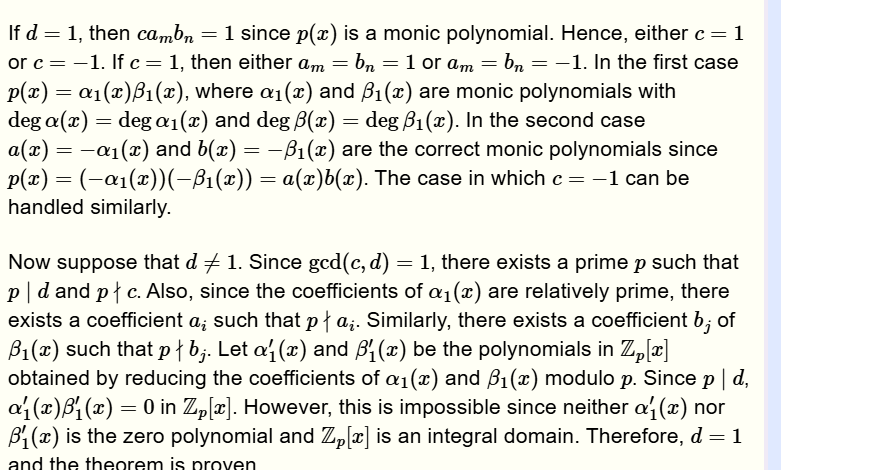 If d = 1, then cambr = 1 since p(x) is a monic polynomial. Hence, either c = 1 or c = -1. If c = 1, then either am = bn = 1 or am = bn = -1. In the first case p(x) = a1(x) B1(x), where a1(x) and B1(x) are monic polynomials with dega(x) = dega1(x) and deg B(x) = deg B1(x). In the second case a(x) = -a1(x) and b(x) = -B1(x) are the correct monic polynomials since p(x) = (-a1(z))(-BI(a)) = a(x)b(x). The case in which c = -1 can be handled similarly. Now suppose that d * 1. Since god(c, d) = 1, there exists a prime p such that p | d and p ) c. Also, since the coefficients of a (@) are relatively prime, there exists a coefficient a; such that p | a;. Similarly, there exists a coefficient b; of B1(x) such that p | bj. Let a; (x) and B'; (x) be the polynomials in Zip [a] obtained by reducing the coefficients of a1 (x) and B1() modulo p. Since p | d, a' (x) B, (x) = 0 in Zp[x]. However, this is impossible since neither a, (a) nor Bi (a) is the zero polynomial and Zo is an integral domain. Therefore, d = 1 and the theorem is proven
Step by Step Solution
There are 3 Steps involved in it
1 Expert Approved Answer
Step: 1 Unlock

Question Has Been Solved by an Expert!
Get step-by-step solutions from verified subject matter experts
Step: 2 Unlock
Step: 3 Unlock