Question: This time, you have been asked to present on survivability and crashworthiness to an audience of newcomers to the industry. You will research and examine
This time, you have been asked to present on survivability and crashworthiness to an audience of newcomers to the industry. You will research and examine an aircraft accident of your choice through the lenses of survivability and crashworthiness.
To begin, choose an aircraft accident from one of the accident databases provided (Do not choose an accident you have already used in this course.)
You were presented with several models used to analyze causal factors in aircraft accidents.
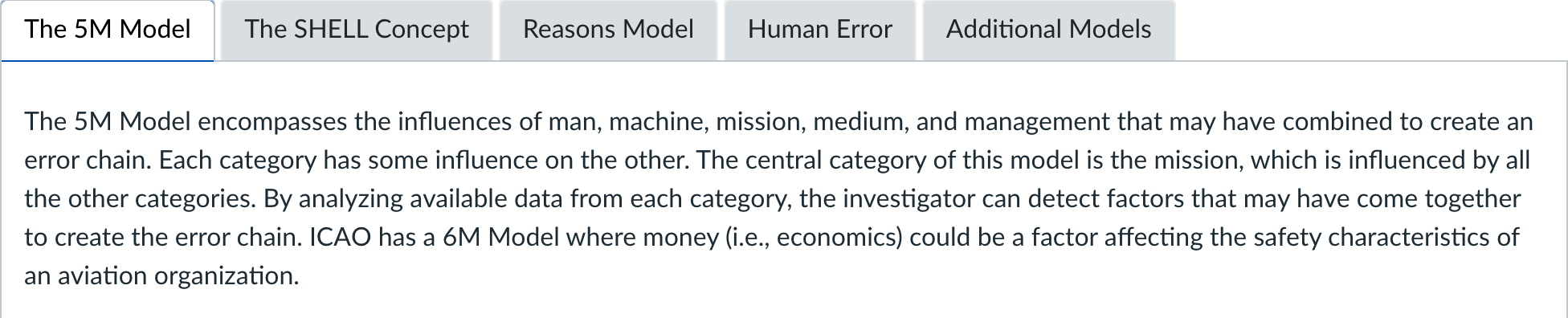
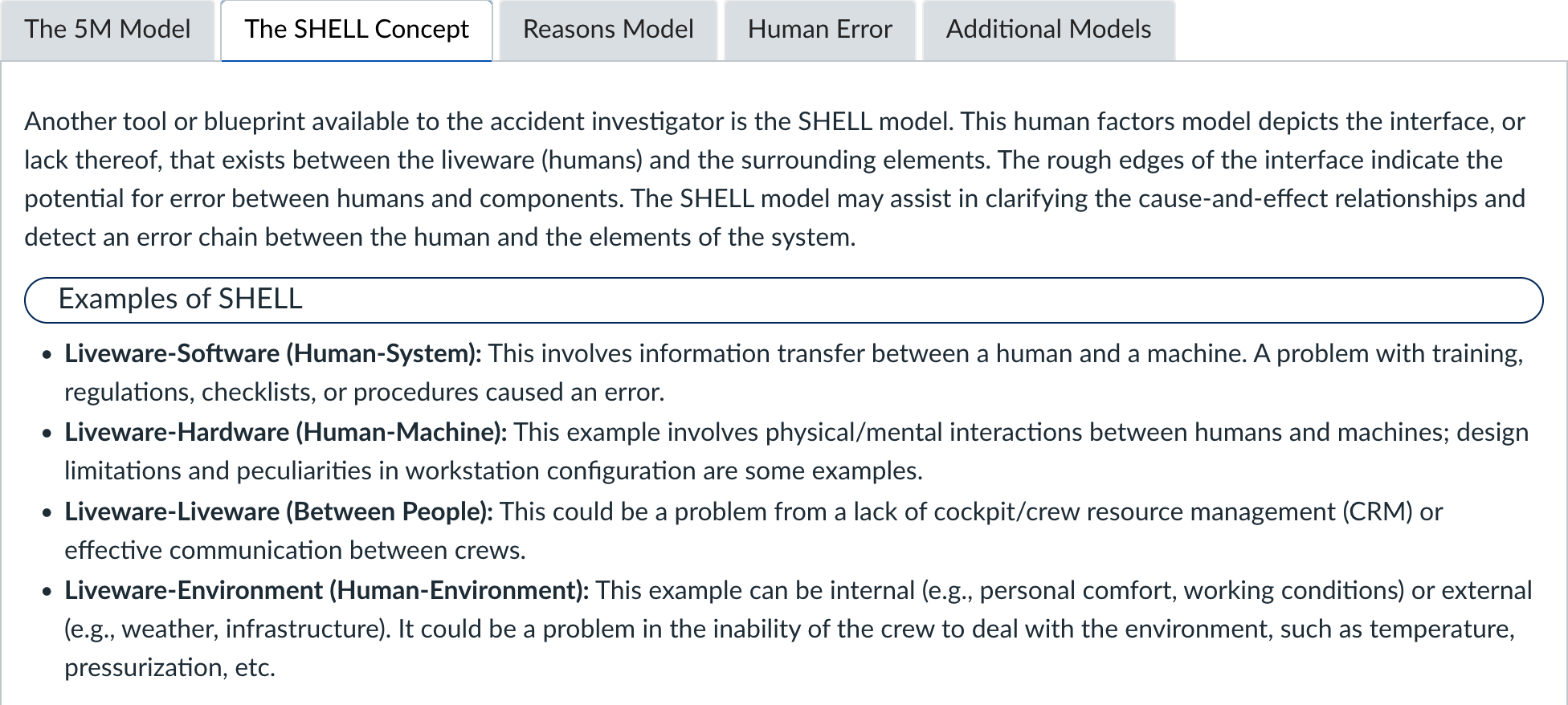
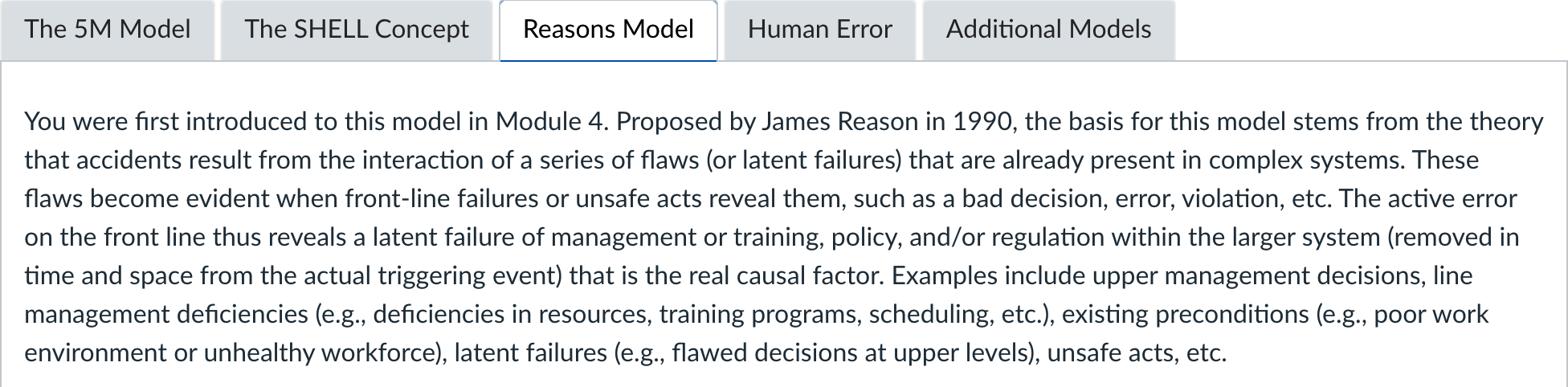
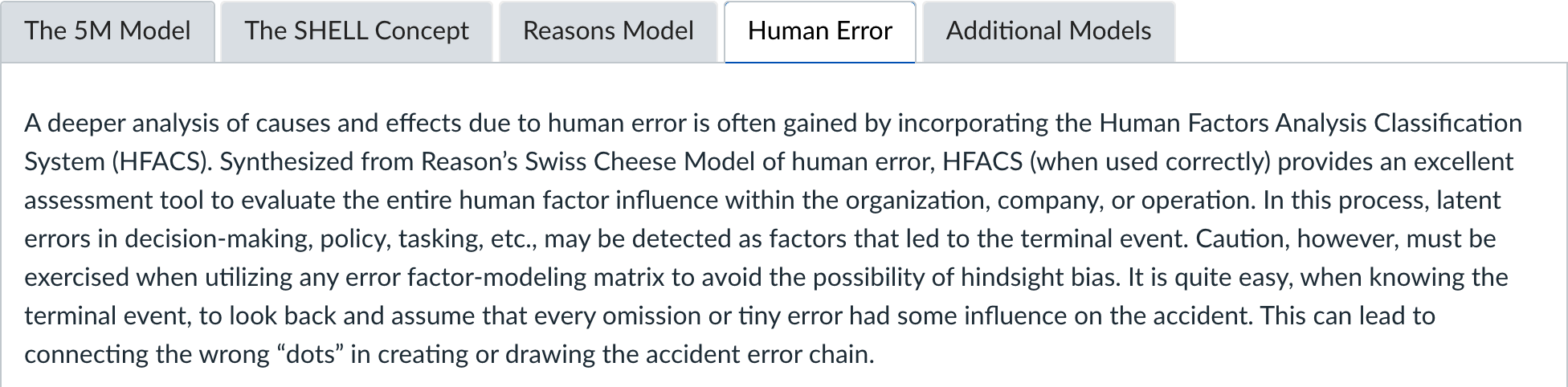
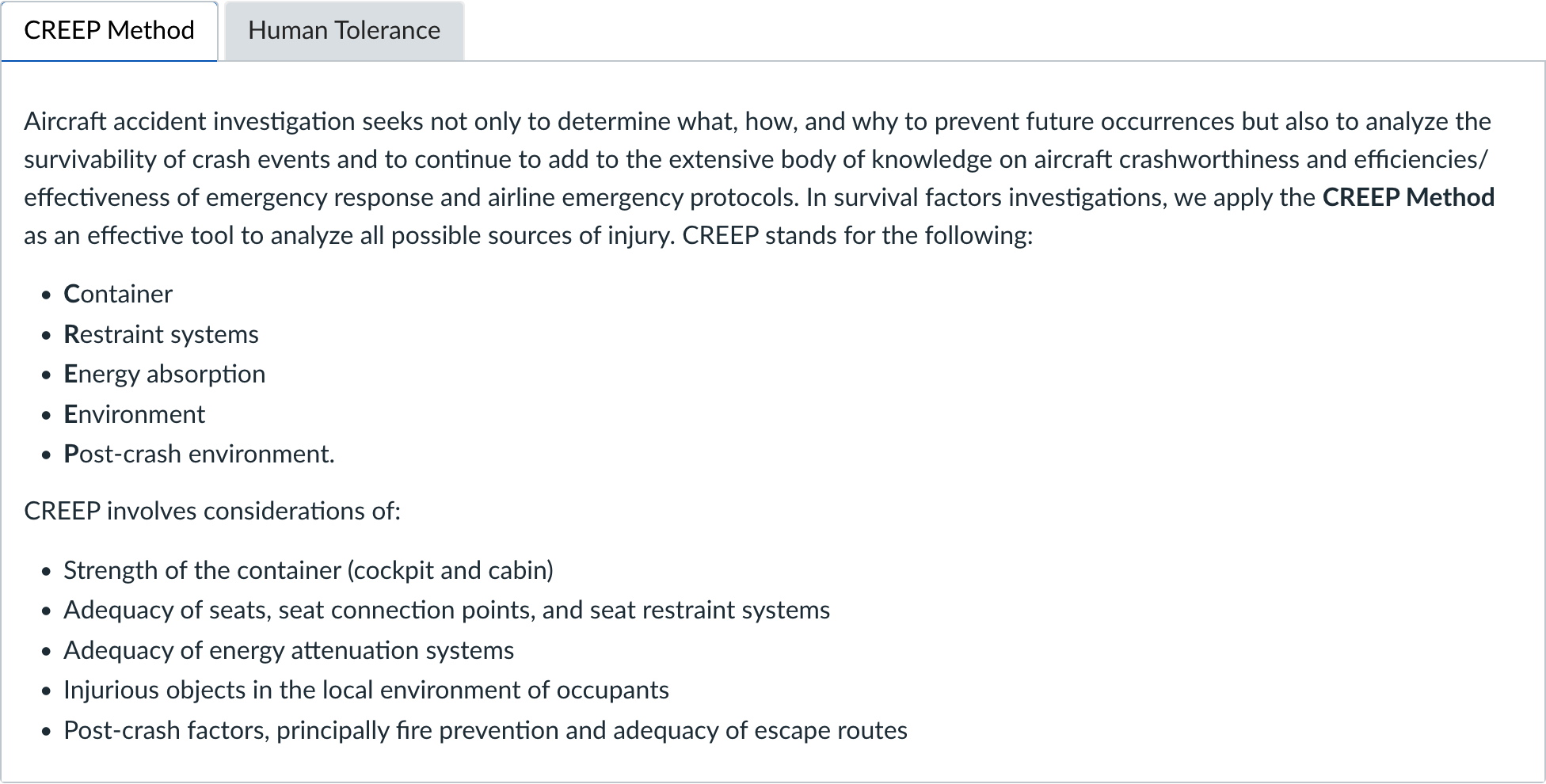
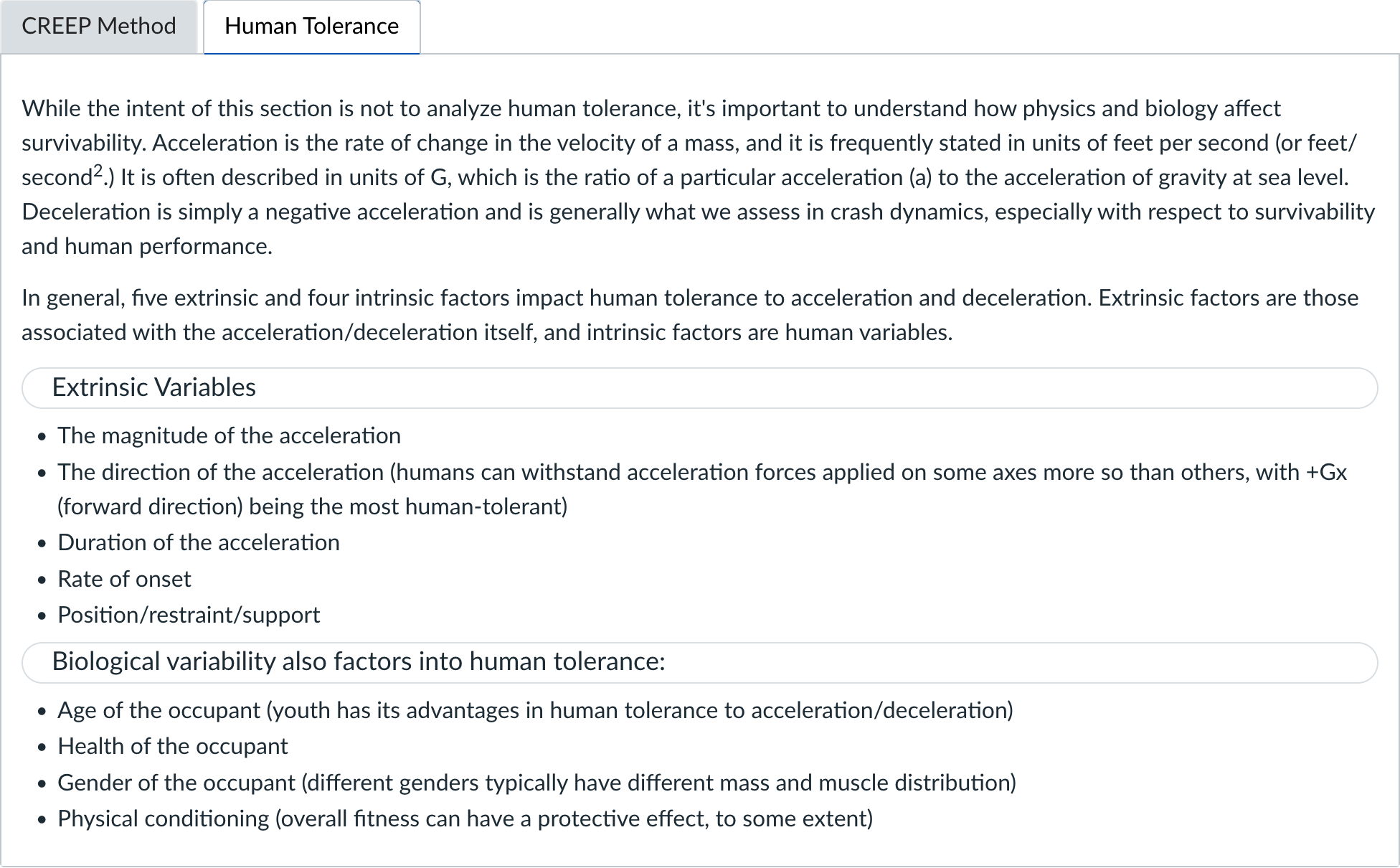
The 5M Model The SHELL Concept Reasons Model Human Error Additional Models The 5M Model encompasses the influences of man, machine, mission, medium, and management that may have combined to create an error chain. Each category has some influence on the other. The central category of this model is the mission, which is influenced by all the other categories. By analyzing available data from each category, the investigator can detect factors that may have come together to create the error chain. ICAO has a 6M Model where money (i.e., economics) could be a factor affecting the safety characteristics of an aviation organization. The 5M Model The SHELL Concept Reasons Model Human Error Additional Models Another tool or blueprint available to the accident investigator is the SHELL model. This human factors model depicts the interface, or lack thereof, that exists between the liveware (humans) and the surrounding elements. The rough edges of the interface indicate the potential for error between humans and components. The SHELL model may assist in clarifying the cause-and-effect relationships and detect an error chain between the human and the elements of the system. ( Examples of SHELL ) o Liveware-Software (Human-System): This involves information transfer between a human and a machine. A problem with training, regulations, checklists, or procedures caused an error. e Liveware-Hardware (Human-Machine): This example involves physical/mental interactions between humans and machines; design limitations and peculiarities in workstation configuration are some examples. e Liveware-Liveware (Between People): This could be a problem from a lack of cockpit/crew resource management (CRM) or effective communication between crews. e Liveware-Environment (Human-Environment): This example can be internal (e.g., personal comfort, working conditions) or external (e.g., weather, infrastructure). It could be a problem in the inability of the crew to deal with the environment, such as temperature, pressurization, etc. The 5M Model The SHELL Concept Reasons Model Human Error Additional Models You were first introduced to this model in Module 4. Proposed by James Reason in 1990, the basis for this model stems from the theory that accidents result from the interaction of a series of flaws (or latent failures) that are already present in complex systems. These flaws become evident when front-line failures or unsafe acts reveal them, such as a bad decision, error, violation, etc. The active error on the front line thus reveals a latent failure of management or training, policy, and/or regulation within the larger system (removed in time and space from the actual triggering event) that is the real causal factor. Examples include upper management decisions, line management deficiencies (e.g., deficiencies in resources, training programs, scheduling, etc.), existing preconditions (e.g., poor work environment or unhealthy workforce), latent failures (e.g., flawed decisions at upper levels), unsafe acts, etc. The 5M Model The SHELL Concept Reasons Model Human Error Additional Models A deeper analysis of causes and effects due to human error is often gained by incorporating the Human Factors Analysis Classification System (HFACS). Synthesized from Reason's Swiss Cheese Model of human error, HFACS (when used correctly) provides an excellent assessment tool to evaluate the entire human factor influence within the organization, company, or operation. In this process, latent errors in decision-making, policy, tasking, etc., may be detected as factors that led to the terminal event. Caution, however, must be exercised when utilizing any error factor-modeling matrix to avoid the possibility of hindsight bias. It is quite easy, when knowing the terminal event, to look back and assume that every omission or tiny error had some influence on the accident. This can lead to connecting the wrong \"dots\" in creating or drawing the accident error chain. CREEP Method Human Tolerance Aircraft accident investigation seeks not only to determine what, how, and why to prevent future occurrences but also to analyze the survivability of crash events and to continue to add to the extensive body of knowledge on aircraft crashworthiness and efficiencies/ effectiveness of emergency response and airline emergency protocols. In survival factors investigations, we apply the CREEP Method as an effective tool to analyze all possible sources of injury. CREEP stands for the following: e Container e Restraint systems e Energy absorption e Environment Post-crash environment. CREEP involves considerations of: o Strength of the container (cockpit and cabin) e Adequacy of seats, seat connection points, and seat restraint systems e Adequacy of energy attenuation systems e Injurious objects in the local environment of occupants e Post-crash factors, principally fire prevention and adequacy of escape routes CREEP Method Human Tolerance While the intent of this section is not to analyze human tolerance, it's important to understand how physics and biology affect survivability. Acceleration is the rate of change in the velocity of a mass, and it is frequently stated in units of feet per second (or feet/ second?) It is often described in units of G, which is the ratio of a particular acceleration (a) to the acceleration of gravity at sea level. Deceleration is simply a negative acceleration and is generally what we assess in crash dynamics, especially with respect to survivability and human performance. In general, five extrinsic and four intrinsic factors impact human tolerance to acceleration and deceleration. Extrinsic factors are those associated with the acceleration/deceleration itself, and intrinsic factors are human variables. Extrinsic Variables The magnitude of the acceleration e The direction of the acceleration (humans can withstand acceleration forces applied on some axes more so than others, with +Gx (forward direction) being the most human-tolerant) Duration of the acceleration Rate of onset e Position/restraint/support Biological variability also factors into human tolerance: o Age of the occupant (youth has its advantages in human tolerance to acceleration/deceleration) e Health of the occupant o Gender of the occupant (different genders typically have different mass and muscle distribution) o Physical conditioning (overall fitness can have a protective effect, to some extent)
Step by Step Solution
There are 3 Steps involved in it
1 Expert Approved Answer
Step: 1 Unlock
Question Has Been Solved by an Expert!
Get step-by-step solutions from verified subject matter experts
Step: 2 Unlock
Step: 3 Unlock
Students Have Also Explored These Related General Management Questions!