







Question: This unit is very conceptual. Therefore, it would be best to review your notes, homeworks, quiz, lab/quiz, and electroscope lab. You should have a basic
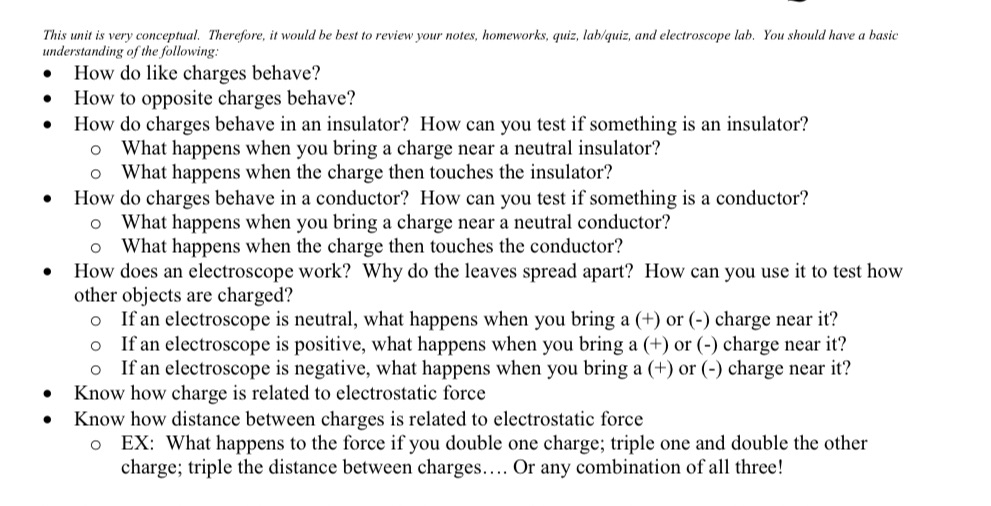
This unit is very conceptual. Therefore, it would be best to review your notes, homeworks, quiz, lab/quiz, and electroscope lab. You should have a basic understanding of the following: . How do like charges behave? How to opposite charges behave? . How do charges behave in an insulator? How can you test if something is an insulator? o What happens when you bring a charge near a neutral insulator? o What happens when the charge then touches the insulator? . How do charges behave in a conductor? How can you test if something is a conductor? o What happens when you bring a charge near a neutral conductor? o What happens when the charge then touches the conductor? . How does an electroscope work? Why do the leaves spread apart? How can you use it to test how other objects are charged? o If an electroscope is neutral, what happens when you bring a (+) or (-) charge near it? o If an electroscope is positive, what happens when you bring a (+) or (-) charge near it? o If an electroscope is negative, what happens when you bring a (+) or (-) charge near it? Know how charge is related to electrostatic force Know how distance between charges is related to electrostatic force o EX: What happens to the force if you double one charge; triple one and double the other charge; triple the distance between charges.... Or any combination of all three
Step by Step Solution
There are 3 Steps involved in it

Get step-by-step solutions from verified subject matter experts
 Study Help