







Question: This week we will be having a mock poster presentation, much like researchers do at academic conferences and symposiums. The goal is to share and
This week we will be having a mock poster presentation, much like researchers do at academic conferences and symposiums. The goal is to share and discuss your research with your peers. Please post your PowerPoint presentation at the start of the week and then comment on the work of at least two of your peers. When posting your presentation, please write your chosen topic within the subject line and then upload your PowerPoint file.
Your replies to classmates should focus on one of the following topics:
- methodology,
- rationale,
- research questions/hypotheses,
- results,
- tie into the concepts we've learned about throughout the term,
- future directions of study, or
- implications of the work.
classmate presentation
Introduction
"According to market estimates, total media advertising spending in the United States in 2020 would amount to 225.8 billion U.S. dollars. By 2024, the figure is expected to grow to 322 billion dollars." (Navarro, 2023).
These large figures are the result of a huge amount of research that has been conducted in the area of the science of effective persuasion. Research has shown that one's attitude will predict their behavior (Aronson et. al, 2022). The science of persuasion studies the techniques that can be used to change the attitude of an audience or potential consumers to provoke a desired behavior.
Marketing agencies use techniques that are aligned with the principles of the Yale Attitude Change Approach when creating advertisements. Carl Hovland was employed by the United States to research the science of persuasion during the Second World War. Afterward, he continued his studies at Yale University and came up with his model of the conditions in which people tend to change their attitudes. Hovland described how the source of the message, its content, and the characteristics of the audience will influence the degree to which it will persuade the audience to change its attitude (Stevens, 2020). A comprehensive study on the marketing techniques of Starbucks found that their success was largely due to how they track consumer behaviors and use this data to create their campaigns. They utilize the sociocultural aspects of their consumer base in each location to create a perfectly appropriate message (Nair et. al, 2021). In an article titled, "The Science and Practice of Persuasion", Robert B. Cialdini and Noah J. Goldstein (2002), use previous research to expand on the Yale Attitude Approach and name six different principles that govern how one may influence another. They label those principles as liking, reciprocation, consistency, scarcity, social validation, and authority. People are more inclined to be persuaded by those they like, those who have done them a favor in the past, or those who show authority. These principles will fall into the first category of the Yale Attitude Approach, discussing how the source of the content can be used to increase persuasiveness. Convincing customers that there is a limited amount of a product will increase sales, the researchers found, as well as showing customers that others have signed up for the service or product. These are examples of how the content of a message can be altered in a way that makes it more convincing. Furthermore, asking customers to commit to buying a product in advance will increase the likelihood of them buying it due to the desire of humans to appear consistent (Cialdini & Goldstein, 2002).
Finding the right audience for a message, the third component of the Yale Attitude Approach is probably the most important factor in advertising. For any persuasion to take place, the audience must be paying attention to the message, so it has to be geared to their interests. In an appeal to a population of higher intelligence, the message must appear as such and be more sophisticated than that of an advertisement geared toward the general population. As well, research has shown that those between the ages of 18-25 are the most easily persuaded, with other age groups being harder to persuade, so more effort must be put into advertisements geared toward these groups (Stevens, 2020).
After deciding whom to persuade and what to convince them of, marketing agencies must decide on the techniques they will use when creating their advertisements. The central route to persuasion involves a direct message of persuasion, while the peripheral route uses a more subtle, indirect message (Aronson et. al, 2022). This analysis will seek to study the techniques used in the creation of six advertisements to increase their persuasiveness, including the source, the message, and the demographics that they are targeting.
methods
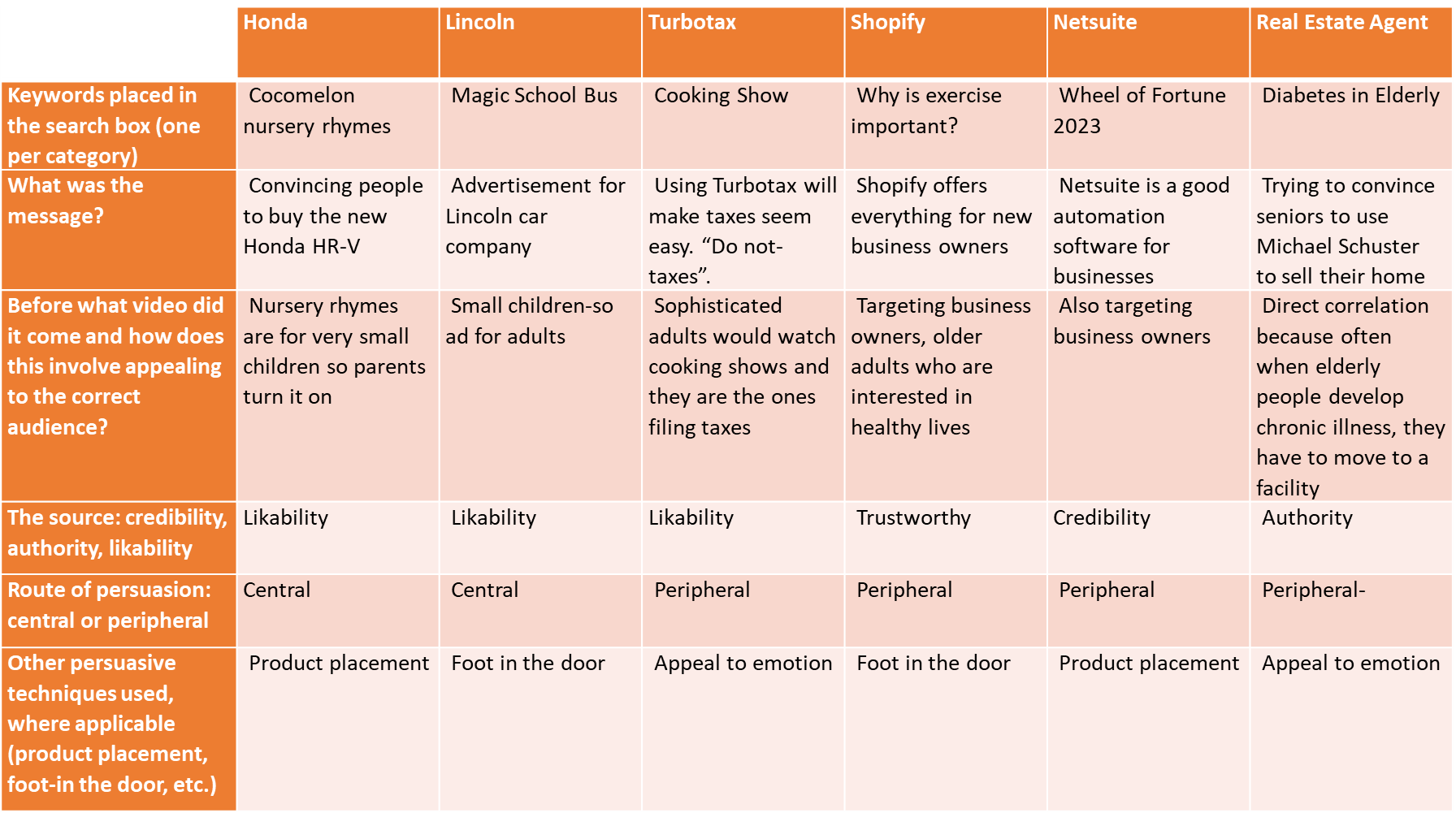
This research will be conducted using six randomly selected digital advertisements that appear at the start of six different YouTube videos. The keywords placed in the YouTube search box to gather the ads will be divided into three categories: words that will bring up videos that target young children, that target the adult population, and that target senior citizens. As well, one of the videos in each category will be about a topic in the category of entertainment and one will be in the category of education, to see how the advertisements differ depending on the type of content the user is seeking. Since YouTube uses previous browsing history when determining which ads should be shown, the browser will be placed in Incognito mode, to control for any previous browsing history affecting which ad shows up. If the same advertisement appears twice, a new one will be selected. The advertisements will be analyzed in the following manner and the data will be collected in chart form: whether the ad uses persuasive techniques regarding the source of the message, including credibility and likability of the source, how the message is being given over, including whether it uses the central or peripheral route to persuasion, and how the message is geared toward the desired audience. Other advertising techniques that are employed will also be mentioned.
materials
Step by Step Solution
There are 3 Steps involved in it

Get step-by-step solutions from verified subject matter experts
 Study Help