







Question: This week we will be performing a simulated experiment on the impact of proprietary compounds on microbial abundance in the large intestine. Specifically, we are
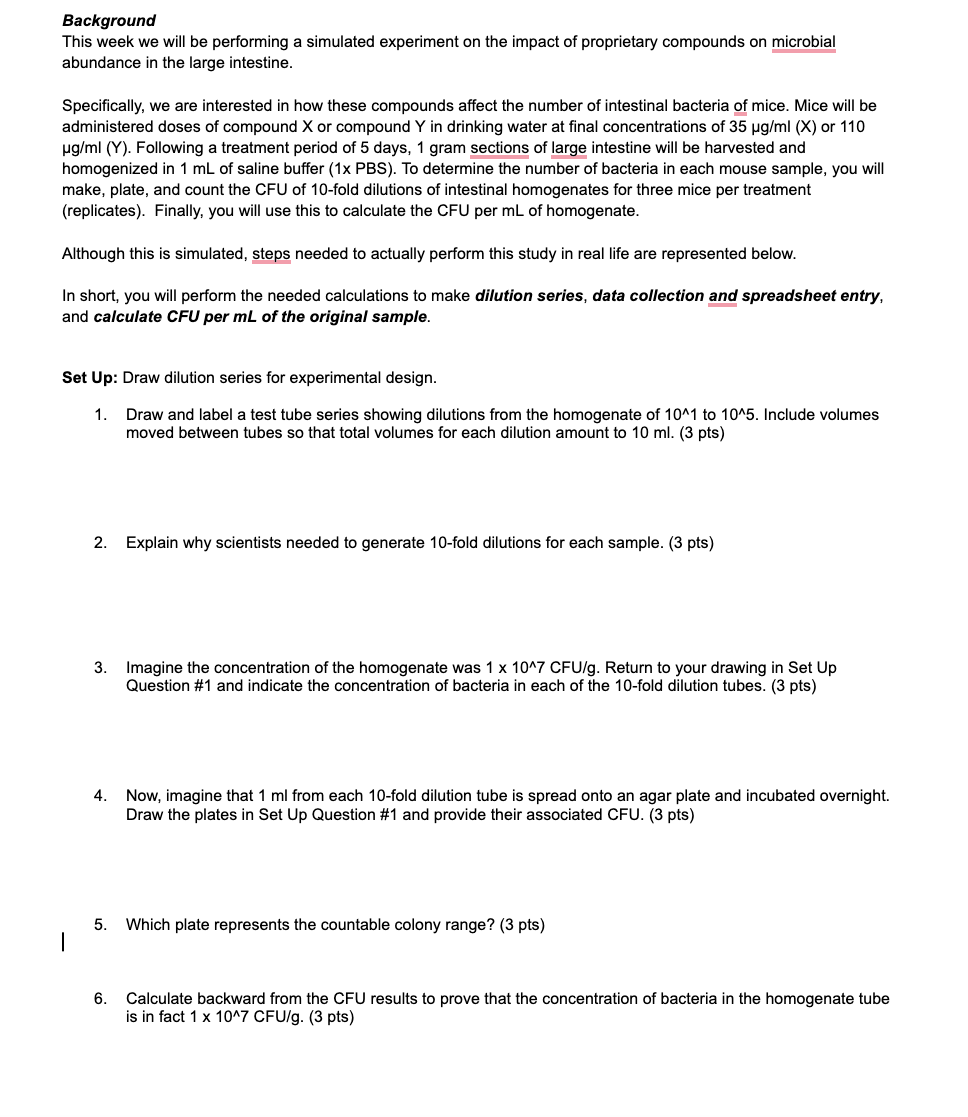
This week we will be performing a simulated experiment on the impact of proprietary compounds on microbial abundance in the large intestine. Specifically, we are interested in how these compounds affect the number of intestinal bacteria of mice. Mice will be administered doses of compound X or compound Y in drinking water at final concentrations of 35g/ml(X) or 110 g/ml(Y). Following a treatment period of 5 days, 1 gram sections of large intestine will be harvested and homogenized in 1mL of saline buffer (1x PBS). To determine the number of bacteria in each mouse sample, you will make, plate, and count the CFU of 10-fold dilutions of intestinal homogenates for three mice per treatment (replicates). Finally, you will use this to calculate the CFU per mL of homogenate. Although this is simulated, steps needed to actually perform this study in real life are represented below. In short, you will perform the needed calculations to make dilution series, data collection and spreadsheet entry, and calculate CFU per mL of the original sample. Set Up: Draw dilution series for experimental design. 1. Draw and label a test tube series showing dilutions from the homogenate of 101 to 105. Include volumes moved between tubes so that total volumes for each dilution amount to 10ml. (3 pts) 2. Explain why scientists needed to generate 10 -fold dilutions for each sample. (3 pts) 3. Imagine the concentration of the homogenate was 1107CFU/g. Return to your drawing in Set Up Question \#1 and indicate the concentration of bacteria in each of the 10 -fold dilution tubes. (3 pts) 4. Now, imagine that 1ml from each 10-fold dilution tube is spread onto an agar plate and incubated overnight. Draw the plates in Set Up Question \#1 and provide their associated CFU. (3 pts) 5. Which plate represents the countable colony range? (3 pts) 6. Calculate backward from the CFU results to prove that the concentration of bacteria in the homogenate tube is in fact 1107CFU/g. (3 pts)
Step by Step Solution
There are 3 Steps involved in it

Get step-by-step solutions from verified subject matter experts
 Study Help