Question: This week we will work on an Argumentation / Persuasion essay, as explained in Chapter 11. It's alot of reading, so all you have to
This week we will work on an Argumentation / Persuasion essay, as explained in Chapter 11.
It's alot of reading, so all you have to d0 this week is read and summarize the text, and read an essay / answer questions. We will work on an essay next week.
Like I said, it's alot of reading, so read through the assignment belowbeforeyou dive in.
ASSIGNMENT --
1) Read and summarize pages 447 - 469 in the text.
Don't panic. Answer the following questions as you go through (short answer), and your summary will be fine. You will get what you need out of the reading, and you won't have to wade through parts that aren't useful to you.
a) What is argumentation / persuasion (pgs. 447 - 448)? Describe in a few sentences.
b) How is argument / persuasion different from other types of writing we have seen in this class, so far? (pg. 449)
c) Briefly define logos, pathos, and ethos. (pgs. 449-450).
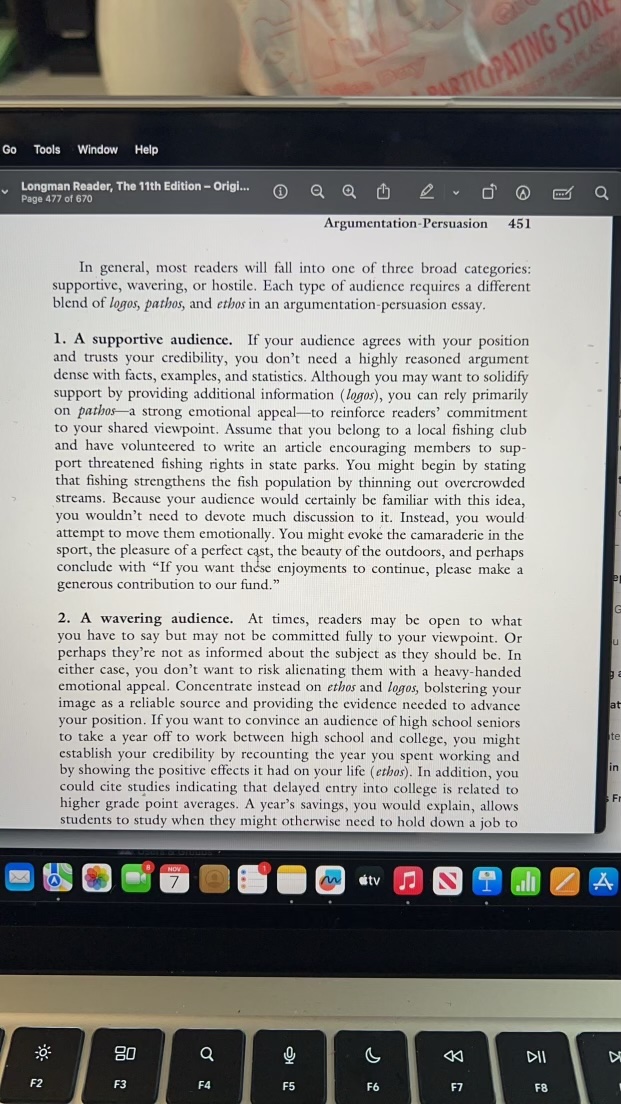
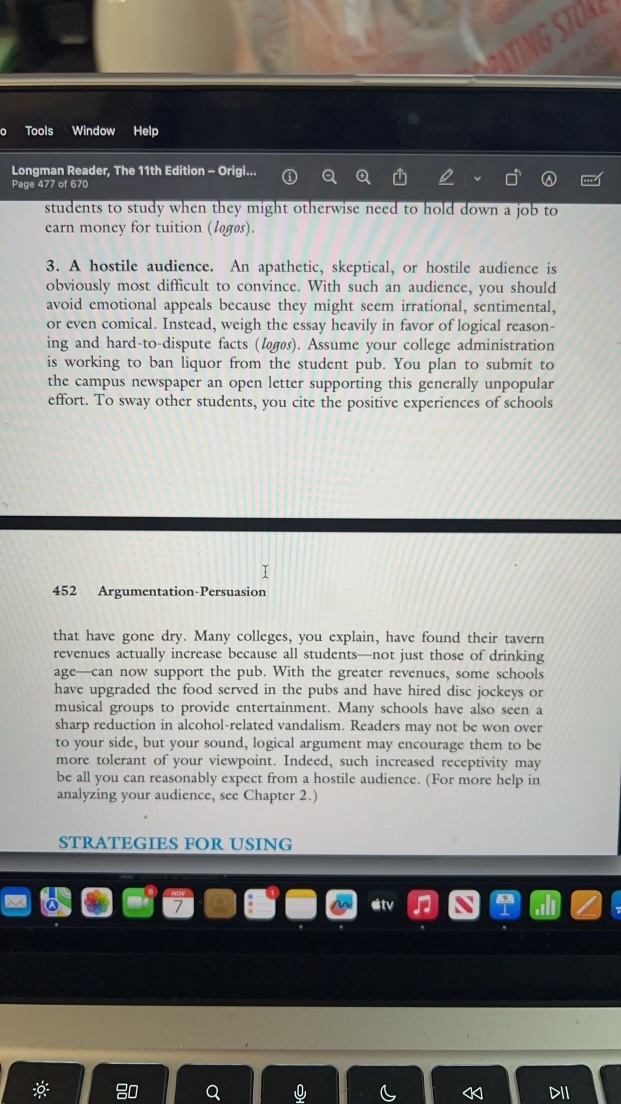
d) Briefly describe the different kinds of audiences (pg. 451).
e) Briefly define the Strategies for Using Argumentation / Persuasion in an Essay (pgs. 452 - 461).
f) Define inductive and deductive reasoning. What is the difference? (pgs. 459 - 461)
2) Read one of the essays at the end of Chapter 11 in your text, EXCEPT for the ones written by Mark Twain, or Anna Quindlen.
3) Answer the Questions for Close Reading at the end of the essay.
That's it for this week!
Next week we will begin a writing assignment for this chapter.
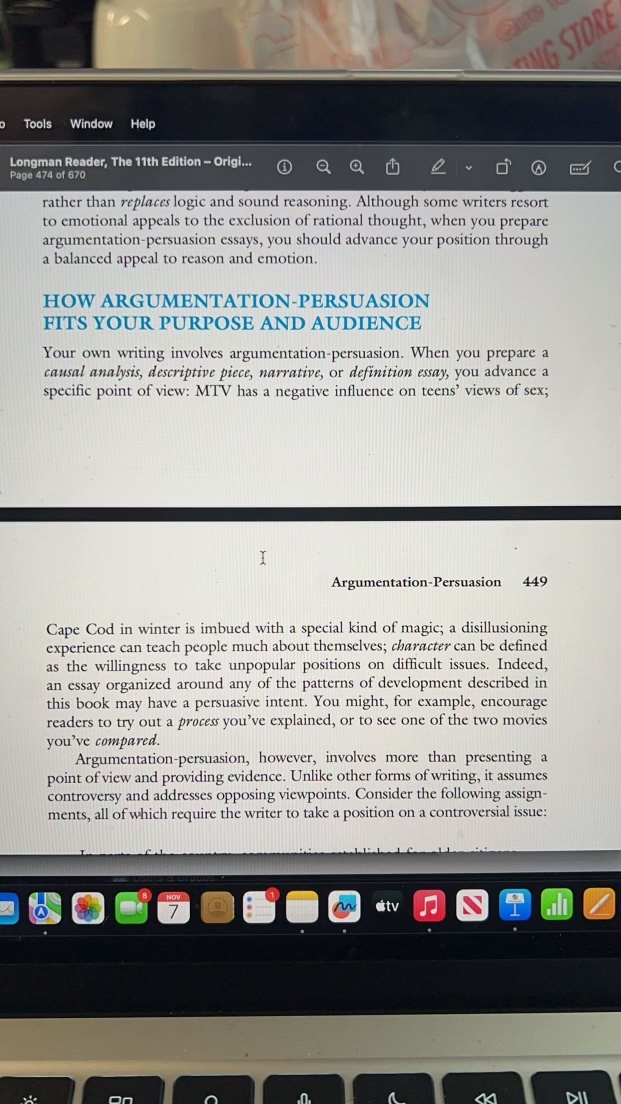
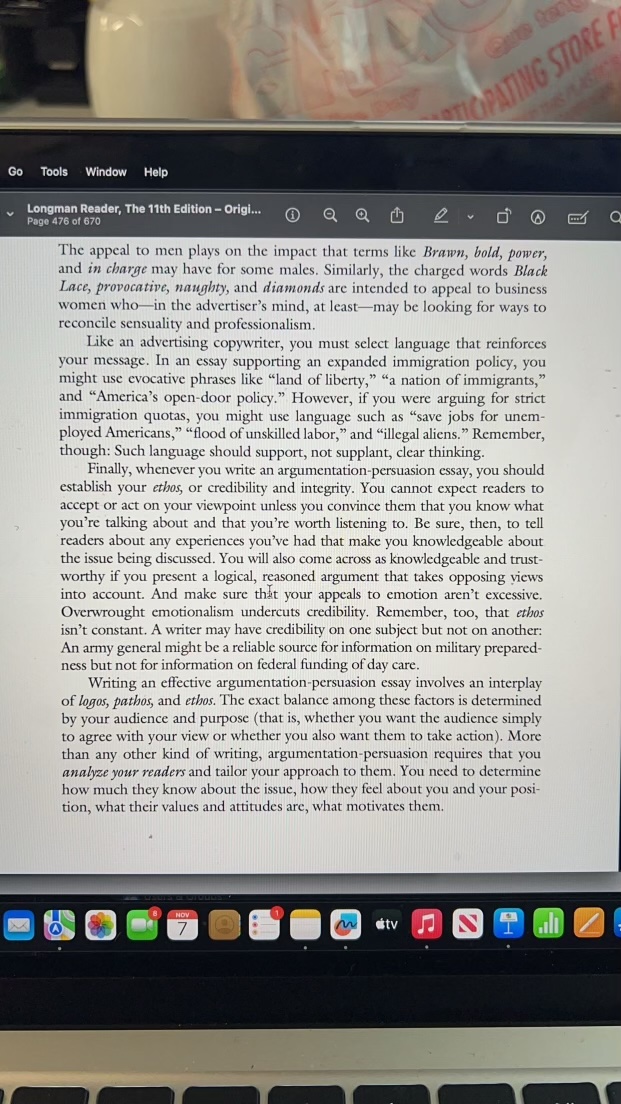
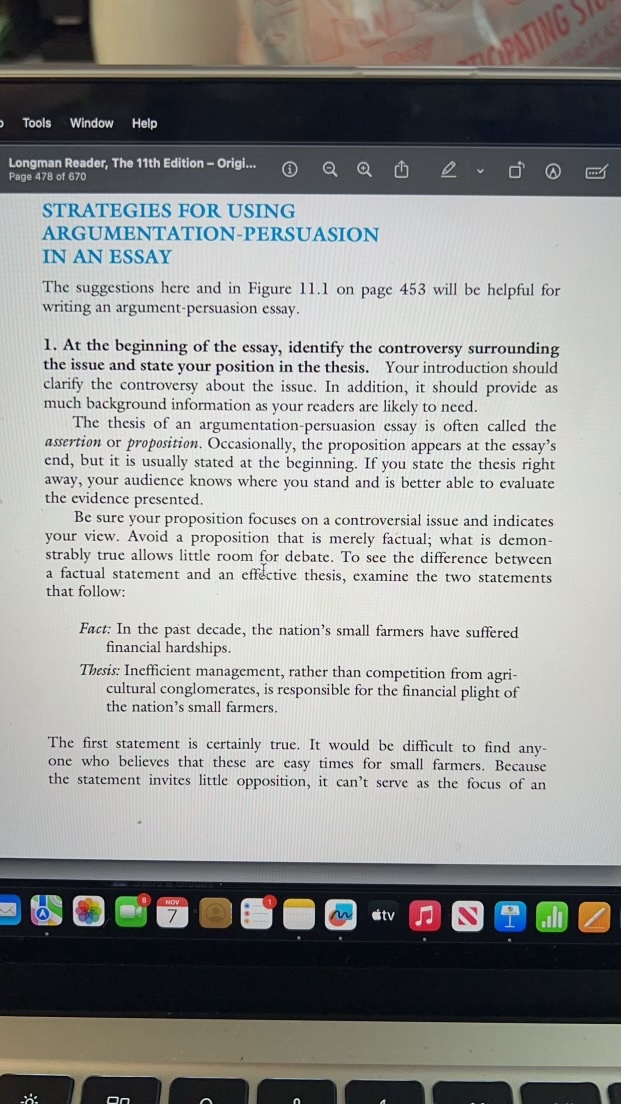
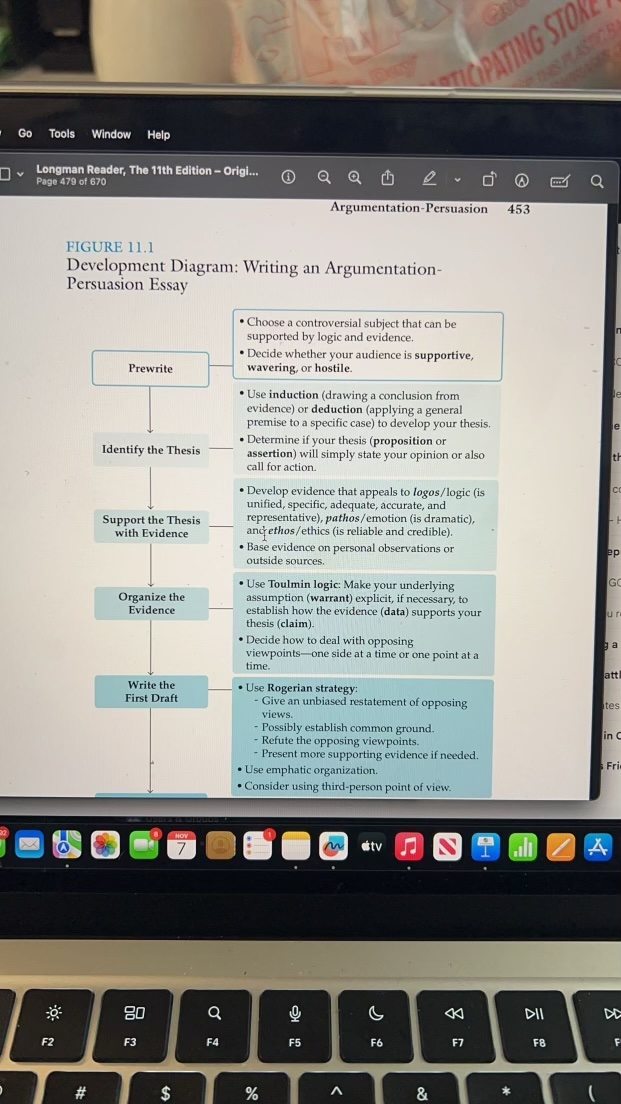
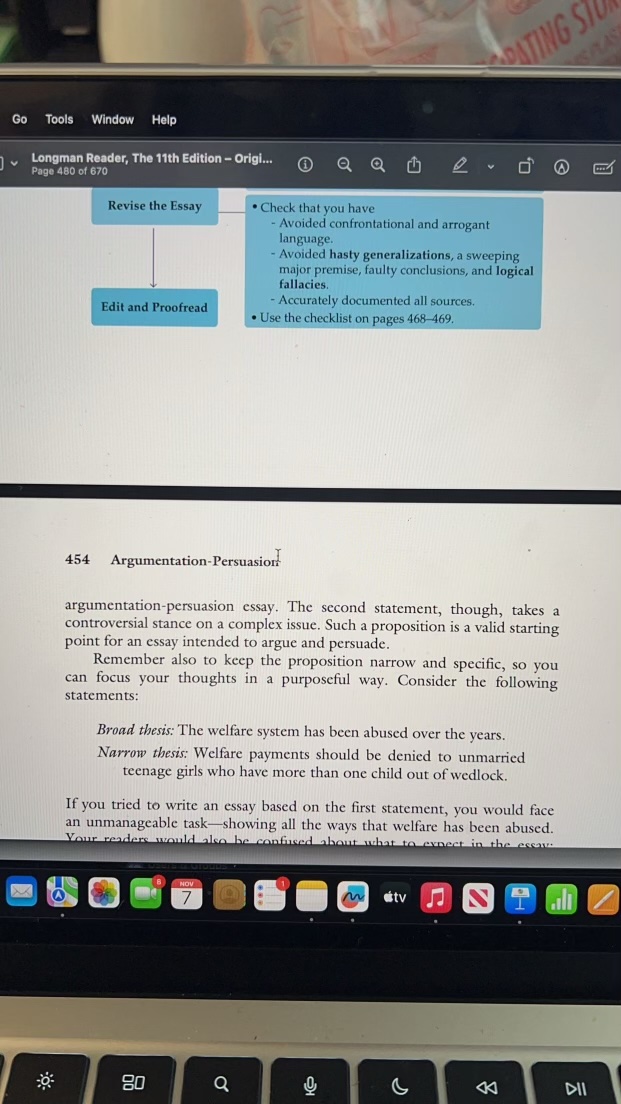
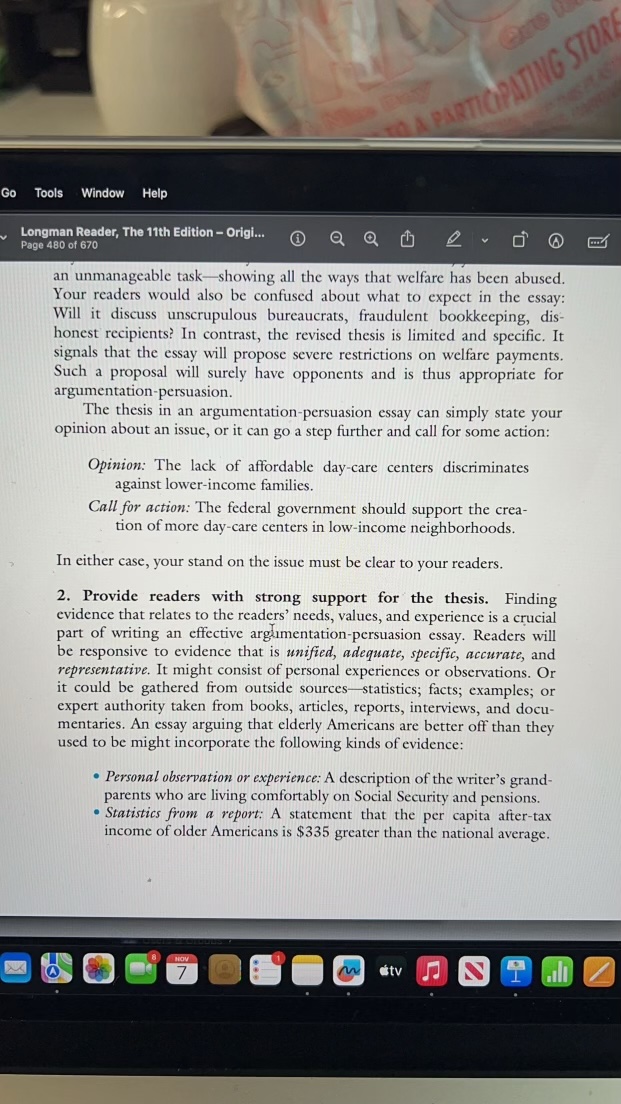
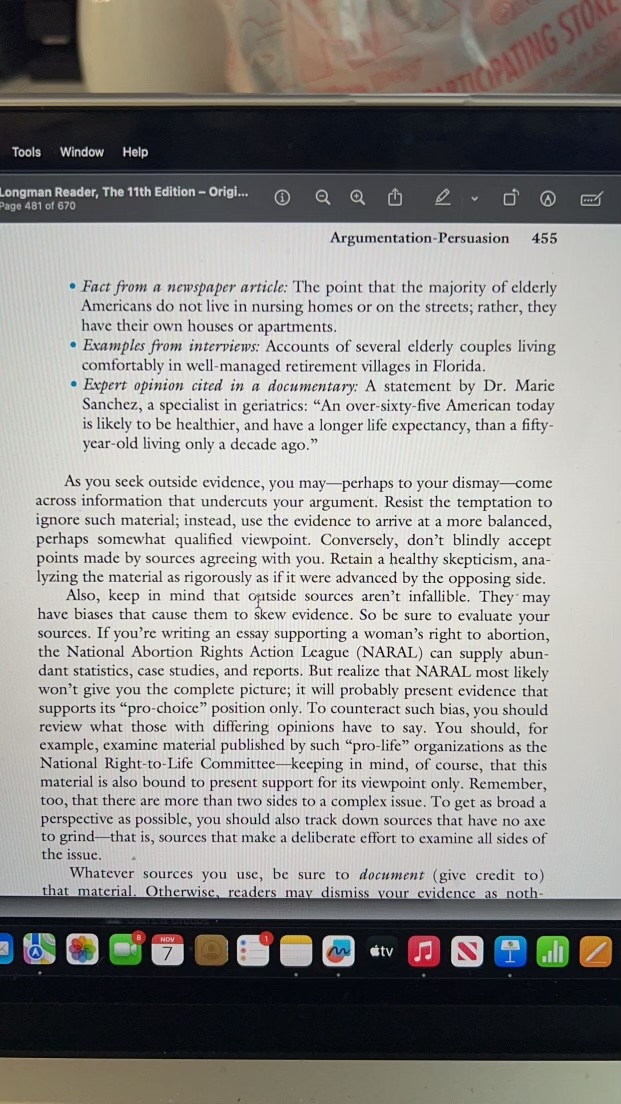
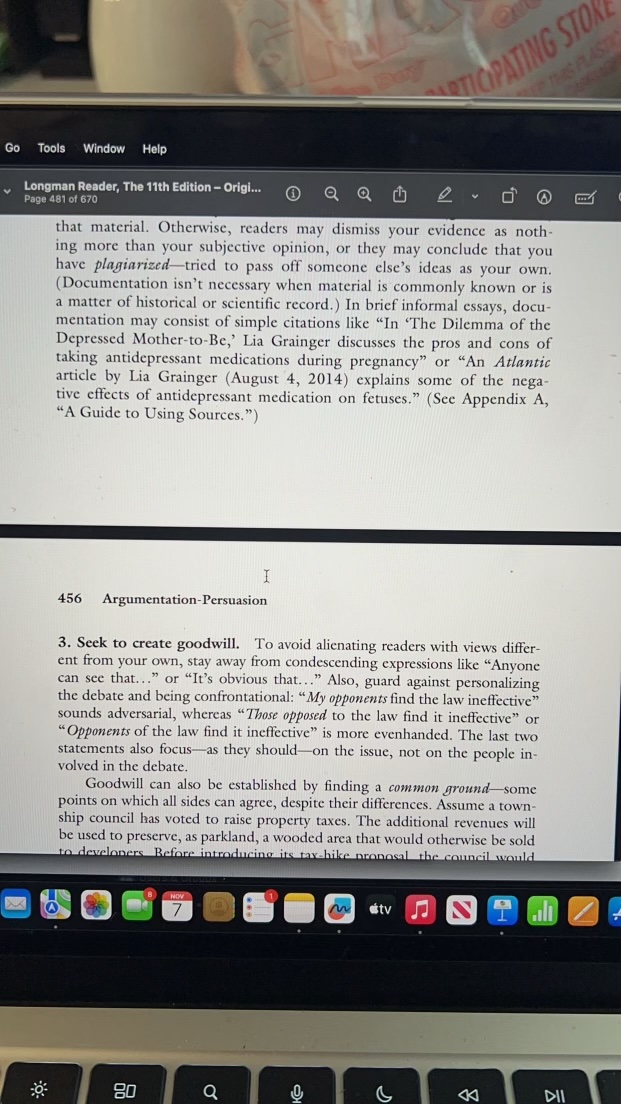
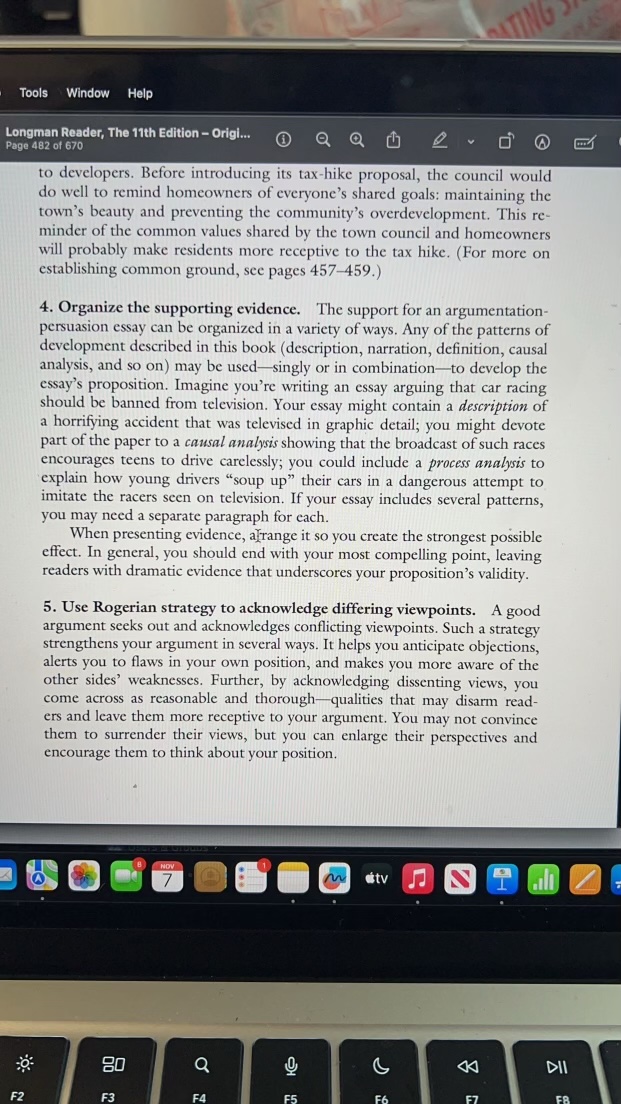
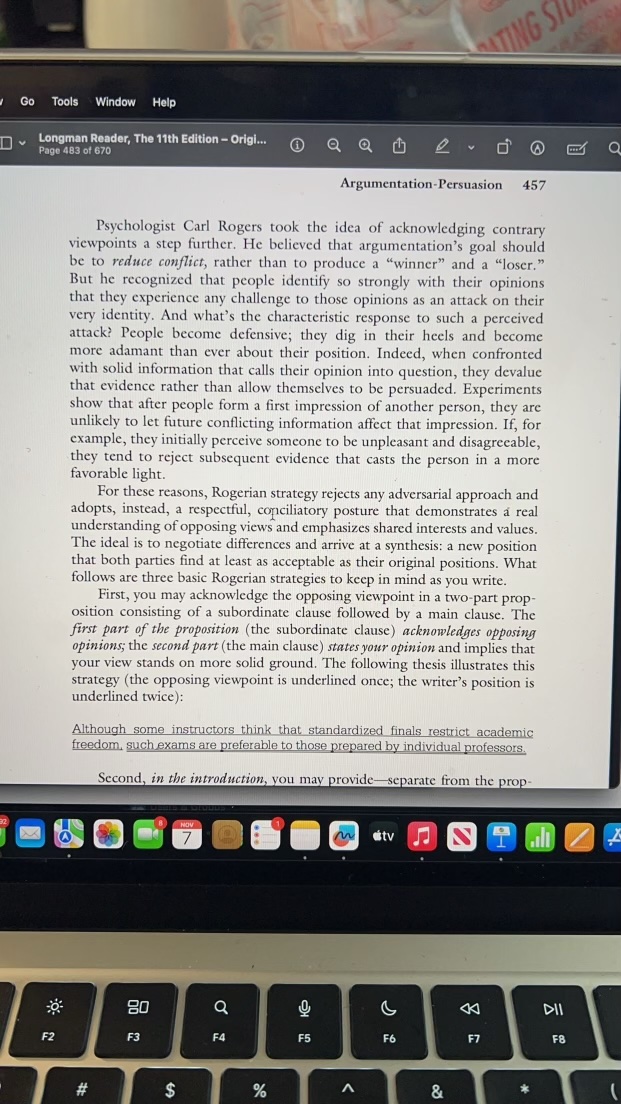
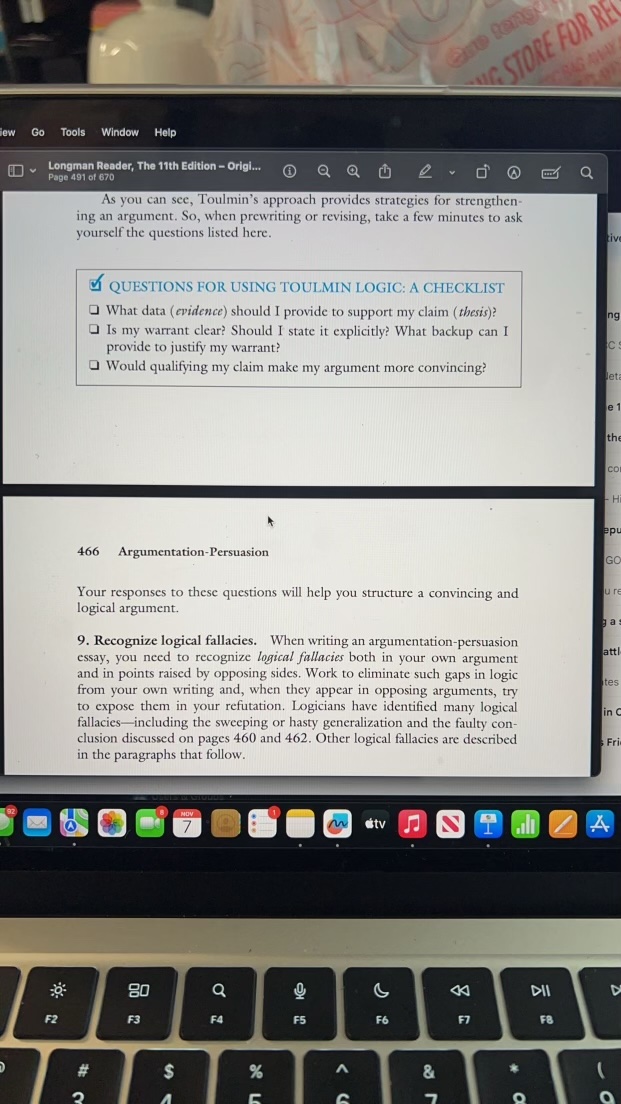
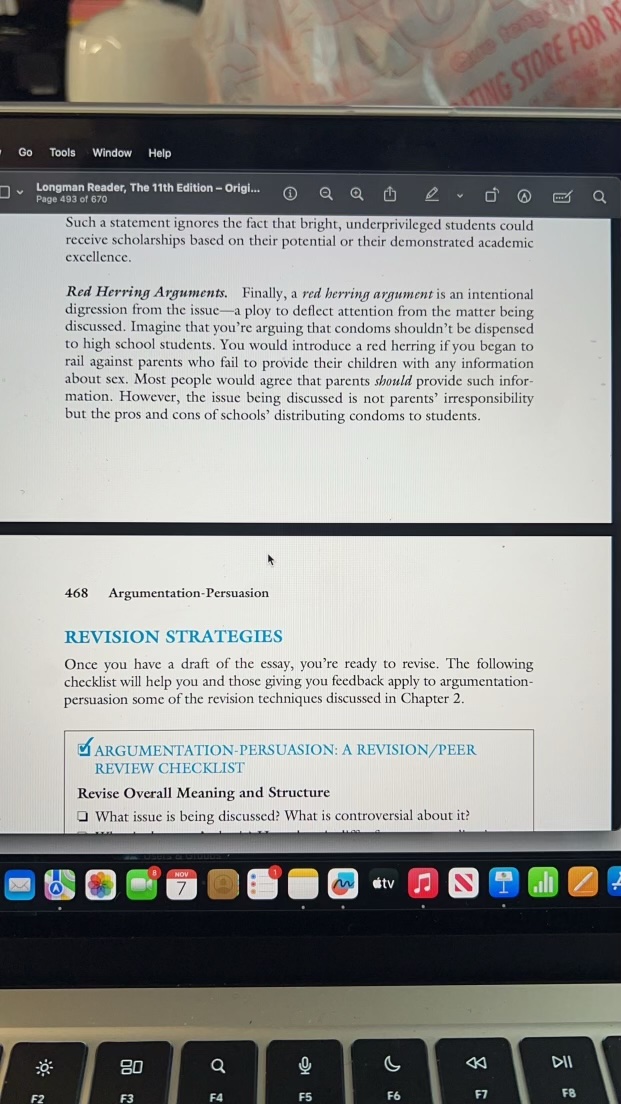
Tools Window Help man Reader, The 11th Edition - Origi... Nl rather than replaces logic and sound reasoning. Although some writers resort to emotional appeals to the exclusion of rational thought, when vou prepare arg'umcmalinn-pcrmm..inn cssays, you should advance your position through a balanced appeal to reason and emotion, HOW ARGUMENTATION-PERSUASION FITS YOUR PURPOSE AND AUDIENCE Your own writing involves argumentation-persuasion. When you prepare a causal analysis, descriptive piece, narrative, or definition essay, you advance a specific point of view: MTV has a negative influence on teens' views of sex; Argumentation-Persuasion 449 Cape Cod in winter is imbued with a special kind of magic; a disillusioning experience can teach people much about themselves; character can be defined as the willingness to take unpopular positions on difficult issues. Indeed, an essay organized around any of the patterns of development described in this book may have a persuasive intent. You might, for example, encourage readers to try out a proces you've explained, or to see one of the two movies you've compared. Argumentation-persuasion, however, involves more than presenting a point of view and providing evidence. Unlike other forms of writing, it assumes controversy and addresses opposing viewpoints. Consider the following assign- ments, all of which require the writer to take a position on a controversial issue: Go Tools Window Help Longman Reader, The 11th Edition = Origi... D i Nl Page The appeal to men plays on the impact that terms like Brawn, bold, power, and in charge may have for some males. Similarly, the charged words Black Lace, provocative, nawghty, and diamonds are intended to appeal to business women whoin the advertiser's mind, at leastmay be looking for ways to reconcile sensuality and professionalism, Like an advertising copywriter, you must select language that reinforces your message. In an essay supporting an expanded immigration policy, you might use evocative phrases like \"land of liberty,\" \"a nation of immigrants,\" and \"America's open-door policy.\" However, if you were arguing for strict immigration quotas, you might use language such as \"save jobs for unem- ployed Americans,\" \"flood of unskilled labor,\" and \"illegal aliens.\" Remember, though: Such language should support, not supplant, clear thinking. Finally, whenever you write an argumentation-persuasion essay, you should establish your ethos, or credibility and integrity. You cannot expect readers to accept or act on your viewpoint unless you convince them that you know what you're talking about and that you're worth listening to. Be sure, then, to tell readers about any experiences you've had that make you knowledgeable about the issue being discussed. You will also come across as knowledgeable and trust- worthy if vou present a logical, reasoned argument that takes opposing vicws into account. And make sure thit your appcals to emotion aren't excessive, Overwrought emotionalism undercuts credibility,. Remember, too, that ethos isn't constant. A writer may have credibility on one subject but not on another: An army general might be a reliable source for information on military prepared- ness but not for information on federal funding of day care. Writing an effective argumentation-persuasion essay involves an interplay of logos, pathes, and ethos. The exact balance among these factors is determined by your audience and purpose (that is, whether you want the audience simply to agree with your view or whether you also want them to take action). More than any other kind of writing, argumentation-persuasion requires that you analyze your readers and tailor your approach to them. You need to determine how much they know about the issue, how they feel about you and vour posi- tion, what their values and attitudes are, what motivates them. Tl 1 Rl Go Tools Window Help Longman Reader, The 11th Edition - Origi... @ [SoY LT_' o D- =& Q Page 477 of 670 "] Argumentation-Persuasion 451 In general, most readers will fall into one of three broad categories: supportive, wavering, or hostile. Each type of audience requires a different blend of logos, pathoes, and erbos in an argumentation-persuasion essay. 1. A supportive audience. If your audience agrees with your position and trusts your credibility, you don't need a highly reasoned argument dense with facts, examples, and statistics. Although you may want to solidify support by providing additional information (logos), you can rely primarily on pathosa strong emotional appealto reinforce readers' commitment to your shared viewpoint. Assume that you belong to a local fishing club and have voluntcered to write an article encouraging members to sup- port threatened fishing rights in state parks. You might begin by stating that fishing strengthens the fish population by thinning out overcrowded streams. Because your audience would certainly be familiar with this idea, you wouldn't need to devote much discussion to it. Instead, you would attempt to move them emotionally. You might evoke the camaraderie in the sport, the pleasure of a perfect cast, the beauty of the outdoors, and perhaps conclude with \"If you want thdse enjoyments to continue, please make a generous contribution to our fund.\" i 2. A wavering audience. At times, readers may be open to what you have to say but may not be committed fully to your viewpoint. Or perhaps they're not as informed about the subject as they should be. In cither case, you don't want to risk alienating them with a Ima-,-}-- handed b emotional appeal. Concentrate instead on ethos and logas, bolstering your image as a reliable source and providing the evidence needed to advance = your position. If you want to convince an audience of high school seniors [ to take a year off to work between high school and college, you might Jte establish your credibility by recounting the year you spent working and by showing the positive cffects it had on your life (ethos). In addition, vou could cite studies indicating that delayed entry into college is related to higher grade point averages. A year's savings, you would explain, allows students to study when they might otherwise need to hold down a job to LTI Rl L o Tools Window Help Longman Reader, The 11th Edition - Origl... {_'1\"| oo} 2] 670 students to study when they might otherwise need to own a job to earn money for tuition (/ogoes). 3. A hostile audience. An apathetic, skeptical, or hostile audience is obviously most difficult to convince. With such an audience, you should avoid emotional appeals because they might seem irrational, sentimental, or even comical. Instead, weigh the essay heavily in favor of logical reason- ing and hard-to-dispute facts (logos). Assume your college administration is working to ban liquor from the student pub. You plan to submit to the campus newspaper an open letter supporting this generally unpopular effort. To sway other students, you cite the positive experiences of schools I 452 Argumentation-Persuasion that have gone dry. Many colleges, you explain, have found their ravern revenues actually increase because all studentsnot just those of drinking agecan now support the pub. With the greater revenues, some schools have upgraded the food served in the pubs and have hired disc jockeys or musical groups to provide entertainment. Many schools have also seen a sharp reduction in alcohol-related vandalism. Readers may not be won over to your side, but your sound, logical argument may encourage them to be more tolerant of your viewpoint. Indeed, such increased receptivity may be all you can reasonably expect from a hostile audience. (For more help in analyzing your audience, sce Chaprer 2.) STRATEGIES FOR USING Tools Window Help Longman Reader, The 11th Edition - Origi... 0 Page 478 of 670 STRATEGIES FOR USING ARGUMENTATION-PERSUASION IN AN ESSAY The suggestions here and in Figure 11.1 on page 453 will be helpful for Writing an argument-persuasion essay. 1. At the beginning of the essay, identify the controversy surrounding the issue and state your position in the thesis. Your introduction should clarify the controversy about the issue. In addition, it should provide as much background information as your readers are likely to need. The thesis of an argumentation-persuasion essay is often called the assertion or proposition. Occasionally, the proposition appears at the essay's end, but it is usually stated at the beginning. If you state the thesis right away, your audience knows where you stand and is better able to evaluate the evidence presented. Be sure your proposition focuses on a controversial issue and indicates your view. Avoid a proposition that is merely factual; what is demon- strably true allows little room for debate. To see the difference between a factual statement and an effdctive thesis, examine the two statements that follow: Fact: In the past decade, the nation's small farmers have suffered financial hardships. Thesis: Inefficient management, rather than competition from agri- cultural conglomerates, is responsible for the financial plight of the nation's small farmers. The first statement is certainly true. It would be difficult to find any- one who believes that these are casy times for small farmers. Because the statement invites little opposition, it can't serve as the focus of an !'iol'w? Go Tools Window Help ) v Longman Reader, The 11th Edition - Origi... @ Gl @ I'_r'l P 2 LR ] O @@ & Q 453 Argumentation-Persuasion FIGURE 11.1 Development Diagram: Writing an Argumentation- Persuasion Essay * Choose a controversial subject that can be supported by logic and evidence. * Decide whether your audience is supportive, Prewrite | wavering, or hostile. * Use induction (drawing a conclusion from = evidence) or deduction (applying a general premise to a specific case) to develop your thesis, e + = Determine if your thesis (proposition or Identify the Thesis assertion) will simply state your opinion or also call for action. * Develop evidence that appeals to logos/logic (is e 4 unified, specific, adequate, accurate, and Support the Thesis representative), pathos /emotion (is d_ra matic), F with Evidence an ethos fethics (is reliable and credible). Base evidence on personal observations or outside sources, 1 * Use Toulmin logic: Make your underlying G Organize the assumption (warrant) explicit, if necessary, to Evidence establish how the evidence (data) supports your r | thesis (claim). | * Decide how to deal with opposing b a viewpointsone side at a time or one point at a time. | Write the = Use Rogerian strategy: First Draft - Give an unbiased restatement of opposing tes views. - Possibly establish common ground. nt - Refute the opposing viewpaints. - Present more supporting evidence if needed. * Use emphatic organization. * Consider using third-person paint of view. CLELTTITERETEI T Go Tools Window Help K Revise the Essay ~ Check that you have - Avoided confrontational and arrogant language. - Avoided hasty generalizations, a sweeping major premise, faulty conclusions, and logical $EEEE sl fallacies. Ry = Accurately documented all sources. IR - Use the chieciist on pages 466469 e | : il 454 Argumentation-Persuasion argumentation-persuasion essay. The second statement, though, takes a controversial stance on a complex issue, Such a proposition is a valid starting point for an essay intended to argue and persuade. Remember also to keep the proposition narrow and specific, so you can focus your thoughts in a purposeful way. Consider the following statements: Broad thesis: The welfare system has been abused over the vears, Narrow thesis: Welfare payments should be denied to unmarted teenage girls who have more than one child out of wedlock. If you tried to write an essay based on the first statement, yvou would face an unmanageable taskshowing all the ways that welfare has been abused. LY - 1 r oy y s g P Go Tools Window Help T T ey . t:_ngm:l:f;lauder.ma 11th Edition - Origi Q Q an unmanageable taskshowing all the ways that welfare has been abused. Your readers would also be confused about what to expect in the essay: Will it discuss unscrupulous bureaucrats, fraudulent bookkeeping, dis- honest recipients? In contrast, the revised thesis is limited and specific. Tt signals that the essay will propose severe restrictions on welfare payments. Such a proposal will surely have opponents and is thus appropriate for argumentation-persuasion, The thesis in an argumentation-persuasion essay can simply state your opinion about an issue, or it can go a step further and call for some action: Opinion: The lack of affordable day-care centers discriminates against lower-income families. Call for action: The federal government should support the crea- tion of more day-care centers in low-income neighborhoods. In either case, your stand on the issue must be clear to your readers. 2. Provide readers with strong support for the thesis. Finding evidence that relates to the readers' needs, values, and experience is a crucial part of writing an effective arglhimentation-persuasion cssay. Readers will be responsive to evidence that is unified, adequate, specific, accurate, and reprresentative. It might consist of personal experiences or observations. Or it could be gathered from outside sourcesstatistics; facts; examples; or expert authority taken from books, articles, reports, interviews, and docu- mentaries. An essay arguing that elderly Americans are better off than they used to be might incorporate the following kinds of evidence: * Personal observation or experience: A description of the writer's grand- parents who are living comfortably on Social Security and pensions. * Statistics from a report: A statement that the per capita after-tax income of older Americans is $335 greater than the national average. Tools Window Help ongman Readur The 11th Edition - Origl... 0 Q Argumentation-Persuasion 455 Fact from a newspaper article: The point that the majority of elderly Americans do not live in nursing homes or on the streets; rather, they have their own houses or apartments. * Examples from interviews: Accounts of several elderly couples living comfortably in well-managed retirement villages in Florida. * Expert opinion cited in a documentary: A statement by Dr. Marie Sanchez, a specialist in geriatrics: \"An over-sixty-five American today is likely to be healthier, and have a longer life expectancy, than a fifty- year-old living only a decade ago.\" As you seek outside evidence, you mayperhaps to your dismaycome across information that undercuts your argument. Resist the temptation to ignore such material; instead, use the evidence to arrive at a more balanced, perhaps somewhat qualified viewpoint. Conversely, don't blindly accept points made by sources agreeing with you. Retain a healthy skepticism, ana- lyzing the material as rigorously as if it were advanced by the opposing side. Also, keep in mind that optside sources aren't infallible. They may have biases that cause them to skew evidence. So be sure to evaluate your sources. If you're writing an essay supporting a woman's right to abortion, the National Abortion Rights Action League (NARAL) can supply abun- dant statistics, case studies, and reports. But realize that NARAL most likely won't give you the complete picture; it will probably present evidence that supports its \"pro-choice position only. To counteract such bias, you should review what those with differing opinions have to say. You should, for example, examine material published by such \"pro-life\" organizations as the , of course, that this material is also bound to present support for its viewpoint only. Remember, too, that there are more than two sides to a complex issue. To get as broad a perspective as possible, you should also track down sources that have no axe to grindthat is, sources that make a deliberate effort to examine all sides of the issue. . Whatever sources y(:-u use, be sure to docwment (give credit to) rial. Otherwise. rcadcrs mayv_dismi idence as noth- that OTICIPATING STONE PLAS Go Tools Window Help Longman Reader, The 11th Edition - Origi... Page 481 of 670 that material. Otherwise, readers may dismiss your evidence as noth- ing more than your subjective opinion, or they may conclude that you have plagiarized-tried to pass off someone else's ideas as your own. (Documentation isn't necessary when material is commonly known or is a matter of historical or scientific record.) In brief informal essays, docu- mentation may consist of simple citations like "In 'The Dilemma of the Depressed Mother-to-Be,' Lia Grainger discusses the pros and cons of taking antidepressant medications during pregnancy" or "An Atlantic article by Lia Grainger (August 4, 2014) explains some of the nega- tive effects of antidepressant medication on fetuses." (See Appendix A, "A Guide to Using Sources.") I 456 Argumentation-Persuasion 3. Seek to create goodwill. To avoid alienating readers with views differ- ent from your own, stay away from condescending expressions like "Anyone can see that..." or "It's obvious that..." Also, guard against personalizing the debate and being confrontational: "My opponents find the law ineffective" sounds adversarial, whereas "Those opposed to the law find it ineffective" or "Opponents of the law find it ineffective" is more evenhanded. The last two statements also focus-as they should-on the issue, not on the people in- volved in the debate. Goodwill can also be established by finding a common ground-some points on which all sides can agree, despite their differences. Assume a town- ship council has voted to raise property taxes. The additional revenues will be used to preserve, as parkland, a wooded area that would otherwise be sold to developers Before introducing its tax-hike proposal the council would City 20 Q 0 DIITools Window Help Longman Reader, The 11th Edition - Origi... (O CEN ] [-l] L Pl to developers, Before introducing its tax-hike proposal, the council would do well to remind homeowners of everyone's shared goals: maintaining the town's beauty and preventing the community's overdevelopment. This re- minder of the common values shared by the town council and homeowners will probably make residents more receptive to the tax hike. (For more on establishing common ground, see pages 457-459.,) 4. Organize the supporting evidence. The support for an argumentation- persuasion essay can be organized in a variety of ways. Any of the patterns of development described in this book (description, narration, definition, causal analysis, and so on) may be usedsingly or in combinationto develop the essay's proposition. Imagine you're writing an cssay arguing that car racing should be banned from television. Your essay might contain a description of a horrifying accident that was televised in graphic detail; you might devote part of the paper to a causal analysis showing that the broadcast of such races encourages teens to drive carclessly; you could include a process analysis to explain how young drivers \"soup up\" their cars in a dangerous attempt to imitate the racers scen on television. If your essay includes several patterns, you may need a separate paragraph for each. When presenting evidence, afrange it 50 you create the strongest possible effect. In general, you should end with your most compelling point, leaving readers with dramatic evidence that underscores your proposition's validity. 5. Use Rogerian strategy to acknowledge differing viewpoints. A good argument secks out and acknowledges conflicting viewpoints. Such a strategy strengthens your argument in several ways. It helps you anticipate objections, alerts you to flaws in your own position, and makes you more aware of the other sides' weaknesses. Further, by acknowledging dissenting views, you come across as reasonable and thoroughqualities that may disarm read- ers and leave them more receptive to your argument. You may not convince them to surrender their views, but you can enlarge their perspectives and encourage them to think about your position. Go Tools Window Help Longman Reader, The 11th Edition = Orig... 2 o R el ] @ O\\ Q U Argumentation-Persuasion 457 Psychologist Carl Rogers took the idea of acknowledging contrary viewpoints a step further. He believed that argumentation's goal should be to reduce conflict, rather than to produce a \"winner\" and a \"loser.\" But he recognized that people identify so strongly with their opinions that they experience any challenge to those opinions as an attack on their very identity. And what's the characteristic response to such a perceived attack? People become defensive; they dig in their heels and become more adamant than ever about their position. Indeed, when confronted with solid information that calls their opinion into question, they devalue that evidence rather than allow themselves to be persuaded. Experiments show that after people form a first impression of another person, they are unlikely to let future conflicting information affect that impression. If, for cxample, they initially perceive someone to be unpleasant and disagreeable, they tend to reject subsequent evidence that casts the person in a more favorable light. For these reasons, Rogerian strategy rejects any adversarial approach and adopts, instead, a respectful, copciliatory posture that demonstrates 4 real understanding of opposing views and emphasizes shared interests and values. The ideal is to negotiate differences and arrive at a synthesis: a new position that both parties find at least as acceptable as their original positions. What follows are three basic Rogerian strategies to keep in mind as you write. First, you may acknowledge the opposing viewpoint in a two-part prop- osition consisting of a subordinate clause followed by a main clause, The first part of the proposition (the subordinate clause) acknowledges opposing opinions; the second part (the main clause) states your opinion and implies that your view stands on more solid ground. The following thesis illustrates this strategy (the opposing viewpoint is underlined once; the writer's position is underlined twice): Although some instructors think that standardized finals rest it academic freedom, such exams are preferable to those prepared by individual professors. Second, in the introduction, you may provideseparate from the pro TLITTIIT LI Tools Window Healp Lengman Reader, The 11th Edition = Origi... L LR As you can see, Toulmin's approach provides strategies for strengthen- ing an argument. 50, when prewniting or revising, take a few minutes to ask yourself the questions listed here, QUESTIONS FOR USING TOULMIN LOGIC: A CHECKLIST I What data (evidence) should I provide to support my claim ( thesis)? 1 Is my warrant clear? Should T state it explicitly? What backup can 1 provide to justify my warrant? U Would qualifying my claim make my argument more convincing? 466 Argumentation-Persuasion Your responses to these questions will help you structure a convincing and logical argument. 9. Recognize logical fallacies. When writing an argumentation-persuasion essay, you nced to recognize logical falfacies both in your own argument and in points raised by opposing sides. Work to eliminate such gaps in logic from your own writing and, when they appear in opposing arguments, try to cxposc them in your refutation. Logicians have identified many logical fallaciesincluding the sweeping or hasty generalization and the faulty con- clusion discussed on pages 460 and 462. Other logical fallacies are described in the paragraphs that follow. Go Tools Window Help n Reader, The 11th Edition - Origi... 4] Such a statement ignores the fact that bright, underprivileged students could receive scholarships based on their potential or their demonstrated academic excellence. Red Herrving Avguments, Finally, a red berring argument is an intentional digression from the issuca ploy to deflect attention from the matter being discussed. Imagine that you're arguing that condoms shouldn't be dispensed to high school students. You would introduce a red herring if you began to rail against parents who fail to provide their children with any information about sex. Most people would agree that parents should provide such infor- mation. However, the issue being discussed is not parents' irresponsibility but the pros and cons of schools' distributing condoms to students. k 468 Argumentation-Persuasion REVISION STRATEGIES Once you have a draft of the essay, you're ready to revise. The following checklist will help vou and those giving you feedback apply to argumentation- persuasion some of the revision techniques discussed in Chaprer 2. :r'&l{{_iL.' MENTATION-PERSUASION: A REVISION /PEER REVIEW CHECKLIST Revise Overall Meaning and Structure 3 What issue is being discussed? What is controversial about it
Step by Step Solution
There are 3 Steps involved in it
1 Expert Approved Answer
Step: 1 Unlock
Question Has Been Solved by an Expert!
Get step-by-step solutions from verified subject matter experts
Step: 2 Unlock
Step: 3 Unlock
Students Have Also Explored These Related Business Writing Questions!









 Study Help