Question: This weeks discussion will focus on management decision-making and control in two companies, American corporation Amazon.com, Inc. and Chinese company Alibaba Group Holding Limited. Decision-making
This weeks discussion will focus on management decision-making and control in two companies, American corporation Amazon.com, Inc. and Chinese company Alibaba Group Holding Limited.
Decision-making and control are two vital, and often interlinked, functions of international management. Strategic evaluation and control are the processes of determining the effectiveness of a given strategy in achieving the organizational objectives and taking corrective actions whenever required. Control can be exercised through formulation of contingency strategies and a crisis management team.
For your discussion, use the Decision-Making Process (stages 1-9) outlined in the textbook (Fig 11-1) and this Modules content. Visit the corporate websites of two companies, Amazon and Alibaba, and examine what these firms are doing relating to the strategic evaluation and control process definition in the process above.
For example:
- Stage 1: What is one problem perception for each company?
- Stage 2: What is the problem identification for each company?
- Repeat for stages 3-9.
What overall assumptions can you make using this decision-making process?
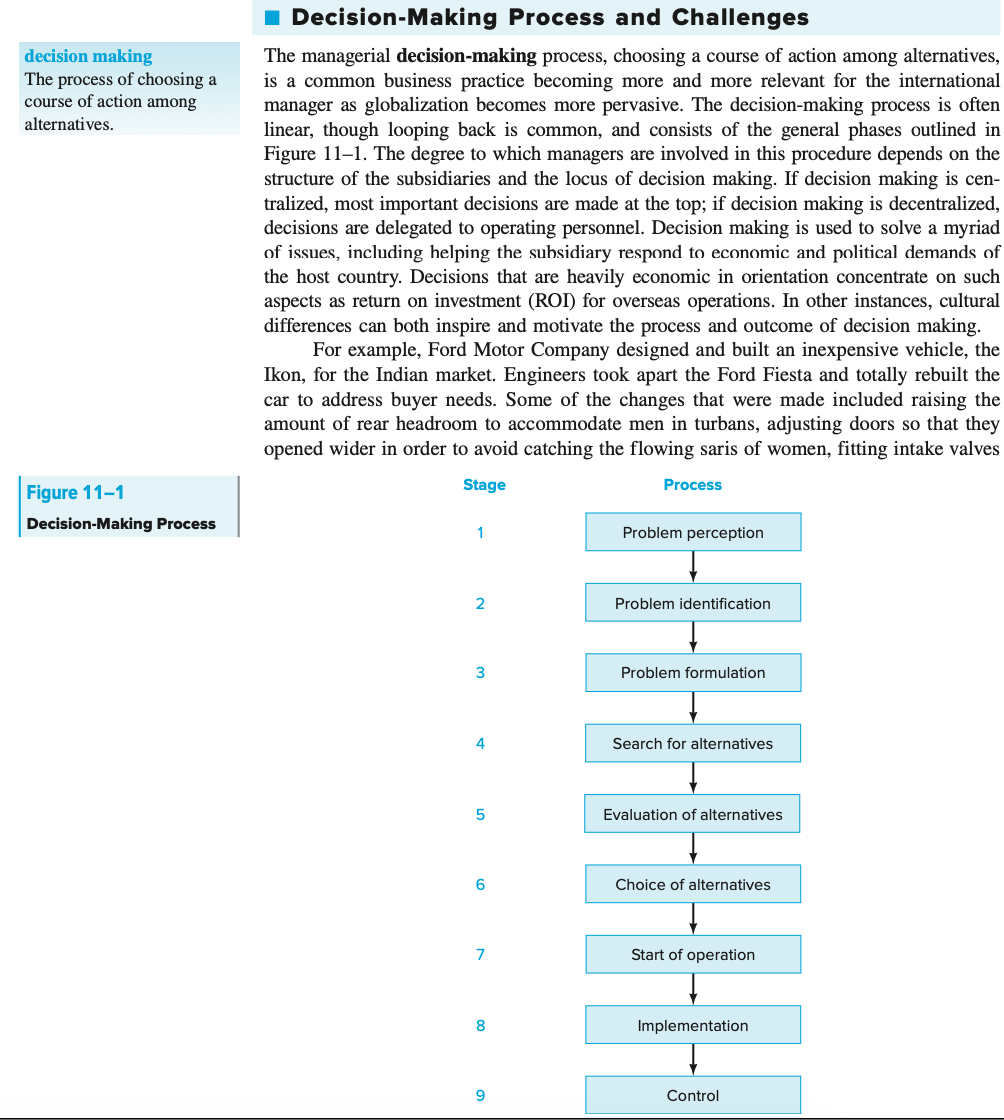
decision making The process of choosing a course of action among alternatives. Decision-Making Process and Challenges The managerial decision-making process, choosing a course of action among alternatives, is a common business practice becoming more and more relevant for the international manager as globalization becomes more pervasive. The decision-making process is often linear, though looping back is common, and consists of the general phases outlined in Figure 11-1. The degree to which managers are involved in this procedure depends on the structure of the subsidiaries and the locus of decision making. If decision making is cen- tralized, most important decisions are made at the top; if decision making is decentralized, decisions are delegated to operating personnel. Decision making is used to solve a myriad of issues, including helping the subsidiary respond to economic and political demands of the host country. Decisions that are heavily economic in orientation concentrate on such aspects as return on investment (ROI) for overseas operations. In other instances, cultural differences can both inspire and motivate the process and outcome of decision making. For example, Ford Motor Company designed and built an inexpensive vehicle, the Ikon, for the Indian market. Engineers took apart the Ford Fiesta and totally rebuilt the car to address buyer needs. Some of the changes that were made included raising the amount of rear headroom to accommodate men in turbans, adjusting doors so that they opened wider in order to avoid catching the flowing saris of women, fitting intake valves Stage Process Figure 11-1 Decision-Making Process 1 Problem perception 2 Problem identification 3 Problem formulation 4 Search for alternatives 5 Evaluation of alternatives 6 Choice of alternatives 7 Start of operation HT 8 Implementation 9 Control









 Study Help