







Question: Three coins are dropped on a table. a. Let A be the event exactly two heads. Find P(A). b. Let B be the event at
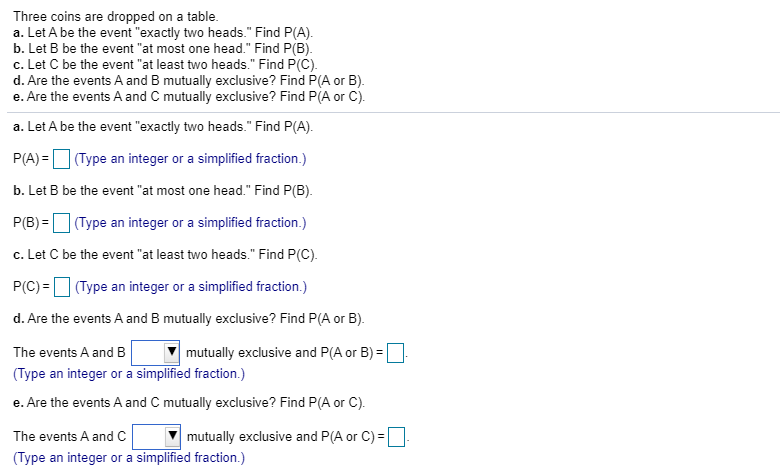
Three coins are dropped on a table. a. Let A be the event "exactly two heads." Find P(A). b. Let B be the event "at most one head." Find P(B). c. Let C be the event "at least two heads." Find P(C). d. Are the events A and B mutually exclusive? Find P(A or B). e. Are the events A and C mutually exclusive? Find P(A or C). a. Let A be the event "exactly two heads." Find P(A). P(A)=(Type an integer or a simplified fraction.) b. Let B be the event "at most one head." Find P(B). P(B)=(Type an integer or a simplified fraction.) c. Let C be the event "at least two heads." Find P(C). P(C)=(Type an integer or a simplified fraction.) d. Are the events A and B mutually exclusive? Find P(A or B). The events A and B mutually exclusive and P(A or B)= (Type an integer or a simplified fraction.) e. Are the events A and C mutually exclusive? Find P(A or C). The events A and C mutually exclusive and P(A or C)=0 (Type an integer or a simplified fraction.)
Step by Step Solution
There are 3 Steps involved in it

Get step-by-step solutions from verified subject matter experts
 Study Help