







Question: Three consumers, Constance (an exponential discounter), Knave (a naive hyperbolic discounter), and Sophie (a sophisticated hyperbolic discounter), are faced with a vice good like potato
Three consumers, Constance (an exponential discounter), Knave (a naive hyperbolic discounter), and Sophie (a sophisticated hyperbolic discounter), are faced with a vice good like potato chips, which they are tempted to consume rapidly. In period 0, each consumer can buy a large (2-serving) or small (1-serving) bag of potato chips and plan its consumption over the next few periods. Assume that Constances discount factor, , equals 0.9, and Knave and Sophie, the two hyperbolic discounters, have a k value equal to 1.4. Each consumer has three options:
Plan A
Buy the small size in period 0, consume one serving in period 1, exercise moderately in period 2, chill out in period 3.
Plan B
Buy the large size in period 0, consume one serving in period 1, consume second serving and exercise moderately in period 2, exercise moderately in period 3.
Plan C
Buy the large size in period 0, consume both servings in period 1, exercise vigorously in period 2, exercise vigorously in period 3.
Each consumer experiences positive utility from consumption: 6 utiles from the small bag and 10 utiles per serving from the large bag due to its lower price per unit. Each consumer also experiences negative utility from exercise: -2 utiles from moderate exercise and -4 utiles from vigorous exercise. Chilling out is associated with a positive utility of 3 utiles. Based on these, the utility indices for the three plans can be inferred as follows.
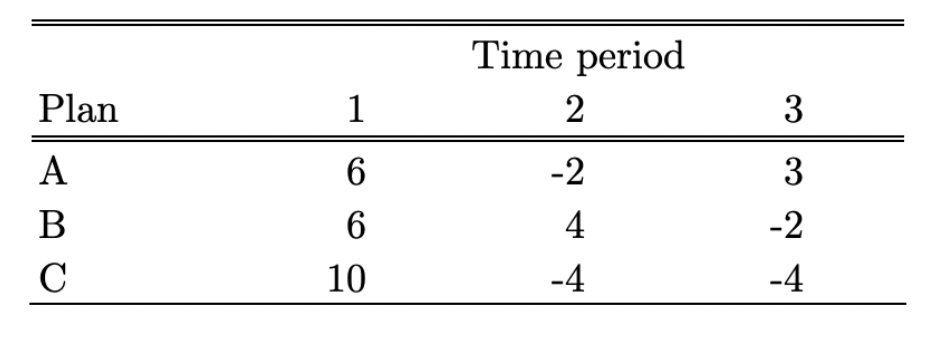
Assume it is period 0.
Calculate the discounted utility for each plan for Constance. Which size of chips would she purchase?
Time period 2 Plan 1 3 6 3 A B 6 -2 4 -4 -2 10 -4 Time period 2 Plan 1 3 6 3 A B 6 -2 4 -4 -2 10 -4
Step by Step Solution
There are 3 Steps involved in it

Get step-by-step solutions from verified subject matter experts
 Study Help