







Question: Three networks - Network A, Network B, and Network C -- are connected to each other with one router between Network A and Network
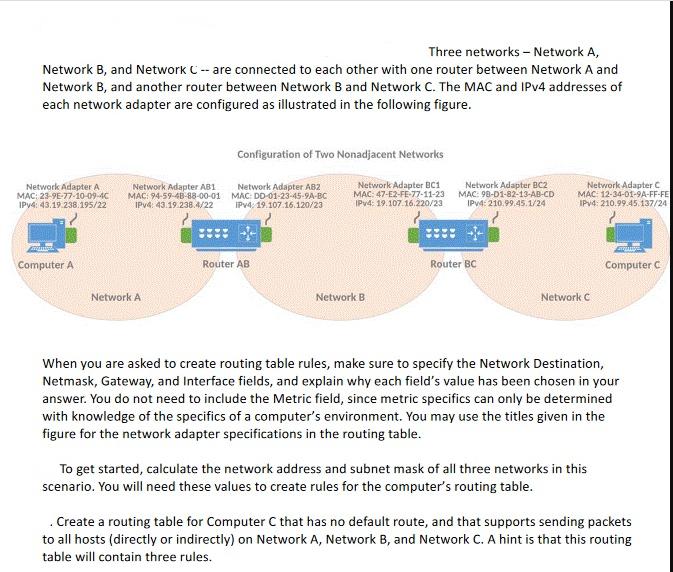
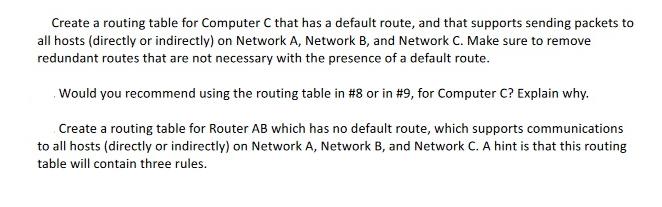
Three networks - Network A, Network B, and Network C -- are connected to each other with one router between Network A and Network B, and another router between Network B and Network C. The MAC and IPv4 addresses of each network adapter are configured as illustrated in the following figure. Network Adapter A MAC: 23-9E-77-10-09-4C IPv4: 43.19.238.195/22 remed Computer A Network Adapter AB1 MAC: 94-59-48-88-00-01 IPv4: 43.19.238.4/22 Network A Configuration of Two Nonadjacent Networks Network Adapter BC1 MAC: 47-E2-FE-77-11-23 IPv4: 19.107.16.220/23 Network Adapter AB2 MAC: DD-01-23-45-9A-BC IPv4: 19.107.16.120/23 Router AB Network B Network Adapter BC2 MAC: 98-D1-82-13-AB-CD IPv4: 210.99.45.1/24 Router BC Network Adapter C MAC: 12-34-01-9A-FF-FE IPv4: 210.99.45.137/24 Network C Computer C When you are asked to create routing table rules, make sure to specify the Network Destination, Netmask, Gateway, and Interface fields, and explain why each field's value has been chosen in your answer. You do not need to include the Metric field, since metric specifics can only be determined with knowledge of the specifics of a computer's environment. You may use the titles given in the figure for the network adapter specifications in the routing table. To get started, calculate the network address and subnet mask of all three networks in this scenario. You will need these values to create rules for the computer's routing table. . Create a routing table for Computer C that has no default route, and that supports sending packets to all hosts (directly or indirectly) on Network A, Network B, and Network C. A hint is that this routing table will contain three rules. Create a routing table for Computer C that has a default route, and that supports sending packets to all hosts (directly or indirectly) on Network A, Network B, and Network C. Make sure to remove redundant routes that are not necessary with the presence of a default route. Would you recommend using the routing table in #8 or in #9, for Computer C? Explain why. Create a routing table for Router AB which has no default route, which supports communications to all hosts (directly or indirectly) on Network A, Network B, and Network C. A hint is that this routing table will contain three rules.
Step by Step Solution
3.48 Rating (158 Votes )
There are 3 Steps involved in it
In a Layer 2 network broadcasting refers to sending traffic to all nodes on a network Layer 2 broadcast traffic stays within a local area network LAN ... View full answer

Get step-by-step solutions from verified subject matter experts
 Study Help