



Question: thx for answering these 4 questions Two simple charge configurations encountered a lot in electrostatics are the electric dipole and the uniform line charge. Our
thx for answering these 4 questions
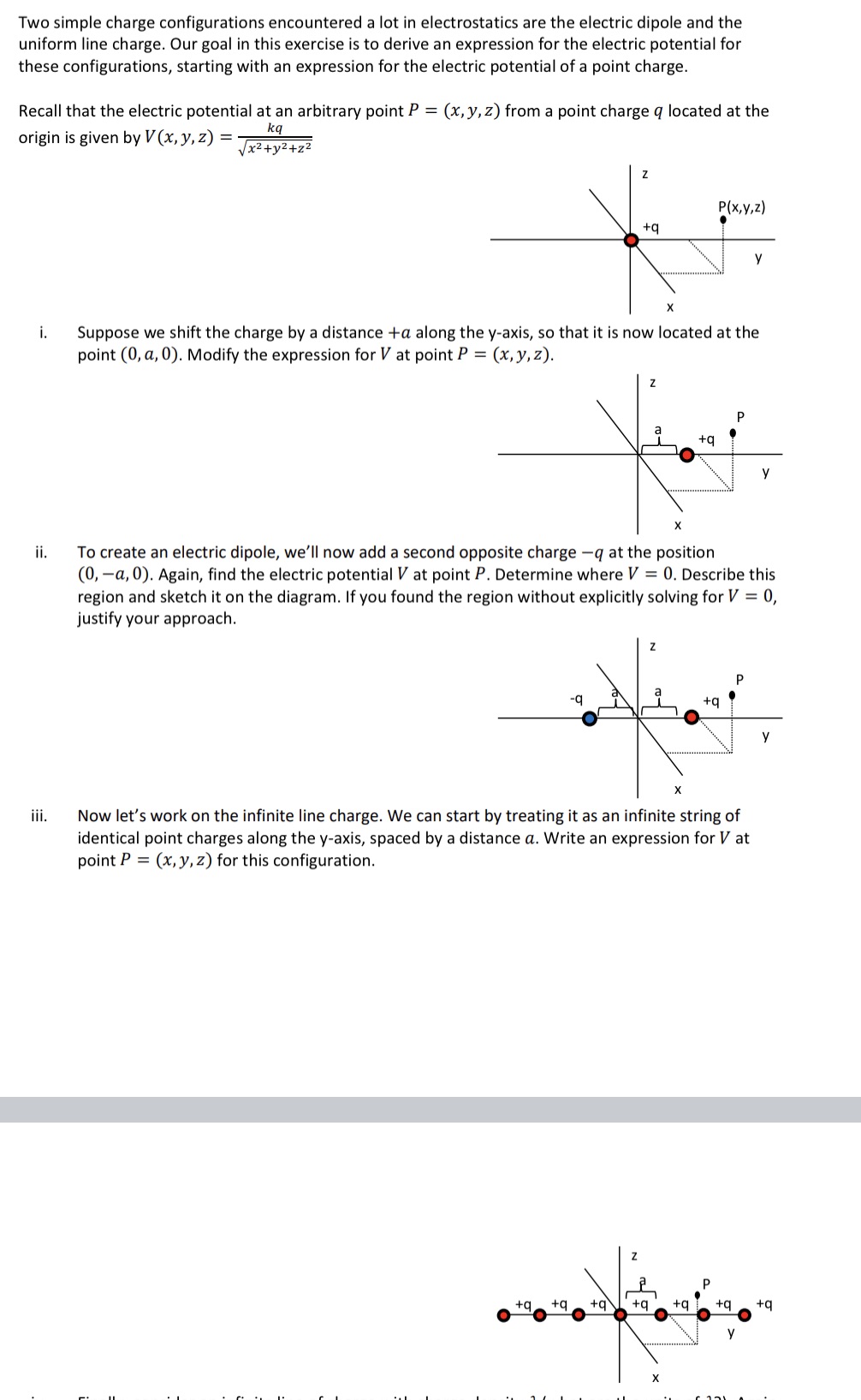
Two simple charge configurations encountered a lot in electrostatics are the electric dipole and the uniform line charge. Our goal in this exercise is to derive an expression for the electric potential for these configurations, starting with an expression for the electric potential of a point charge. Recall that the electric potential at an arbitrary point P = (x, 31,2) from a point charge q located at the origin is given by V(x,y, z) = in: 'fxz +yz+22 i. Suppose we shift the charge by a distance +a along the yaxis, so that it is now located at the point (0, {1,0}. Modify the expression for V at point P = (x, y, z). ii. To create an electric dipole, we'll now add a second opposite charge q at the position (0, a. 0). Again, nd the electric potential V at point P. Determine where V = 0. Describe this region and sketch it on the diagram. lfvou found the region without explicitly solving for V = 0, justify your approach. iii. Now let's work on the infinite line charge. We can start by treating it as an infinite string of identical point charges along the y-axis, spaced by a distance a. Write an expression for V at point P = (x, y,z) for this configuration. I . .I -. r1-n a
Step by Step Solution
There are 3 Steps involved in it

Get step-by-step solutions from verified subject matter experts