







Question: Tile Matching This question involves a problem-solving agent. The environment for this problem is a 5 x 5 tiled area. Each tile has one letter
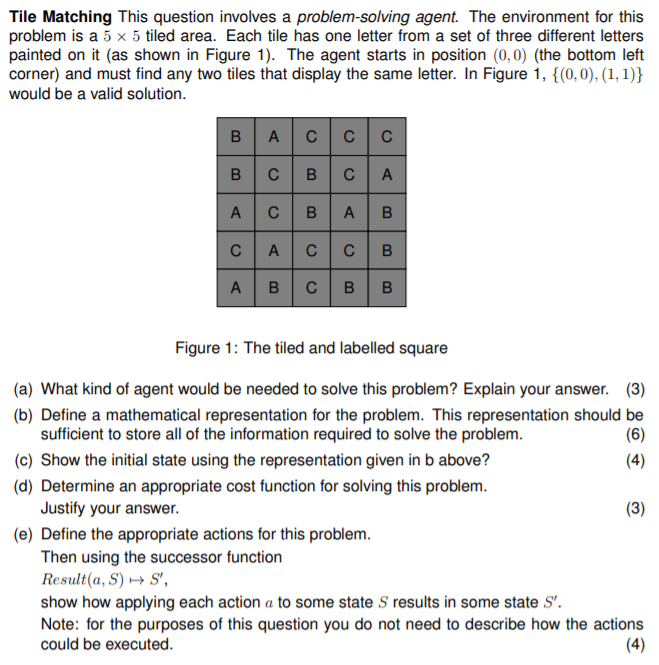
Tile Matching This question involves a problem-solving agent. The environment for this problem is a 5 x 5 tiled area. Each tile has one letter from a set of three different letters painted on it (as shown in Figure 1). The agent starts in position (0,0) (the bottom left corner) and must find any two tiles that display the same letter. In Figure 1, {(0,0), (1,1)} would be a valid solution. B A B B A A B B B Figure 1: The tiled and labelled square (6) (a) What kind of agent would be needed to solve this problem? Explain your answer. (3) (b) Define a mathematical representation for the problem. This representation should be sufficient to store all of the information required to solve the problem. (c) Show the initial state using the representation given in b above? (4) (d) Determine an appropriate cost function for solving this problem. Justify your answer. (3) (e) Define the appropriate actions for this problem. Then using the successor function Result(a, S) S', show how applying each action a to some state S results in some state S'. Note: for the purposes of this question you do not need to describe how the actions could be executed. (4) Tile Matching This question involves a problem-solving agent. The environment for this problem is a 5 x 5 tiled area. Each tile has one letter from a set of three different letters painted on it (as shown in Figure 1). The agent starts in position (0,0) (the bottom left corner) and must find any two tiles that display the same letter. In Figure 1, {(0,0), (1,1)} would be a valid solution. B A B B A A B B B Figure 1: The tiled and labelled square (6) (a) What kind of agent would be needed to solve this problem? Explain your answer. (3) (b) Define a mathematical representation for the problem. This representation should be sufficient to store all of the information required to solve the problem. (c) Show the initial state using the representation given in b above? (4) (d) Determine an appropriate cost function for solving this problem. Justify your answer. (3) (e) Define the appropriate actions for this problem. Then using the successor function Result(a, S) S', show how applying each action a to some state S results in some state S'. Note: for the purposes of this question you do not need to describe how the actions could be executed. (4)
Step by Step Solution
There are 3 Steps involved in it

Get step-by-step solutions from verified subject matter experts
 Study Help