







Question: Tile.java public class Tile implements Cloneable { // instance variables private int color; private int shape; // Behavior #1: constructor public Tile ( int c,
Tile.java
public class Tile implements Cloneable {
// instance variables
private int color;
private int shape;
// Behavior #1: constructor
public Tile ( int c, int s ) {
// if invalid parameter values, default to 1
if (c >= 1 && c
color = c;
else
color = 1;
if (s >= 1 && s
shape = s;
else
shape = 1;
} // end constructor
// Behavior #2 : accessor for color
public int getColor( ) {
return color;
}
// Behavior #3 : accessor for shape
public int getShape( ) {
return shape;
}
// Behavior #4 : mutator for color
public void setColor( int c ) {
// doesn't change color if c is invalid
if ( c >= 1 && c
color = c;
}
// Behavior #5 : mutator for shape
public void setShape( int s ) {
// doesn't change shape if s is invalid
if ( s >= 1 && s
shape = s;
}
// Behavior #6 : String representation of a Tile
public String toString( ) {
String colorNames[] = {"orange", "green", "yellow", "red", "blue", "purple"};
String shapeNames[] = {"four-pointed star", "clover", "eight-pointed star",
"diamond", "square", "circle"};
if (color 6 || shape 6)
return "unknown";
return colorNames[color-1] + " " + shapeNames[shape-1];
}
// Behavior # 7 : compare two tiles
public boolean equals (Tile other) {
return shape == other.shape && color == other.color;
}
// Behavior #8 : clone a tile
public Tile clone( ) {
Tile answer;
try {
answer = (Tile) super.clone();
}
catch (CloneNotSupportedException e) {
throw new RuntimeException
("This class doesn't support Cloneable.");
}
return answer;
}
} // end Tile Class
ArrayStacks.java
An ArrayStack is a generic stack of
* references to E objects.
*
* Limitations:
*
* (1) The capacity of one of these stacks can change after it's created, but
* the maximum capacity is limited by the amount of free memory on the
* machine. The constructor, ensureCapacity, push,
* and trimToSize will result in an
* OutOfMemoryError when free memory is exhausted.
*
* (2) A stack's capacity cannot exceed the maximum integer 2,147,483,647
* (Integer.MAX_VALUE). Any attempt to create a larger capacity
* results in a failure due to an arithmetic overflow.
*
* Java Source Code for this class:
*
* http://www.cs.colorado.edu/~main/edu/colorado/collections/ArrayStack.java
*
*
* @author Michael Main
* (main@colorado.edu)
*
* @version Feb 10, 2016
*
* @see LinkedStack
******************************************************************************/
public class ArrayStack
{
// Invariant of the ArrayStack class:
// 1. The number of items in the stack is in the instance variable
// manyItems.
// 2. For an empty stack, we do not care what is stored in any of data;
// for a non-empty stack, the items in the stack are stored in a
// partially-filled array called data, with the bottom of the stack
// at data[0], the next item at data[1], and so on
// to the top of the stack at data[manyItems-1].
private E[ ] data;
private int manyItems;
/**
* Initialize an empty stack with an initial capacity of 10. Note that the
* push method works efficiently (without needing more
* memory) until this capacity is reached.
* Postcondition:
* This stack is empty and has an initial capacity of 10.
* @exception OutOfMemoryError
* Indicates insufficient memory for:
* new Object[10].
**/
@SuppressWarnings("unchecked")
public ArrayStack( )
{
final int INITIAL_CAPACITY = 10;
manyItems = 0;
data = (E[]) new Object[INITIAL_CAPACITY];
}
/**
* Initialize an empty stack with a specified initial capacity. Note that the
* push method works efficiently (without needing more
* memory) until this capacity is reached.
* @param initialCapacity
* the initial capacity of this stack
* Precondition:
* initialCapacity is non-negative.
* Postcondition:
* This stack is empty and has the given initial capacity.
* @exception IllegalArgumentException
* Indicates that initialCapacity is negative.
* @exception OutOfMemoryError
* Indicates insufficient memory for:
* new Object[initialCapacity].
**/
@SuppressWarnings("unchecked")
public ArrayStack(int initialCapacity)
{
if (initialCapacity
throw new IllegalArgumentException
("initialCapacity too small " + initialCapacity);
manyItems = 0;
data = (E[]) new Object[initialCapacity];
}
/**
* Generate a copy of this stack.
* @return
* The return value is a copy of this stack. Subsequent changes to the
* copy will not affect the original, nor vice versa.
* @exception OutOfMemoryError
* Indicates insufficient memory for creating the clone.
**/
@SuppressWarnings("unchecked")
public ArrayStack
{ // Clone an ArrayStack.
ArrayStack
try
{
answer = (ArrayStack
}
catch (CloneNotSupportedException e)
{
// This exception should not occur. But if it does, it would probably indicate a
// programming error that made super.clone unavailable. The most comon error
// The most common error would be forgetting the "Implements Cloneable"
// clause at the start of this class.
throw new RuntimeException
("This class does not implement Cloneable");
}
answer.data = data.clone( );
return answer;
}
/**
* Change the current capacity of this stack.
* @param minimumCapacity
* the new capacity for this stack
* Postcondition:
* This stack's capacity has been changed to at least minimumCapacity.
* If the capacity was already at or greater than minimumCapacity,
* then the capacity is left unchanged.
* @exception OutOfMemoryError
* Indicates insufficient memory for: new Object[minimumCapacity].
**/
@SuppressWarnings("unchecked")
public void ensureCapacity(int minimumCapacity)
{
E biggerArray[ ];
if (data.length
{
biggerArray = (E[]) new Object[minimumCapacity];
System.arraycopy(data, 0, biggerArray, 0, manyItems);
data = biggerArray;
}
}
/**
* Accessor method to get the current capacity of this stack.
* The push method works efficiently (without needing
* more memory) until this capacity is reached.
* @return
* the current capacity of this stack
**/
public int getCapacity( )
{
return data.length;
}
/**
* Determine whether this stack is empty.
* @return
* true if this stack is empty;
* false otherwise.
**/
public boolean isEmpty( )
{
return (manyItems == 0);
}
/**
* Get the top item of this stack, without removing the item.
* Precondition:
* This stack is not empty.
* @return
* the top item of the stack
* @exception EmptyStackException
* Indicates that this stack is empty.
**/
@SuppressWarnings("unchecked")
public E peek( )
{
if (manyItems == 0)
// EmptyStackException is from java.util and its constructor has no argument.
throw new EmptyStackException( );
return data[manyItems-1];
}
/**
* Get the top item, removing it from this stack.
* Precondition:
* This stack is not empty.
* @return
* The return value is the top item of this stack, and the item has
* been removed.
* @exception EmptyStackException
* Indicates that this stack is empty.
**/
@SuppressWarnings("unchecked")
public E pop( )
{
if (manyItems == 0)
// EmptyStackException is from java.util and its constructor has no argument.
throw new EmptyStackException( );
return data[--manyItems];
}
/**
* Push a new item onto this stack. If the addition
* would take this stack beyond its current capacity, then the capacity is
* increased before adding the new item. The new item may be the null
* reference.
* @param item
* the item to be pushed onto this stack
* Postcondition:
* The item has been pushed onto this stack.
* @exception OutOfMemoryError
* Indicates insufficient memory for increasing the stack's capacity.
* Note:
* An attempt to increase the capacity beyond
* Integer.MAX_VALUE will cause the stack to fail with an
* arithmetic overflow.
**/
public void push(E item)
{
if (manyItems == data.length)
{
// Double the capacity and add 1; this works even if manyItems is 0. However, in
// case that manyItems*2 + 1 is beyond Integer.MAX_VALUE, there will be an
// arithmetic overflow and the bag will fail.
ensureCapacity(manyItems*2 + 1);
}
data[manyItems] = item;
manyItems++;
}
/**
* Accessor method to determine the number of items in this stack.
* @return
* the number of items in this stack
**/
public int size( )
{
return manyItems;
}
/**
* Reduce the current capacity of this stack to its actual size (i.e., the
* number of items it contains).
* Postcondition:
* This stack's capacity has been changed to its current size.
* @exception OutOfMemoryError
* Indicates insufficient memory for altering the capacity.
**/
@SuppressWarnings("unchecked")
public void trimToSize( )
{
E trimmedArray[ ];
if (data.length != manyItems)
{
trimmedArray = (E[]) new Object[manyItems];
System.arraycopy(data, 0, trimmedArray, 0, manyItems);
data = trimmedArray;
}
}
}
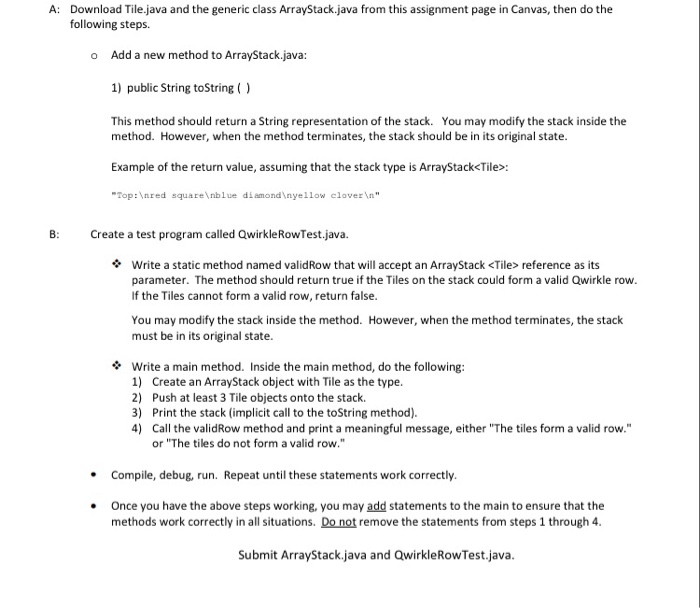
A: Download Tile.java and the generic class ArrayStack.java from this assignment page in Canvas, then do the following steps o Add a new method to ArrayStack.java 1) public String toString) This method should return a String representation of the stack. You may modify the stack inside the method. However, when the method terminates, the stack should be in its original state. Example of the return value, assuming that the stack type is ArrayStack
Step by Step Solution
There are 3 Steps involved in it

Get step-by-step solutions from verified subject matter experts
 Study Help