







Question: time between decay events. microsecond deadtime. deadtime. (Ans.: 86.47%) d) By direct integration, find (t) actual e) By direct integration, find ( t) measured Discuss
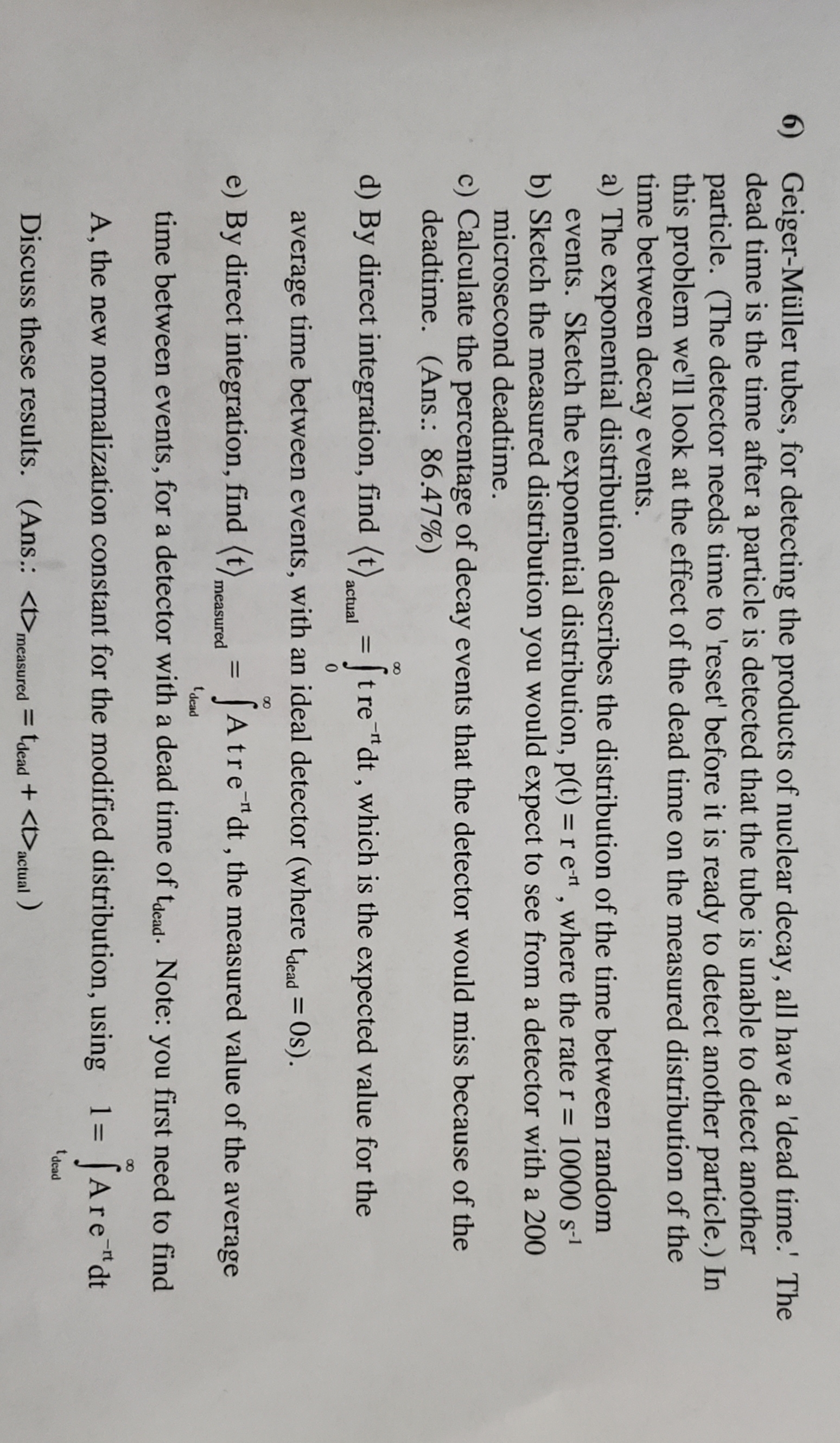
time between decay events. microsecond deadtime. deadtime. (Ans.: 86.47%) d) By direct integration, find (t) actual e) By direct integration, find ( t) measured Discuss these results. (Ans.: measured = tdead + actual ) average time between events, with an ideal detector (where tdead = Os). 8 t dead 8 a) The exponential distribution describes the distribution of the time between random c) Calculate the percentage of decay events that the detector would miss because of the b) Sketch the measured distribution you would expect to see from a detector with a 200 dead time is the time after a particle is detected that the tube is unable to detect another this problem we'll look at the effect of the dead time on the measured distribution of the events. Sketch the exponential distribution, p(t) =re-" , where the rate r = 10000 s-1 particle. (The detector needs time to 'reset' before it is ready to detect another particle.) In Geiger-Muller tubes, for detecting the products of nuclear decay, all have a 'dead time.' The time between events, for a detector with a dead time of tdead. Note: you first need to find A, the new normalization constant for the modified distribution, using 1= Are-"dt =tre-"dt , which is the expected value for the Atre "dt , the measured value of the average t dead 8
Step by Step Solution
There are 3 Steps involved in it

Get step-by-step solutions from verified subject matter experts
 Study Help