







Question: time Problem 1. (10 POINTS) IMPULSIVE FORCING AND THE DIRAC DELTA FUNCTION. In many IVPs with impulsive forcing, the use of the delta function
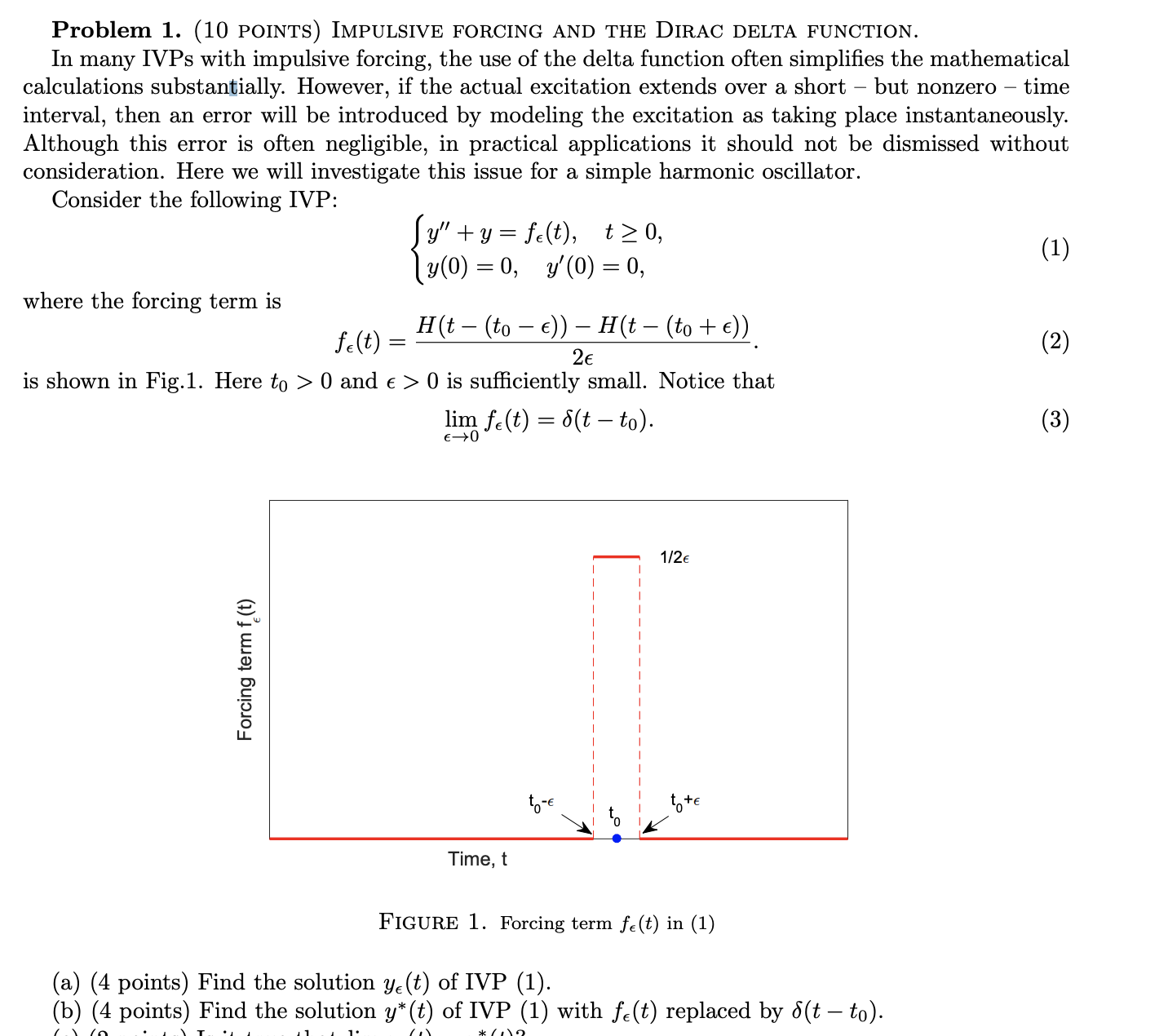
time Problem 1. (10 POINTS) IMPULSIVE FORCING AND THE DIRAC DELTA FUNCTION. In many IVPs with impulsive forcing, the use of the delta function often simplifies the mathematical calculations substantially. However, if the actual excitation extends over a short but nonzero interval, then an error will be introduced by modeling the excitation as taking place instantaneously. Although this error is often negligible, in practical applications it should not be dismissed without consideration. Here we will investigate this issue for a simple harmonic oscillator. Consider the following IVP: Sy" + y = fe(t), t 0, [y(0) = 0, y'(0) = 0, where the forcing term is fe(t): H(t (to e)) H(t (to + )) = 2 is shown in Fig.1. Here to > 0 and > 0 is sufficiently small. Notice that lim fe(t) = 8(t to). 0 Forcing term f (t) 1/2 Time, t FIGURE 1. Forcing term f(t) in (1) (a) (4 points) Find the solution y(t) of IVP (1). (b) (4 points) Find the solution y*(t) of IVP (1) with f(t) replaced by (t to). *12 (1) (2) (3)
Step by Step Solution
There are 3 Steps involved in it

Get step-by-step solutions from verified subject matter experts
 Study Help