



Question: Time Value of Money: Basics Using Excel or the equations and tables in Appendix 1 2 A of this chapter, determine the answers to each
Time Value of Money: Basics
Using Excel or the equations and tables in Appendix A of this chapter, determine the answers to each of the following independent situations:
Round answers to the nearest whole number.
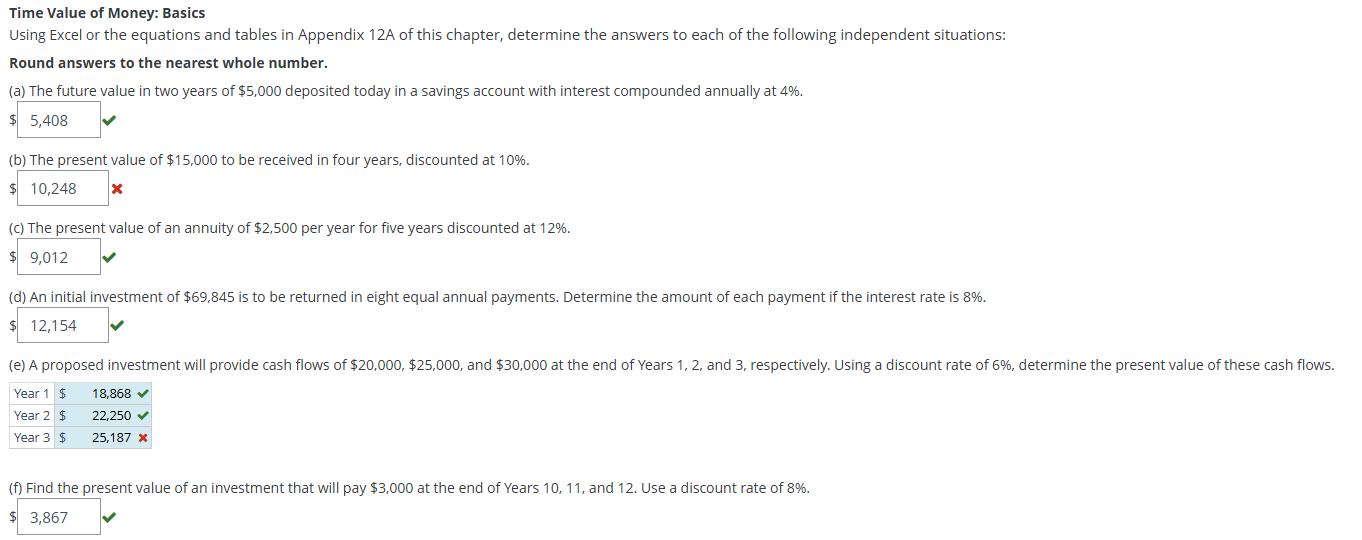
a The future value in two years of $ deposited today in a savings account with interest compounded annually at
$
b The present value of $ to be received in four years, discounted at
$
c The present value of an annuity of $ per year for five years discounted at
$
d An initial investment of $ is to be returned in eight equal annual payments. Determine the amount of each payment if the interest rate is
$
e A proposed investment will provide cash flows of $ $ and $ at the end of Years and respectively. Using a discount rate of determine the present value of these cash flows.
f Find the present value of an investment that will pay $ at the end of Years and Use a discount rate of
$
Step by Step Solution
There are 3 Steps involved in it
1 Expert Approved Answer
Step: 1 Unlock

Question Has Been Solved by an Expert!
Get step-by-step solutions from verified subject matter experts
Step: 2 Unlock
Step: 3 Unlock