







Question: Tip # 1 : Review all 5 pages carefully before you start working on the problem. Tip # 2 : Check your units in your
Tip #: Review all pages carefully before you start working on the problem.
Tip #: Check your units in your solution.
Consider a fully developed, isothermal, steadystate, unidirectional in direction laminar flow of an incompressible nonNewtonian fluid between two concentric cylinders see illustration below The outer cylinder rotates steadily about its axis at an angular velocity of and the inner cylinder is stationary ie the inner cylinder does not rotate The cylinders are long compared to the radii ie The fluid flow is only driven by the rotation of the outer cylinder.
The fluid is a Power Law liquid, with a shear stress shear rate relationship represented by the following equation for the unidirectional laminar flow:
shear stress shear rate
Where is the fluid consistency index and is the flow behavior index.
The Navier Stokes equations ie momentum equations and shear stress components for the cylindrical coordinate system are listed on the next page.
Momentum equation in direction:
Momentum equation in direction:
Momentum equation in z direction:
Also, the law of viscosity for the Power Law fluid with constant density may be expressed as:
;;
;
a State all pertinent assumptions; also, use the continuity equation. points
b Develop a mathematical model differential equations boundary conditions that will represent the flow of this fluid between the two concentric cylinders. Start with the momentum equations shown above. points
c Solve the mathematical model developed in b and obtain an algebraic expression that will represent the velocity profile of the Power Law fluid. Show your work. points
d BONUS: If the exponent in the obtained solution in part c is set to does your solution reduce itself to a velocity profile that could be obtained for a Newtonian fluid? Start with Navier Stokes equations for Newtonian fluids, and show your work. points
e BONUS: Develop an expression for the rotational volumetric flow rate of fluid, using the velocity profile for the Power Law fluid obtained in part c points
f BONUS: Again, check if your answer in part e is correct by reducing the obtained expression to the wellknown results for a Newtonian fluid ie set Use the velocity profile obtained in part d and show your work. points
See the next page for part of the problem.
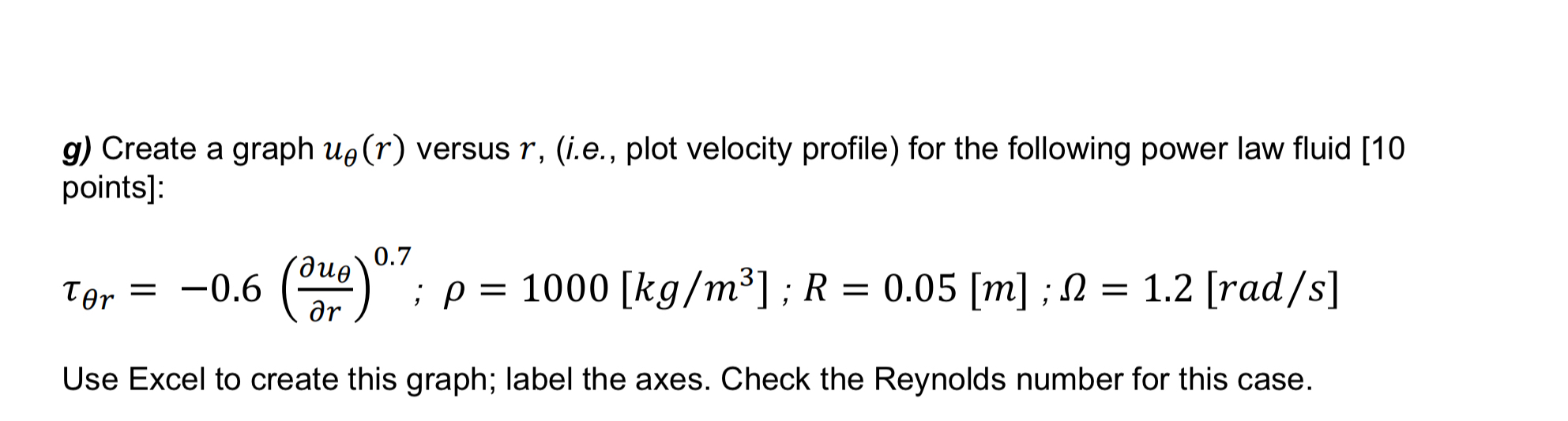
g Create a graph versus ie plot velocity profile for the following power law fluid points:
;;;
Use Excel to create this graph; label the axes. Check the Reynolds number for this case.
Step by Step Solution
There are 3 Steps involved in it
1 Expert Approved Answer
Step: 1 Unlock

Question Has Been Solved by an Expert!
Get step-by-step solutions from verified subject matter experts
Step: 2 Unlock
Step: 3 Unlock
 Study Help