







Question: Tips and Notes: e Most students find probability to be one of the trickier (and perhaps the trickiest) segments of the course. Therefore, many of
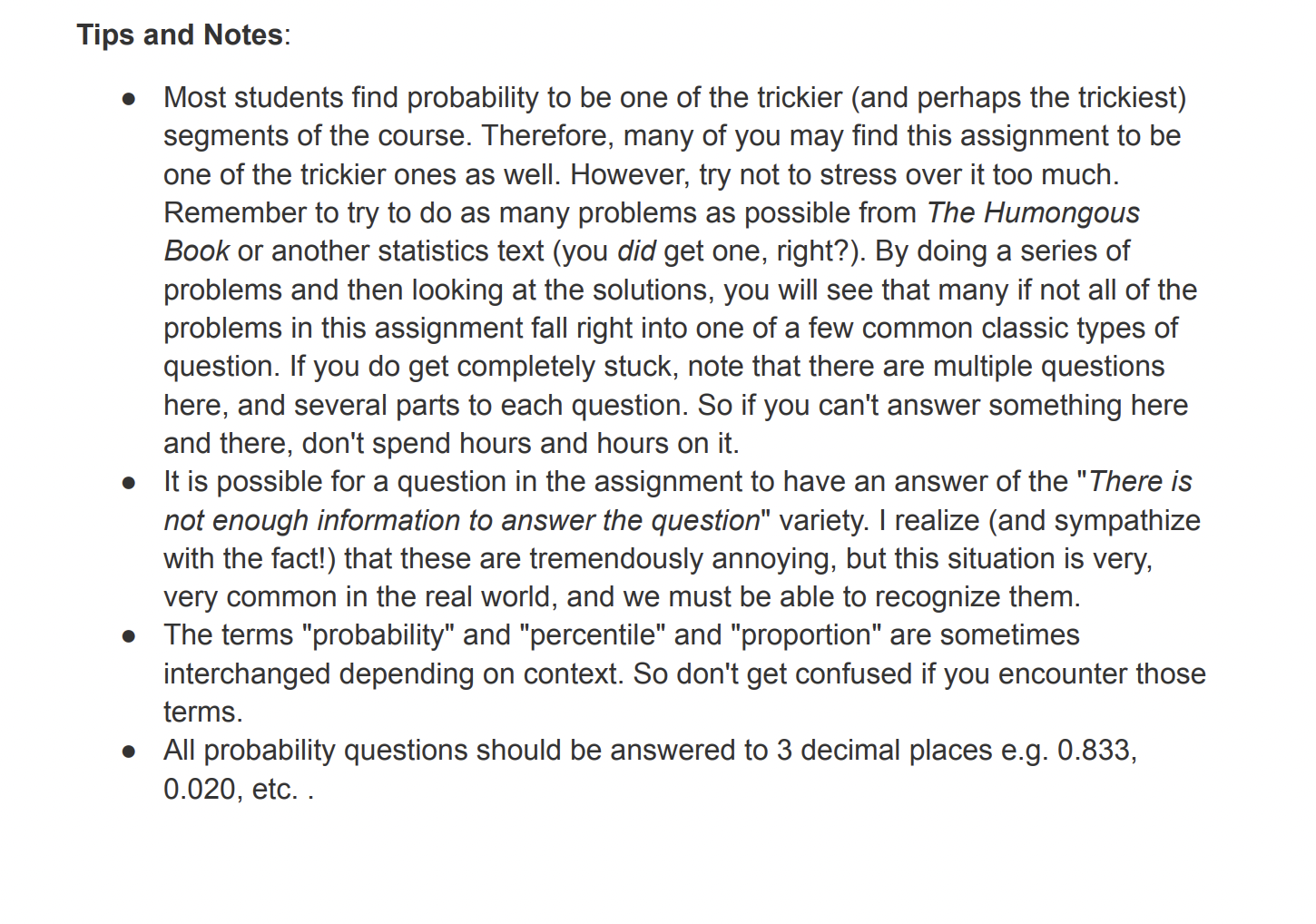
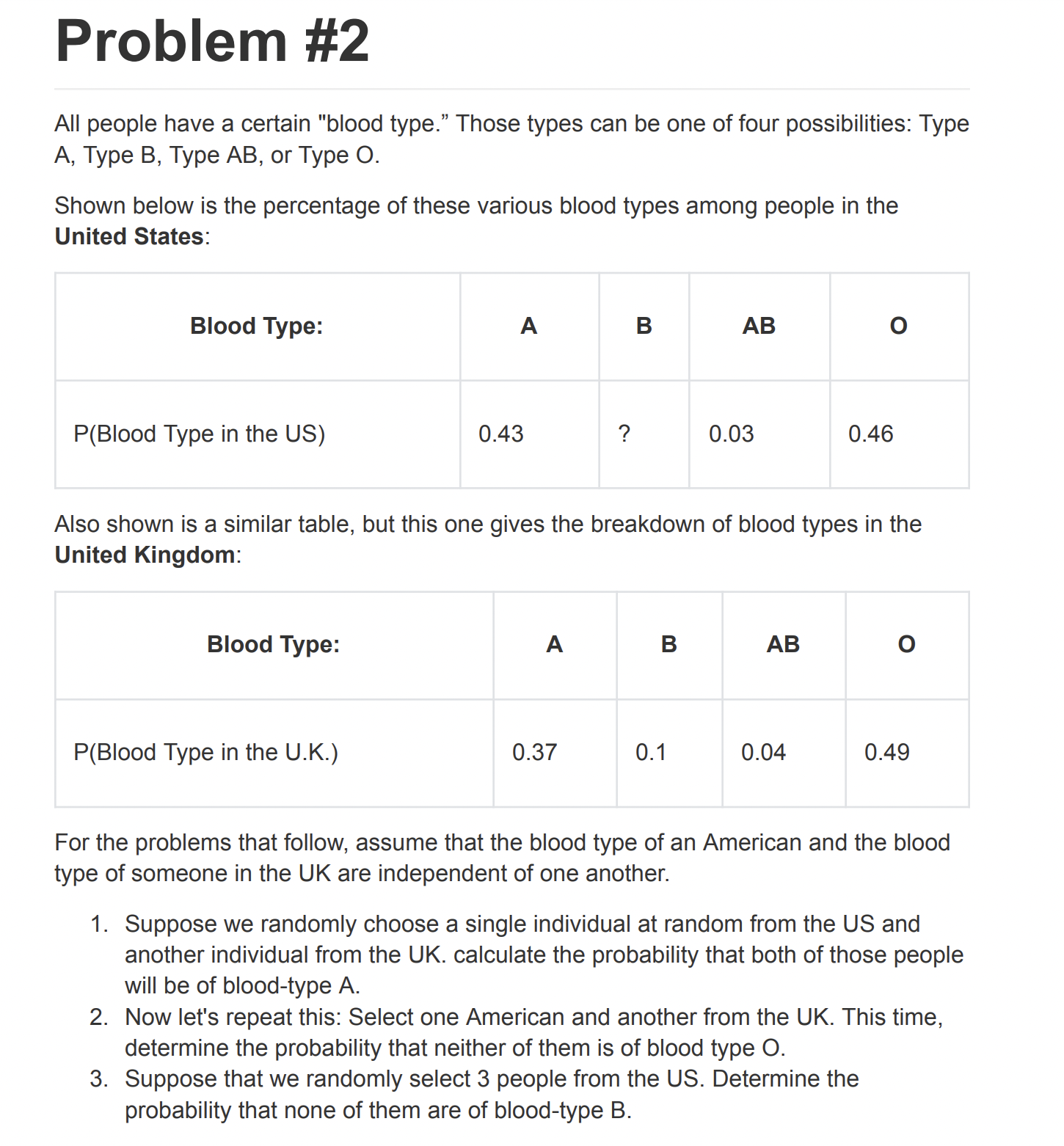
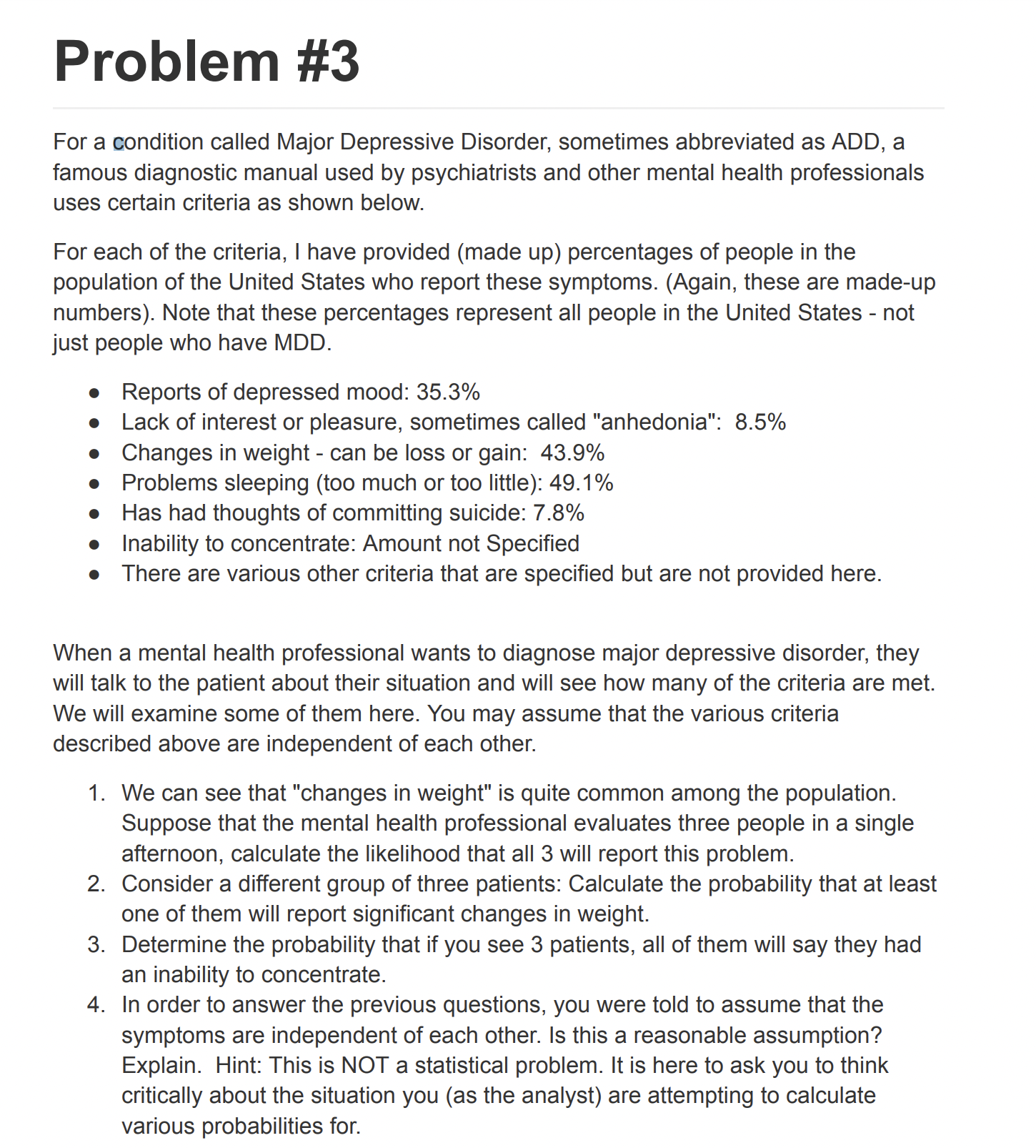
Tips and Notes: e Most students find probability to be one of the trickier (and perhaps the trickiest) segments of the course. Therefore, many of you may find this assignment to be one of the trickier ones as well. However, try not to stress over it too much. Remember to try to do as many problems as possible from The Humongous Book or another statistics text (you did get one, right?). By doing a series of problems and then looking at the solutions, you will see that many if not all of the problems in this assignment fall right into one of a few common classic types of question. If you do get completely stuck, note that there are multiple questions here, and several parts to each question. So if you can't answer something here and there, don't spend hours and hours on it. e |tis possible for a question in the assignment to have an answer of the "There is not enough information to answer the question\" variety. | realize (and sympathize with the fact!) that these are tremendously annoying, but this situation is very, very common in the real world, and we must be able to recognize them. e The terms "probability\" and "percentile" and "proportion" are sometimes interchanged depending on context. So don't get confused if you encounter those terms. e All probability questions should be answered to 3 decimal places e.g. 0.833, 0.020, ete. . Problem #2 All people have a certain "blood type.\" Those types can be one of four possibilities: Type A, Type B, Type AB, or Type O. Shown below is the percentage of these various blood types among people in the United States: Blood Type: A B AB O P(Blood Type in the US) 0.43 ? 0.03 0.46 Also shown is a similar table, but this one gives the breakdown of blood types in the United Kingdom: Blood Type: A B AB O P(Blood Type in the U.K.) 0.37 0.1 0.04 0.49 For the problems that follow, assume that the blood type of an American and the blood type of someone in the UK are independent of one another. 1. Suppose we randomly choose a single individual at random from the US and another individual from the UK. calculate the probability that both of those people will be of blood-type A. 2. Now let's repeat this: Select one American and another from the UK. This time, determine the probability that neither of them is of blood type O. 3. Suppose that we randomly select 3 people from the US. Determine the probability that none of them are of blood-type B. Problem #3 For a eondition called Major Depressive Disorder, sometimes abbreviated as ADD, a famous diagnostic manual used by psychiatrists and other mental health professionals uses certain criteria as shown below. For each of the criteria, | have provided (made up) percentages of people in the population of the United States who report these symptoms. (Again, these are made-up numbers). Note that these percentages represent all people in the United States - not just people who have MDD. Reports of depressed mood: 35.3% Lack of interest or pleasure, sometimes called "anhedonia": 8.5% Changes in weight - can be loss or gain: 43.9% Problems sleeping (too much or too little): 49.1% Has had thoughts of committing suicide: 7.8% Inability to concentrate: Amount not Specified There are various other criteria that are specified but are not provided here. When a mental health professional wants to diagnose major depressive disorder, they will talk to the patient about their situation and will see how many of the criteria are met. We will examine some of them here. You may assume that the various criteria described above are independent of each other. 1. We can see that "changes in weight" is quite common among the population. Suppose that the mental health professional evaluates three people in a single afternoon, calculate the likelihood that all 3 will report this problem. . Consider a different group of three patients: Calculate the probability that at least one of them will report significant changes in weight. Determine the probability that if you see 3 patients, all of them will say they had an inability to concentrate. . In order to answer the previous questions, you were told to assume that the symptoms are independent of each other. Is this a reasonable assumption? Explain. Hint: This is NOT a statistical problem. It is here to ask you to think critically about the situation you (as the analyst) are attempting to calculate various probabilities for
Step by Step Solution
There are 3 Steps involved in it

Get step-by-step solutions from verified subject matter experts
 Study Help